
Enzyme inhibitor 2026-10-18
An enzyme inhibitor lowers an enzyme's reaction rate. In reversible enzyme inhibition, reducing free inhibitor concentration can restore activity; slow release can make this difficult to distinguish experimentally from irreversible inactivation. Competitive inhibition and mixed inhibition describe different changes in enzyme kinetics; pure noncompetitive inhibition is a special case of mixed inhibition, not a name for every inhibitor that binds away from an active site.[ref]
Symbolism and Terminology in Enzyme Kinetics (Recommendation 1981) by Nomenclature Committee of the International Union of Biochemistry. Symbolism and Terminology in Enzyme Kinetics, recommendation 1981, sections 6.1 and 6.4: reversibility and the ambiguity of non-competitive
The useful question is how adding substrate changes the inhibition. The model below connects binding to a measurable reaction rate, predicts when more substrate can overcome inhibition, and supplies examples for comparison with an enzyme inhibition initial-rate assay. Its inhibition constants are explicitly defined; neither a binding cartoon nor one reduced reaction rate by itself determines a mechanism.
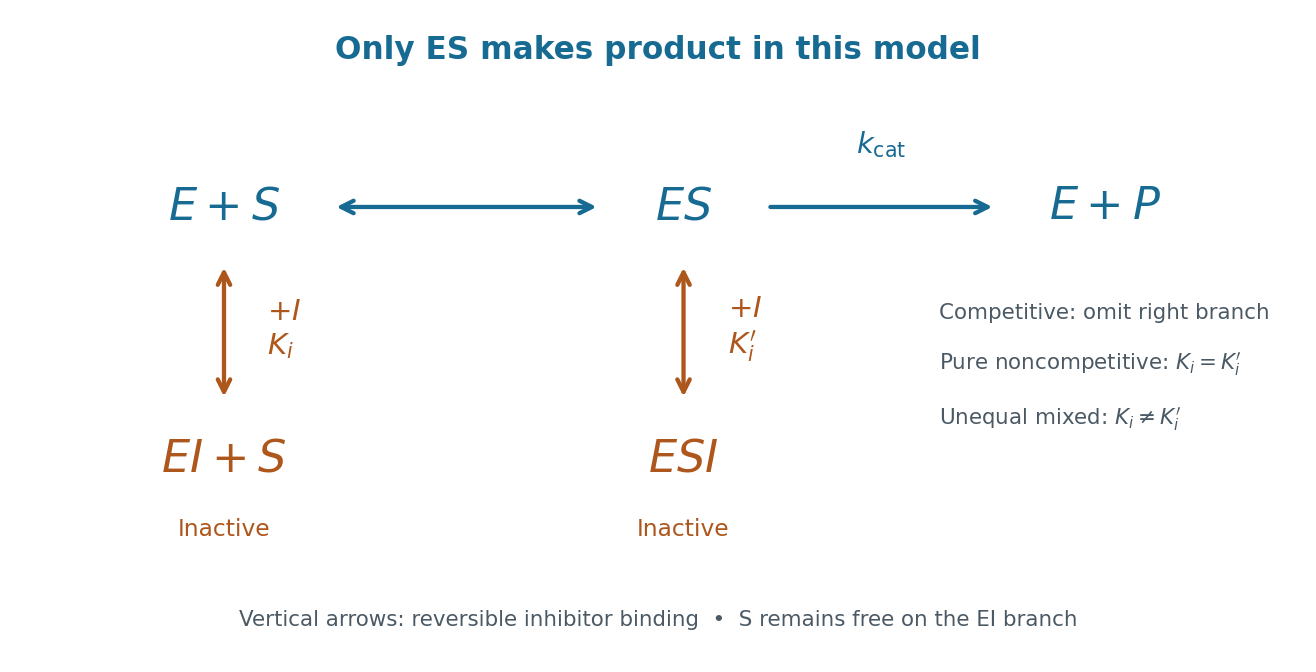
Reversible enzyme inhibition: which bound states can form?
Original branching scheme for a single substrate. is free enzyme, free substrate, free inhibitor, the productive enzyme-substrate complex, and and inactive complexes. Reversible vertical arrows show inhibitor binding and release. In competitive inhibition the right-hand inhibitor-binding branch is absent. Pure noncompetitive inhibition retains both branches with equal inhibition constants; general mixed inhibition permits unequal constants. The drawing specifies populations and allowed steps, not an atomic binding-site geometry. Details.
Inhibition constant 2026-10-18
An inhibition constant sets an inhibitor concentration scale in an enzyme kinetics model. In the rapid-binding construction under reversible enzyme inhibition, and are dissociation constants. Smaller values favour the corresponding bound population at fixed free inhibitor concentration. More generally, fitted inhibition constants need not be true binding dissociation constants; a mechanism must justify that interpretation.[ref]
Symbolism and Terminology in Enzyme Kinetics (Recommendation 1981) by Nomenclature Committee of the International Union of Biochemistry. Symbolism and Terminology in Enzyme Kinetics, section 6.4, final paragraphs: operational inhibition constants versus explicitly defined dissociation constants
For example, choosing makes in this model, but does not imply that half of all enzyme is : and also contribute to the total population.
Institutional nomenclature committee credited with Symbolism and Terminology in Enzyme Kinetics (Recommendation 1981) by Nomenclature Committee of the International Union of Biochemistry. This entry identifies an institutional body.