An enzyme inhibitor lowers an enzyme's reaction rate. In reversible enzyme inhibition, reducing free inhibitor concentration can restore activity; slow release can make this difficult to distinguish experimentally from irreversible inactivation. Competitive inhibition and mixed inhibition describe different changes in enzyme kinetics; pure noncompetitive inhibition is a special case of mixed inhibition, not a name for every inhibitor that binds away from an active site.[ref]
Symbolism and Terminology in Enzyme Kinetics (Recommendation 1981) by Nomenclature Committee of the International Union of Biochemistry. Symbolism and Terminology in Enzyme Kinetics, recommendation 1981, sections 6.1 and 6.4: reversibility and the ambiguity of non-competitive
The useful question is how adding substrate changes the inhibition. The model below connects binding to a measurable reaction rate, predicts when more substrate can overcome inhibition, and supplies examples for comparison with an enzyme inhibition initial-rate assay. Its inhibition constants are explicitly defined; neither a binding cartoon nor one reduced reaction rate by itself determines a mechanism.
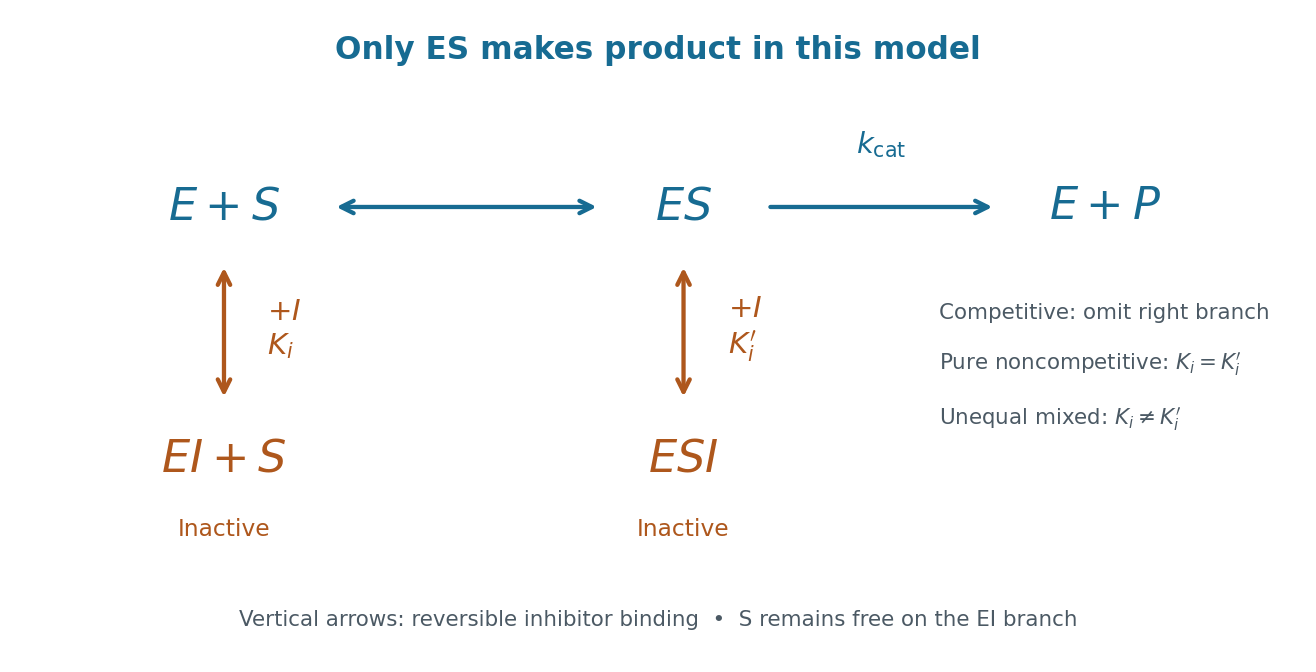
Reversible enzyme inhibition: which bound states can form?
Original branching scheme for a single substrate. is free enzyme, free substrate, free inhibitor, the productive enzyme-substrate complex, and and inactive complexes. Reversible vertical arrows show inhibitor binding and release. In competitive inhibition the right-hand inhibitor-binding branch is absent. Pure noncompetitive inhibition retains both branches with equal inhibition constants; general mixed inhibition permits unequal constants. The drawing specifies populations and allowed steps, not an atomic binding-site geometry. Details.A small molecule that inhibits transcription through interaction with XPB. Its known target supplies a biochemical comparator, not evidence that another compound has the same target.[ref]
Construct a minimal model with one substrate and no appreciable accumulated reaction product. Only the enzyme-substrate complex produces product, with catalytic rate constant ; and are inactive. Write and for free molar concentrations, and for total enzyme molar concentration. Assume a suitable quasi-steady-state approximation, rapid inhibitor binding and release relative to turnover, and negligible depletion of free inhibitor. In this construction the population relations areHere is the uninhibited Michaelis constant, and are the inhibition constants for the two indicated binding branches. The symbol denotes a free concentration, not an amount added to the tube. Define . Conservation of enzyme gives an original short derivation:Thus fitting a Michaelis-Menten equation at a fixed would return the apparent parameters“Apparent” means conditional on that inhibitor concentration. The uninhibited Michaelis constant has not been redefined. Dimensional analysis checks the denominator: both and have units of molar concentration; the resulting has units of reaction rate.
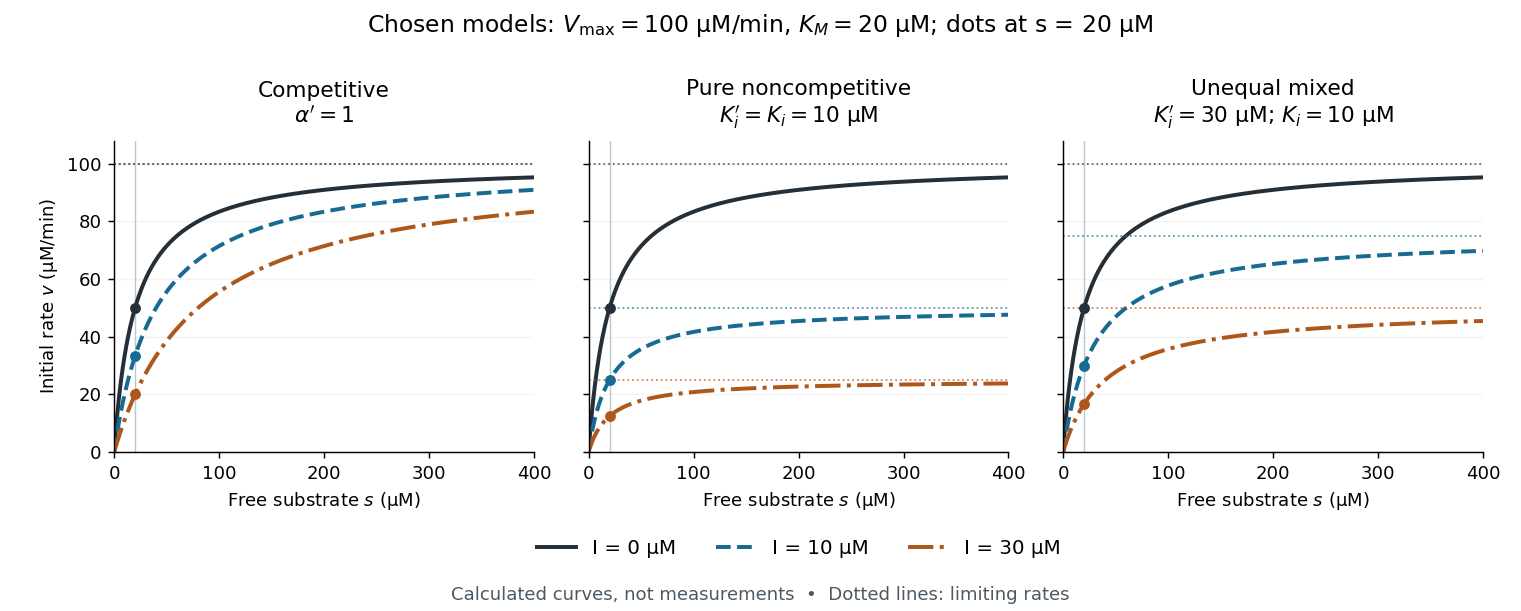
The shared numerical choices make the mechanisms comparable. At and , all three models give . At , the respective reaction rates are , , and ; at they are , , and . These are independently chosen teaching models, not measured inhibition constants for a named enzyme.
An inhibition constant sets an inhibitor concentration scale in an enzyme kinetics model. In the rapid-binding construction under reversible enzyme inhibition, and are dissociation constants. Smaller values favour the corresponding bound population at fixed free inhibitor concentration. More generally, fitted inhibition constants need not be true binding dissociation constants; a mechanism must justify that interpretation.[ref]
Symbolism and Terminology in Enzyme Kinetics (Recommendation 1981) by Nomenclature Committee of the International Union of Biochemistry. Symbolism and Terminology in Enzyme Kinetics, section 6.4, final paragraphs: operational inhibition constants versus explicitly defined dissociation constants
For example, choosing makes in this model, but does not imply that half of all enzyme is : and also contribute to the total population.
In the model of reversible enzyme inhibition, competitive inhibition makes substrate binding and inhibitor binding mutually exclusive: is allowed but is absent. Set , equivalently take . ThenFor the chosen , : the half-limiting substrate concentration rises from to , while the limiting reaction rate remains . At the inhibited reaction rate is , compared with the uninhibited . “Overcome by substrate” means that their ratio tends to one as , not that any finite addition removes the difference.
A competitive inhibitor is an enzyme inhibitor that produces competitive inhibition relative to a specified substrate. In the usual single-substrate kinetic description, it reduces the low-substrate response while leaving the limiting rate unchanged. A common molecular model has the inhibitor bind free enzyme and prevent formation of the enzyme-substrate complex; the kinetic classification alone does not prove a particular binding location.[ref]
Symbolism and Terminology in Enzyme Kinetics (Recommendation 1981) by Nomenclature Committee of the International Union of Biochemistry. §§6.1–6.4: reversible inhibition, competitive classification and mechanistic interpretation
For the simple reversible model at fixed free inhibitor concentration ,Here is the inhibition constant for this model and the uninhibited Michaelis constant. Take illustrative values , , and . Then and the apparent Michaelis constant is6micromolar. At , the inhibited rate is3micromolar per minute, compared with6without inhibitor.
As substrate concentration grows, both rates approach the same limiting value in this model. That is a limit, not an assertion that a particular finite substrate addition removes all inhibition. Characterizing a candidate therefore requires rates over suitable substrate and inhibitor ranges with controlled enzyme amount; one reduced rate does not establish that the inhibitor is competitive.[ref]
Symbolism and Terminology in Enzyme Kinetics (Recommendation 1981) by Nomenclature Committee of the International Union of Biochemistry. §4.2, Michaelis-Menten parameters; §6.4, operational inhibition classes
In the branching model, mixed inhibition retains inhibitor binding to both free enzyme and the enzyme-substrate complex. Unequal and shift both apparent parameters; their equality gives pure noncompetitive inhibition. For the chosen unequal case, gives and , hence and . Because , binding favours free enzyme, and the apparent Michaelis constant increases. Reversing that inequality decreases it.
The limiting behaviour provides a useful diagnostic within this model:Low substrate concentration isolates through the initial slope; high substrate concentration isolates through the plateau. At , the chosen competitive inhibition and unequal mixed inhibition examples have the same low- slope, , but different plateaus, and . Measuring only low substrate concentrations would miss that distinction.
Set , so that . The reversible enzyme inhibition equation reduces toAt the chosen , every reaction rate is one quarter of its uninhibited value. The plateau falls to , but half that plateau still occurs at . Increasing substrate cannot restore the uninhibited plateau. An unchanged apparent Michaelis constant here expresses equality of the two binding effects, rather than an absence of inhibitor binding to the enzyme-substrate complex.
The complementary limit of the branching model permits inhibitor binding only to the enzyme-substrate complex: set , hence , with finite . Then both and decrease by , while their ratio stays fixed. This limit helps distinguish preferential binding to in mixed inhibition from exclusive binding to in uncompetitive inhibition.
The protocol used in the trypsin colorimetric assay requires – inhibition and rejects hazy or yellow BAPNA solution.[ref]
Enzymatic Assay of APROTININ - Sigma Quality Control Test Procedure. A6012, SPBAPN02.001, revised 22 December 1997, p. 3, Notes 1–2: target inhibition range and substrate-solution quality
The trypsin colorimetric assay explains blank subtraction and conversion to a reaction rate using the Beer-Lambert law. This protocol is an activity comparison at one substrate level, not evidence that aprotinin obeys any particular curve above. To test the model, an experimental extension would vary both free inhibitor and free substrate concentrations, estimate early linear reaction rates before appreciable depletion, and fit the whole collection by nonlinear regression. Include a no-inhibitor series and inhibitor-matched blanks: inhibitor-dependent absorbance drift must not be mistaken for changed catalysis.
There is a mathematical reason to collect more than one reaction rate. At with the chosen uninhibited parameters, measuring would imply only . Both and satisfy that observation, although their high- limits differ. A broader substrate range tests which model fits. Even a fitted curve leaves binding geometry unresolved. Check activity recovery after reducing inhibitor concentration separately; the simple equation also ceases to apply when free inhibitor is substantially depleted by binding or inhibitor exchange has not equilibrated during the measured interval.


