Construct a minimal model with one substrate and no appreciable accumulated reaction product. Only the enzyme-substrate complex produces product, with catalytic rate constant ; and are inactive. Write and for free molar concentrations, and for total enzyme molar concentration. Assume a suitable quasi-steady-state approximation, rapid inhibitor binding and release relative to turnover, and negligible depletion of free inhibitor. In this construction the population relations areHere is the uninhibited Michaelis constant, and are the inhibition constants for the two indicated binding branches. The symbol denotes a free concentration, not an amount added to the tube. Define . Conservation of enzyme gives an original short derivation:Thus fitting a Michaelis-Menten equation at a fixed would return the apparent parameters“Apparent” means conditional on that inhibitor concentration. The uninhibited Michaelis constant has not been redefined. Dimensional analysis checks the denominator: both and have units of molar concentration; the resulting has units of reaction rate.
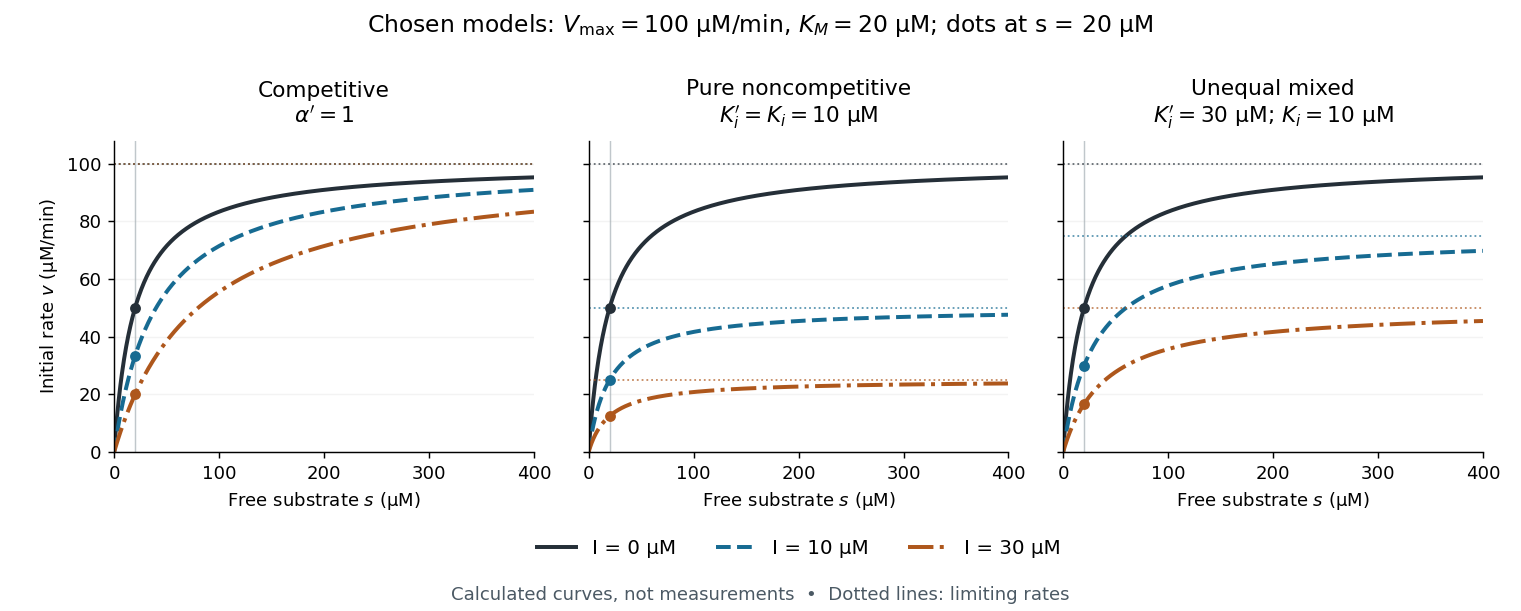

The shared numerical choices make the mechanisms comparable. At and , all three models give . At , the respective reaction rates are , , and ; at they are , , and . These are independently chosen teaching models, not measured inhibition constants for a named enzyme.
Articles by others on the same topic
There are currently no matching articles.