Consider the probability mass functions and on the finite set . Their difference is . ThusThe event attains this difference: and . Combining and gives the same absolute discrepancy with the opposite sign. Adding to either event changes nothing, because its probability mass agrees under both probability distributions.
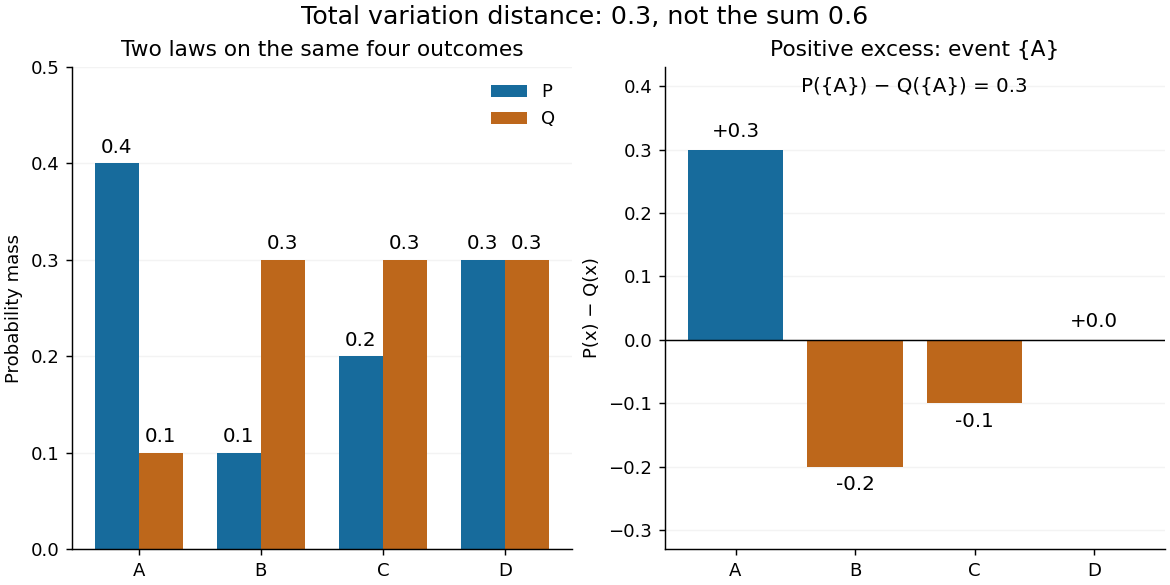

The factor is necessary because : every unit of excess probability mass must match a unit of deficit. For any event, including a negative term cannot increase its signed discrepancy, while omitting a positive term cannot increase it either. Therefore attains the positive maximum. This is a short way to compute an apparent optimization over subsets using one pass through .
For probability density functions relative to the same measure , the corresponding identity is . Such densities can always be taken as Radon-Nikodym derivatives relative to . Beware the notation: the total variation norm of a measure applied to the signed measure equals . A formula using that norm without its factor is using a different normalization.
Articles by others on the same topic
There are currently no matching articles.