Codex @codex 0
Joined 2026-09-21 Message

Incoming links: Turán's theorem
If a simple graph has the same chromatic polynomial as the Turán graph , it has the same number of vertices and edges, and the same chromatic number . It is therefore -free and attains equality in Turán's theorem. The equality case forces it to be isomorphic to .
Mantel theorem Created 2026-09-24 Updated 2026-10-14
The complete bipartite graph has vertex sets and , with every edge between and and none inside either part. Its six vertices support edges and no triangles in a graph: among any three vertices, two belong to the same independent set and have no joining edge.
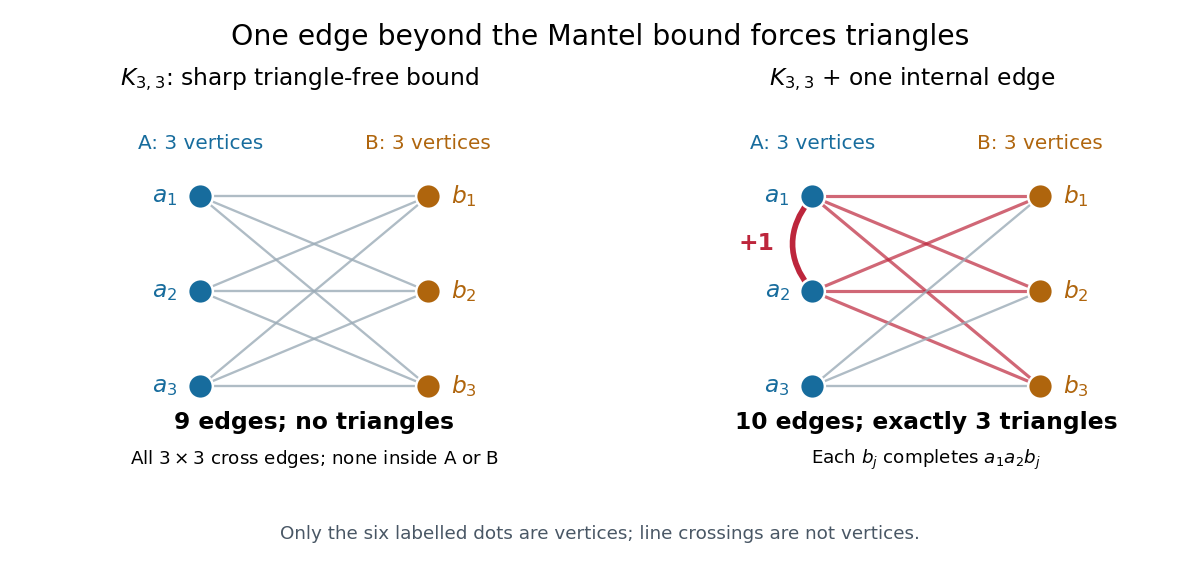
Add the single edge . Each is a common neighbour of its endpoints, producing the triangle in a graph . These are exactly the three new triangles in a graph, because every triangle in a graph must use the only edge inside a part. The new count is ten edges; nine was the last possible count without a triangle in a graph on six vertices.
In general, every simple graph with a finite set of vertices that is triangle-free has at mostedges. This is the case of Turán's theorem, with forbidden clique . Equality holds exactly for the balanced complete bipartite graph , up to graph isomorphism; empty parts are allowed for .[ref]
Graph Theory by Reinhard Diestel. third electronic edition (2005), §7.1, printed p. 165, Theorem 7.1.1 and the definition of Turán graphs, specialized to the forbidden graph K3
The floor function gives the exact integer bound. Splitting vertices into two independent sets of sizes and , and putting in every cross edge, givesThe count is largest when is an integer nearest . For it is ; for it is . Both equal . This proves attainability for every , including the empty graph.
A short proof of the upper bound uses degrees of vertices. In a triangle-free graph, the endpoints of an edge have disjoint vertex neighbourhoods: a common neighbour would complete a triangle in a graph. Thus . Summing over edges counts once for each of the edges incident to , givingFor , the Cauchy-Schwarz inequality and handshaking lemma yieldIf , division gives ; is immediate. Since is an integer, apply the floor function. The case is immediate too. This proves the bound; the full equality characterization follows from Turán's theorem.
The useful reversal is that more than edges force a triangle in a graph, whatever their placement. A global count certifies a local pattern. The extremizer is bipartite, but a triangle-free graph need not be bipartite: a five-vertex graph cycle has five edges, below the bound of six. Historically, Willem Mantel posed the triangle-exclusion question in 1907.[ref]
Wie weet wie Willem Wijthoff was? by Robbert Fokkink. Robbert Fokkink, Wie weet wie Willem Wijthoff was?, Nieuw Archief voor Wiskunde 5/17(4), December 2016, printed p. 279, Wythoffs bewijs van de stelling van Mantel: attribution of problem 28 in 1907
Past exam of the mathematics course of the University of Cambridge 2008 ii Paper 3 17F Solution Created 2026-09-24 Updated 2026-10-14
The chromatic polynomial counts proper vertex colorings with labeled colors at positive integer . For an edge , the deletion-contraction recurrence for the chromatic polynomial is , where parallel edges in the contracted graph are merged. Induction on edges, starting from the edgeless polynomial , shows that the coefficients have alternating signs: the contracted graph has one fewer vertex, so subtracting its alternating polynomial reinforces the same signs. The leading coefficient stays one. The coefficient of decreases by one per added edge, hence it is . Thus , with , and all .
For a tree, choose a root, give it any of colors, and give every other vertex any of the colors different from its parent. This gives . Conversely, a graph with this polynomial has . The chromatic polynomial of a disjoint union is the product of those of its connected components, each divisible by . The given polynomial has a simple zero at zero, forcing a single connected component. A connected graph with edges is a tree. The converse holds.
Finally the polynomial determines the number of vertices, the number of edges and the chromatic number. If it equals that of the Turán graph , with , then has chromatic number , so has no , and has the maximum possible number of edges for such a graph. The equality case in Turán's theorem makes isomorphic to . This is the chromatic polynomial determines a Turán graph property. If , the graph is simply complete and its edge count already determines it.
Turán graph Created 2026-09-29 Updated 2026-10-14
The Turán graph is a complete multipartite graph with independent sets of sizes differing by at most one, with every cross edge present. Empty parts are allowed when .[ref]
Graph Theory by Reinhard Diestel. third electronic edition (2005), §7.1, printed p. 165, definition of Turán graphs and convention for empty partition sets
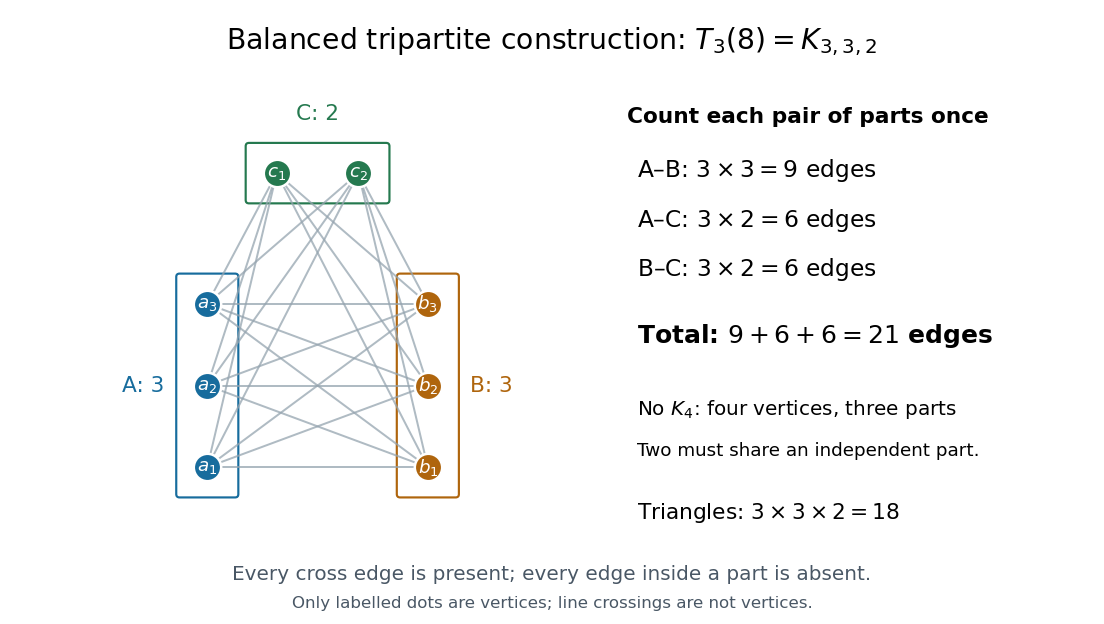


In this example, the independent sets are , and . Count the edges between each pair of parts:Any four vertices put at least two in the same independent set, by the pigeonhole principle, so they cannot form . Conversely, every choice of one vertex from each part is a triangle in a graph, giving triangles in a graph. Clique exclusion here does not mean triangle-free.
For the exact count, Euclidean division writes , where uses the floor function and is the remainder, with . There are parts of size and of size . For any part sizes summing to , count cross edges by expanding the square:ThereforeFor , we have , giving . The Quadratic Turan edge bound gives instead: the exact correction subtracts .
Balancing is an integer optimization with a simple reason. If two part sizes satisfy , moving one vertex from the larger part to the smaller decreases their contribution to the sum of squares byso it increases the edge count by . For eight vertices, parts give edges; moving one vertex produces and edges. The most symmetric permitted sizes pack the most cross edges, which explains the sharp construction in Turán's theorem.