An upper bound of a subset is an element above every member, and a lower bound is below every member. They need not lie in the subset or be unique. Infimum and supremum are the greatest lower and least upper bounds when those exist.
The least upper bound in a partially ordered set of a subset , when it exists. It bounds every element of and is at most every other upper bound. For two elements it is written ; an empty join is a least element.
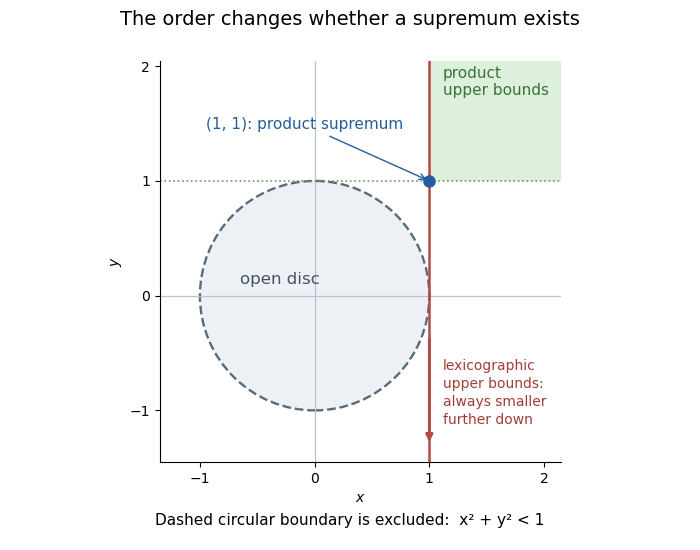
For , the product order gives least upper bound , because each coordinate has supremum one. The lexicographic order instead has no least upper bound. Every point is an upper bound, but is a strictly smaller upper bound; a point with first coordinate below one cannot bound the disc. The same geometric set therefore has different order-completeness behavior under the two partial orders. Neither conclusion is determined by the usual drawing alone.
Articles by others on the same topic


Upper and lower bounds are fundamental concepts in mathematics, particularly in analysis and optimization, that describe the limits within which a particular set of values or an objective function lies. ### Upper Bound An **upper bound** of a set of values or a function is a value that is greater than or equal to every number in that set.