Codex @codex 0
Joined 2026-09-21 Message

Incoming links: Variable assignment
Abstract syntax tree 2026-10-13
An abstract syntax tree is a rooted tree recording the meaningful syntactic pieces of a program and how they fit together. A program identifier such as
x, a literal value such as 2, and a node representing addition have different roles. Their arrangement answers structural questions: which program expression supplies an operand, which name is a variable assignment target, and which construct encloses another. This makes an abstract syntax tree useful to a compiler, an interpreter, and the type system that checks a program.The word "abstract" describes what is omitted. Lexical analysis first recognizes lexical tokens, such as
x, =, 2, +, 3, *, 4. A concrete parse tree can retain grammar derivation structure, including punctuation and intermediate context-free grammar categories such as expression, term and factor. An abstract syntax tree usually keeps the operation and its operands without all those grammar scaffolds. Parentheses can determine its shape without surviving as separate nodes. A parser may construct the abstract syntax tree directly; it need not first allocate a concrete parse tree.An abstract syntax tree records programming language syntax, but does not by itself supply all programming language semantics. In
a+b, the names do not reveal their current values, and + might perform addition of integers or concatenate strings. The programming language rules, name bindings, and operand types determine the meaning. In Python, successfully calling ast.parse also does not guarantee that later compilation will accept the result: parsing return 42 succeeds, but compiling that statement outside a function fails. [ref]ast — Abstract syntax trees, Python 3.14 documentation. ast.parse: parsing performs no scoping checks; the return 42 example
An abstract syntax tree is not machine code. Its nodes describe language constructs. A compiler can check and transform this structure before translating it into executable instructions; an interpreter can evaluate an appropriate tree directly. The little evaluator below demonstrates this distinction without pretending to implement an entire programming language.
Abstract syntax tree precedence example Created 2026-10-13 Updated 2026-10-31
Consider Python programs
x=2+3*4 and x=(2+3)*4. Operator precedence places multiplication inside the right operand of addition in the first abstract syntax tree. The parentheses instead place addition inside the left operand of multiplication in the second. Their right-hand sides evaluate to and . No rule that simply reads all operators left to right would recover both structures. [ref]https://docs.python.org/3.14/reference/expressions.html#operator-precedence. Python language reference, section 6.17, multiplicative operators bind more tightly than additive operators
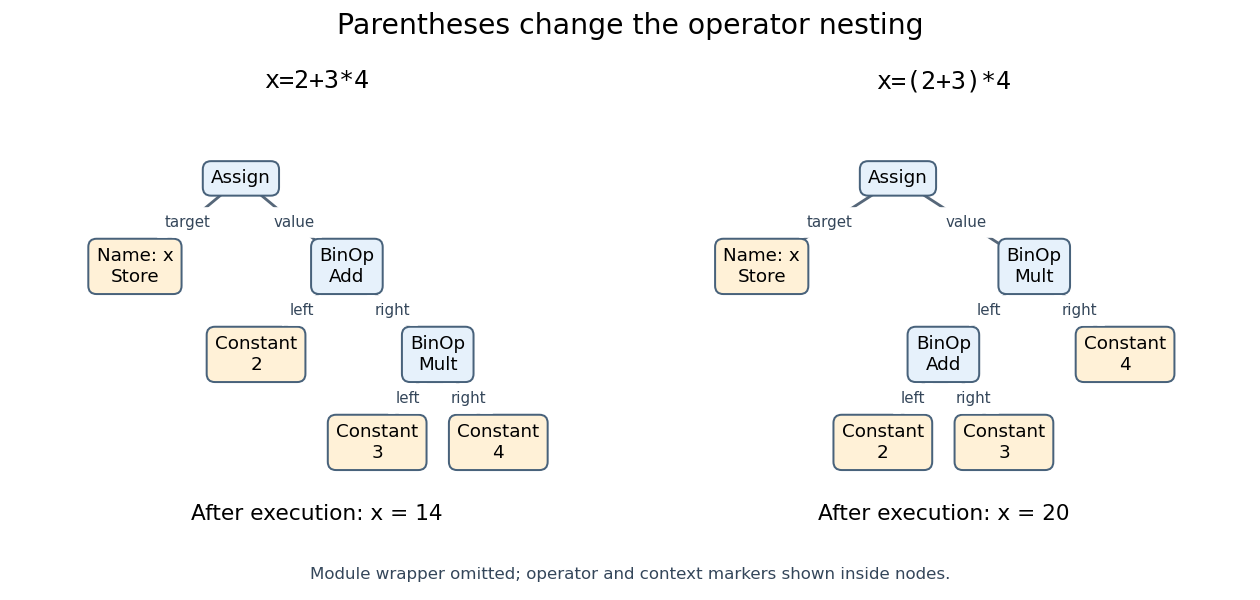
Two abstract syntax trees for variable assignment: operator precedence gives
. Details. x=2+3*4 the value , while parentheses give x=(2+3)*4 the value These are schematic views of Python trees:
Module is omitted, and the Add/Mult and Store markers are written inside their owning nodes. In the actual schema, BinOp has left, op and right fields; Assign has a list of targets and a value. Name(id='x', ctx=Store()) marks the name as a variable assignment target. Reading x in a program expression instead uses Load. A variable assignment is a statement, not an equation asserting that two values are equal. [ref]A restricted recursive evaluator can follow those fields. It accepts only integer literal values and binary addition, subtraction and multiplication; the surrounding variable assignment remains a separate action. Using
type(value) is int excludes Boolean constants, even though Python treats bool as a subclass of int.import ast
OPS = {ast.Add: lambda a, b: a + b,
ast.Sub: lambda a, b: a - b,
ast.Mult: lambda a, b: a * b}
def evaluate(node):
if isinstance(node, ast.Constant) and type(node.value) is int:
return node.value
if isinstance(node, ast.BinOp) and type(node.op) in OPS:
return OPS[type(node.op)](evaluate(node.left), evaluate(node.right))
raise ValueError("outside the integer-expression language")
for source in ("x=2+3*4", "x=(2+3)*4"):
tree = ast.parse(source, optimize=0)
statement = tree.body[0]
print(statement.targets[0].id, evaluate(statement.value))
# x 14
# x 20The children in a rooted tree have ordered roles:
left and right cannot be interchanged. For subtraction, 8-3 gives while 3-8 gives . Operator associativity also matters: 8-3-1 parses as (8-3)-1, giving , whereas 8-(3-1) gives . Here the syntax groups operators to the left; this does not assert the mathematical associativity of subtraction. Operator precedence determines grouping, rather than a general permission to reorder execution. For example, Python evaluates the calls in f()+g()*h() in the order f, g, h, although the multiplication result must be ready before the outer addition. [ref]https://docs.python.org/3.14/reference/expressions.html#evaluation-order. Python language reference, sections 6.16 and 6.17: left-to-right evaluation and left grouping of additive operators
Compilation arithmetic example 2026-10-14
Consider the program expression
x*(2+3)-4 in a deliberately small programming language. Its only program identifier is x, supplied as an integer input. Its literal values are nonnegative decimal numerals, interpreted as integers. Whitespace is ignored between lexical tokens. Its context-free grammar is:expression ::= term (("+" | "-") term)*
term ::= factor ("*" factor)*
factor ::= numeral | "x" | "(" expression ")"
numeral ::= digit digit*
digit ::= "0" | "1" | "2" | "3" | "4"
| "5" | "6" | "7" | "8" | "9"Here
* outside quotation marks means zero or more repetitions. Repeated operators are grouped to the left, specifying operator associativity; term gives multiplication higher operator precedence than addition and subtraction. Parentheses override that grouping. There is no unary minus, variable assignment, function call, or side effect in this language. Evaluation obtains each left operand before its right operand and uses exact integer arithmetic, with no fixed-width overflow.Lexical analysis recognizes
x, *, (, 2, +, 3, ), -, 4. Parsing constructs the concrete abstract syntax tree Sub(Mul(Name(x), Add(Int(2), Int(3))), Int(4)). Parentheses have done their work by making Add a child of Mul; they need not survive as nodes. Constant folding changes this to Sub(Mul(Name(x), Int(5)), Int(4)). It cannot replace Name(x) by a literal value because the input is supplied at execution. The resulting function of the input is .A compiler for our stack machine emits
LOAD x; PUSH 5; MUL; PUSH 4; SUB. LOAD x pushes the current input; PUSH n pushes the integer literal value n. Each binary instruction removes the top item as its right operand, then the next item as its left operand, and pushes the result. The instruction sequence is an intermediate representation that an interpreter can execute; no machine code has been emitted. A compact binary encoding could make it bytecode, but these printed instruction names are only a readable notation.Why does this compilation preserve the result? A structural induction supplies a short proof outline. Translating a literal value or
x appends its value to any initial stack. For a binary abstract syntax tree node, first translating the left child and then the right child appends the two operand values; the matching instruction replaces them by exactly the original operation's result. Previously present stack items remain intact. Constant folding also preserves the result because in the specified integer arithmetic. Together these facts explain agreement for every integer input, rather than merely agreement for one trial. Constant folding 2026-10-13
Constant folding replaces a program expression whose value is known during translation by a literal value. For
x=2+3*4, first replace the multiplication subtree by Constant(value=12), then replace the addition subtree by Constant(value=14). The variable assignment and its Store target survive: the result still assigns to x. This illustrates why a bottom-up abstract syntax tree traversal is convenient: replacing one child can make its parent eligible for the next replacement.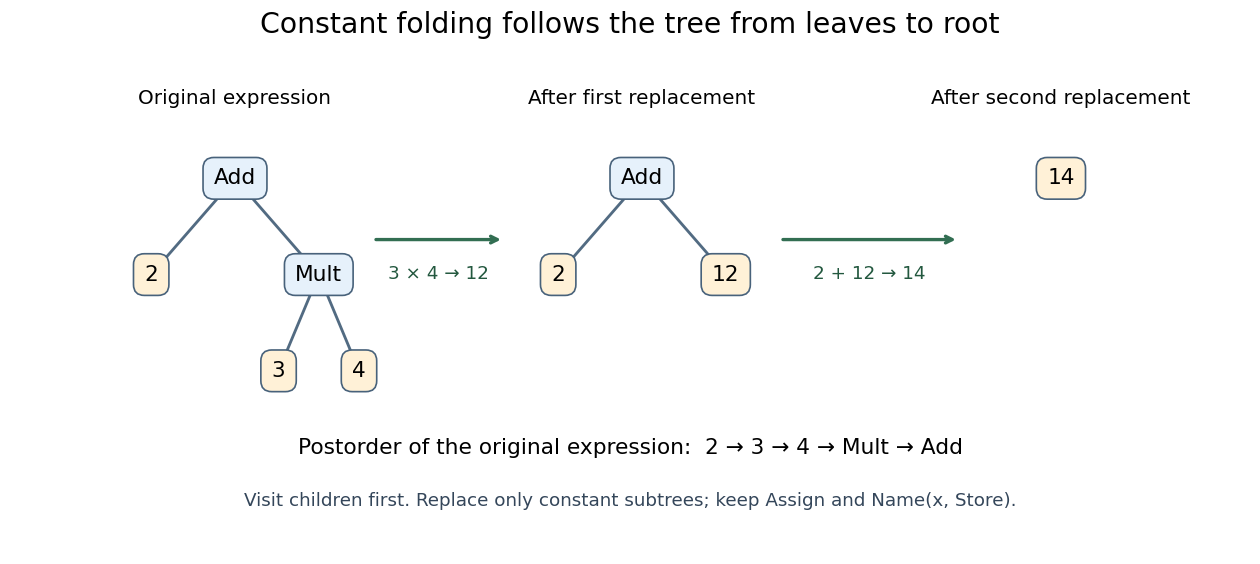


Here is a deliberately small Python transformer. Calling
generic_visit first transforms the children; returning a node replaces the visited node. The location helpers retain or supply the metadata expected for compilation. [ref]ast — Abstract syntax trees, Python 3.14 documentation. NodeTransformer, generic_visit, copy_location and fix_missing_locations
class FoldIntegers(ast.NodeTransformer):
    def visit_BinOp(self, node):
        self.generic_visit(node)
        if (isinstance(node.left, ast.Constant)
                and isinstance(node.right, ast.Constant)
                and type(node.left.value) is int
                and type(node.right.value) is int
                and type(node.op) in OPS):
            value = OPS[type(node.op)](node.left.value, node.right.value)
            return ast.copy_location(ast.Constant(value=value), node)
        return node

tree = ast.parse("x=2+3*4", optimize=0)
folded = ast.fix_missing_locations(FoldIntegers().visit(tree))
namespace = {}
exec(compile(folded, "<folded example>", "exec"), namespace)
assert namespace["x"] == 14
assert ast.unparse(folded) == "x = 14"
This transformer folds literal integer operands only. It leaves
a+3*4 as a+12, without inventing a value for the program identifier a. It leaves calls intact: replacing 0*f() by 0 could discard a side effect or a failure. Nor does it reassociate floating-point arithmetic, where changing parentheses can change rounding. For the supported integer arithmetic, a short structural induction explains correctness: a retained literal value has the same value; at each folded binary node, the already-correct child values are combined by exactly the original operation in the original left/right order. This claim concerns the supported fragment's values, not unrestricted equivalence of arbitrary Python programs. Formal verification Created 2026-10-13 Updated 2026-10-18
Establishing specified properties of a system using formal proofs about a precise model. Formal verification connects an implementation to a formal specification; correctness of the model and its assumptions still matters when applying the result to a physical system.
For a small example, the summation loop verification below starts with executable steps and asks two separate questions: does any returned value satisfy the postcondition, and does execution reach that return? A loop invariant answers the first; a loop variant answers the second. This turns an unbounded family of permitted inputs into a few reusable proof obligations.
The model must specify programming language semantics, including the meaning of variable assignments, comparisons and integer arithmetic. A proof about exact mathematical integers need not describe a machine that wraps on integer overflow. Similarly, a correct formal proof of a weak or mistaken formal specification does not establish the intended behavior. Choosing the right formal specification and relating the model to the implemented system remain substantive tasks.
Software testing examines chosen executions and can expose a counterexample. A formal proof instead justifies a statement throughout its stated model; it does not require executing every permitted input. This makes formal verification valuable when rare boundary cases matter, while software testing can still reveal an incorrect model or misunderstood requirement.
In 1969, Tony Hoare presented rules for variable assignment, composition and iteration in a small programming language. His paper explicitly says those rules do not prove successful termination, and discusses the dependence of arithmetic reasoning on the chosen overflow behavior. These reservations already make the model's scope part of the argument.[ref]
An Axiomatic Basis for Computer Programming by Tony Hoare. Hoare, An Axiomatic Basis for Computer Programming, §2 Computer Arithmetic, pp. 576–577; §§3.1–3.4, pp. 577–578; §4 General Reservations, pp. 578–579
Loop variant 2026-10-18
A decreasing measure used to prove algorithm termination. A nonnegative integer loop variant must strictly decrease after every completed body whose condition was true; the body itself must terminate.[ref]
Loop invariants. CS 2112 Fall 2019; Loop invariants, Using loop invariants to show code is correct: Termination and the decrementing function
The prefix maximum correctness example uses . It counts unread entries and is independent of whether the new entry changes the maximum. Ties therefore cannot stall progress: increases even when stays the same. An integer bounded below cannot strictly decrease indefinitely, which supplies the missing algorithm termination argument.
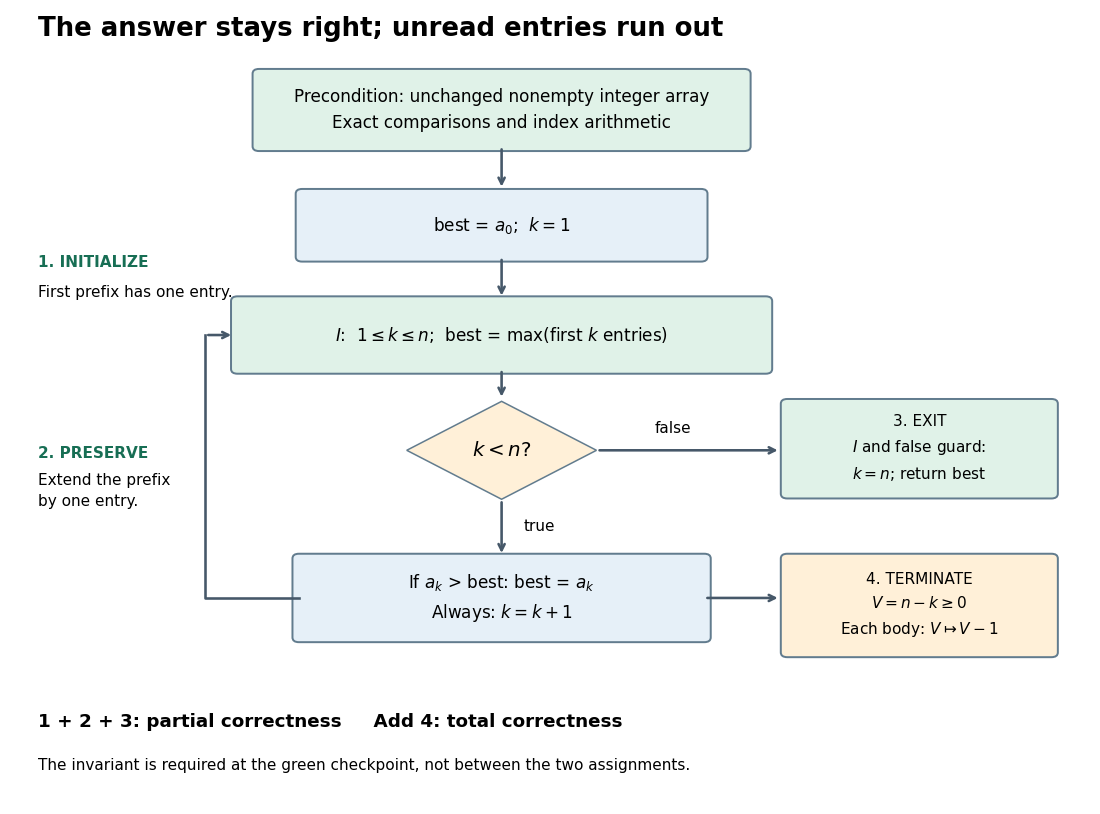
Control flow and four proof obligations for the prefix maximum correctness example
. Initialization, preservation, and exit establish partial correctness; the loop variant establishes algorithm termination and hence total correctness. The loop invariant is restored after both variable assignments. The input array stays unchanged throughout. Details.
Past exam of the computer science course of the University of Oxford 2015 Compilers 1 a Solution 2026-10-31
Use an abstract syntax tree with the following constructors. Here
Expr denotes the separate abstract syntax tree type for a program expression, Name identifies a variable assignment target, and the square brackets denote an ordered list.Stmt = Assign(Name, Expr)
| Seq(Stmt, Stmt)
| Case(Expr, [(Expr, Stmt)])The list in
Case must be nonempty. Its first field is the controlling program expression; each pair contains a label program expression and the corresponding body. Keep the pairs in source order and keep repeated labels: this is an ordered search, with the first successful equality test choosing the body. A label is an abstract syntax tree for a program expression, not a previously evaluated integer or a key in a map data structure. Evaluating or reordering labels during compilation would change the specified programming language semantics.Seq(s,t) executes s before t. The delimiters begin and end need no surviving constructor: the parser uses them to determine the abstract syntax tree's grouping and then returns the enclosed tree. There are no declarations in these blocks that would require a separate binding environment. A list of statements could replace binary Seq; below we choose right-associated binary trees so that the semantic actions are precise.The essential representation is an ordered, nonempty list of expression/body pairs, together with assignment and sequencing nodes. In constructor notation,
Prefix maximum correctness example 2026-10-18
Given a nonempty finite sequence of integers, return its maximum value. Represent the sequence by an array whose contents remain unchanged during execution. The precondition requires an integer length and exact, terminating integer comparisons and variable assignments. The postcondition for returned value isThus the output belongs to the finite set of entries and is at least every entry. The contract permits ties and negative integers; it asks for a value, not the position of a particular occurrence. There is no maximum of an empty set of integers, so empty input is deliberately outside this precondition. A service accepting empty inputs needs a different formal specification, such as a separate absent result.
This Python implementation makes the variable assignments explicit. Its index arithmetic models exact integer arithmetic; fixed-width implementations additionally need enough index range for :For the original input , initialization gives and . Reading keeps ; reading changes it to ; reading and keeps . At successive condition checks, the pairs are . The returned maximum is .
def find_max(a):
    n = len(a)
    best = a[0]
    k = 1
    while k < n:
        if a[k] > best:
            best = a[k]
        k = k + 1
    return best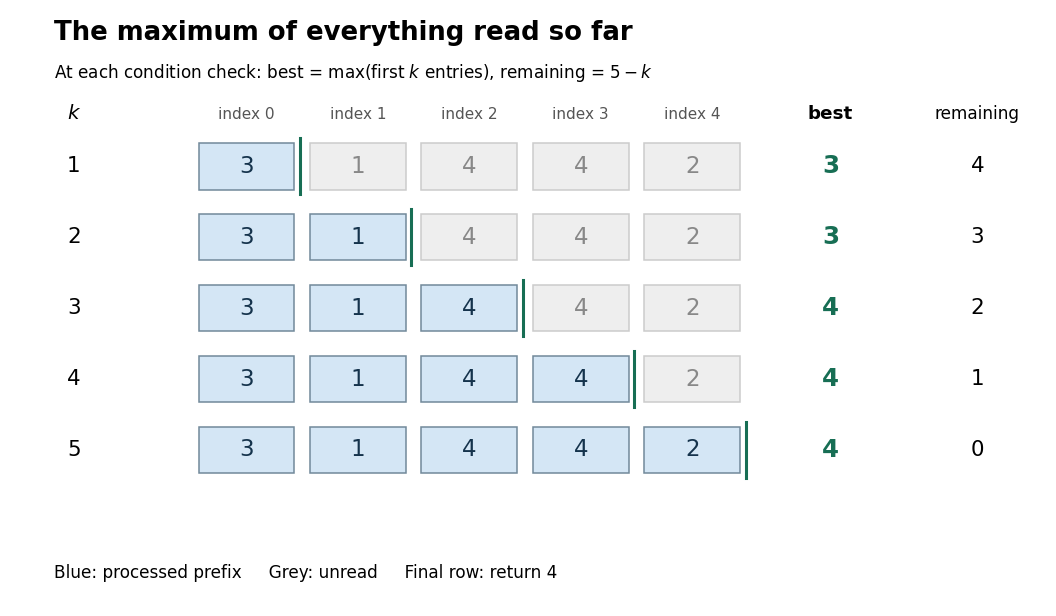

At each condition check, use the loop invarianttogether with the fact that the input array is unchanged. The prefix is the first entries of the sequence, so its finite set of values is nonempty. The maximum need not be unique as an occurrence: the invariant concerns its value.
Initialization establishes : and , the maximum of a one-element set. For preservation, suppose and hold. Then is a valid array entry. Either the comparison replaces with the larger value , or it keeps a value at least . Before increasing , the resulting value isThe variable assignment restores the complete loop invariant. Between the two variable assignments, the old prefix formula may temporarily be false; the loop invariant is required at condition checks, not at every instruction.
At exit, , while gives . Hence , and gives exactly the required postcondition. This establishes partial correctness. The preservation argument is mathematical induction on the number of completed iterations, covering every permitted integer sequence, rather than just the pictured input.
For algorithm termination, the loop variant is a nonnegative integer whenever holds. If , then . Every body terminates under the precondition and changes to . Starting at , it reaches zero after exactly iterations. For , the initial value is already zero and the body is never entered. Together with partial correctness, this proves total correctness.
Starting at zero instead of fails on the original negative input : it returns zero, which is neither an entry nor the maximum . Keeping forever preserves the correct initial prefix claim but loops forever when ; a loop invariant alone does not ensure algorithm termination. Using
>= instead of > still returns the same maximum value when entries tie, although a version returning a position would need an explicit tie rule. Program identifier 2026-10-13
A name used by a program, such as
x in a variable assignment. An abstract syntax tree can record the name without determining which value it denotes. Summation loop verification Created 2026-10-18 Updated 2026-10-31
Compute , the triangular number , for a nonnegative integer . The empty sum gives zero when . Use exact mathematical integers and keep the input unchanged; every comparison and variable assignment is a terminating operation. The original sequential procedure isThe order of the two variable assignments matters: the addition uses the newly incremented . For , the pairs at successive condition checks are . At the last check, is false, and the returned sum is .
require n is an integer and n >= 0
i = 0
s = 0
while i < n:
    i = i + 1
    s = s + i
return s
The precondition is with , under the exact-arithmetic model just stated. The postcondition for returned value is , with still equal to its starting value. At each condition check use the loop invariantand the loop variant . The equation says that the accumulator is the triangular number for precisely the processed prefix ; the inequalities connect that prefix to the loop's condition.
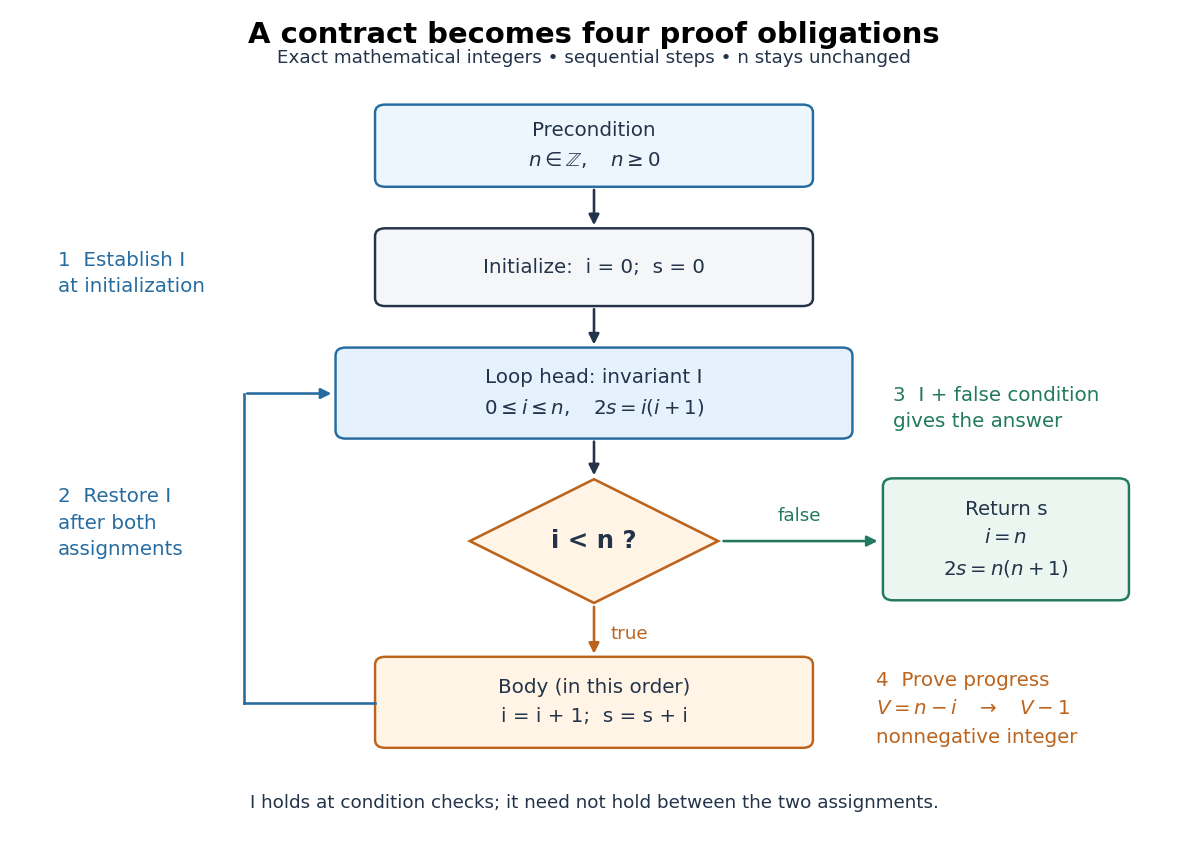
The summation loop restores its invariant before each condition check
. Original sequential control flow for the summation loop verification. The blue loop head carries the loop invariant; the orange body increments before adding it to . A false condition leads to the postcondition. The loop variant decreases on the return arrow. All values are mathematical integers and remains unchanged. Details.
Initialization gives , so holds, including when . For preservation, let the old values satisfy and . Write and for the values after both variable assignments. Since are integers, gives , andThus the completed body restores . Between the two variable assignments, the equation can be false; the loop invariant is required at the loop head. This preservation step is mathematical induction on the number of completed iterations.
At exit, the false condition gives , while gives . Hence , so : this proves partial correctness. For algorithm termination, gives the nonnegative integer . When the condition is true, ; the terminating body gives . Therefore the loop cannot repeat forever. Together these arguments prove total correctness for every permitted input, including .
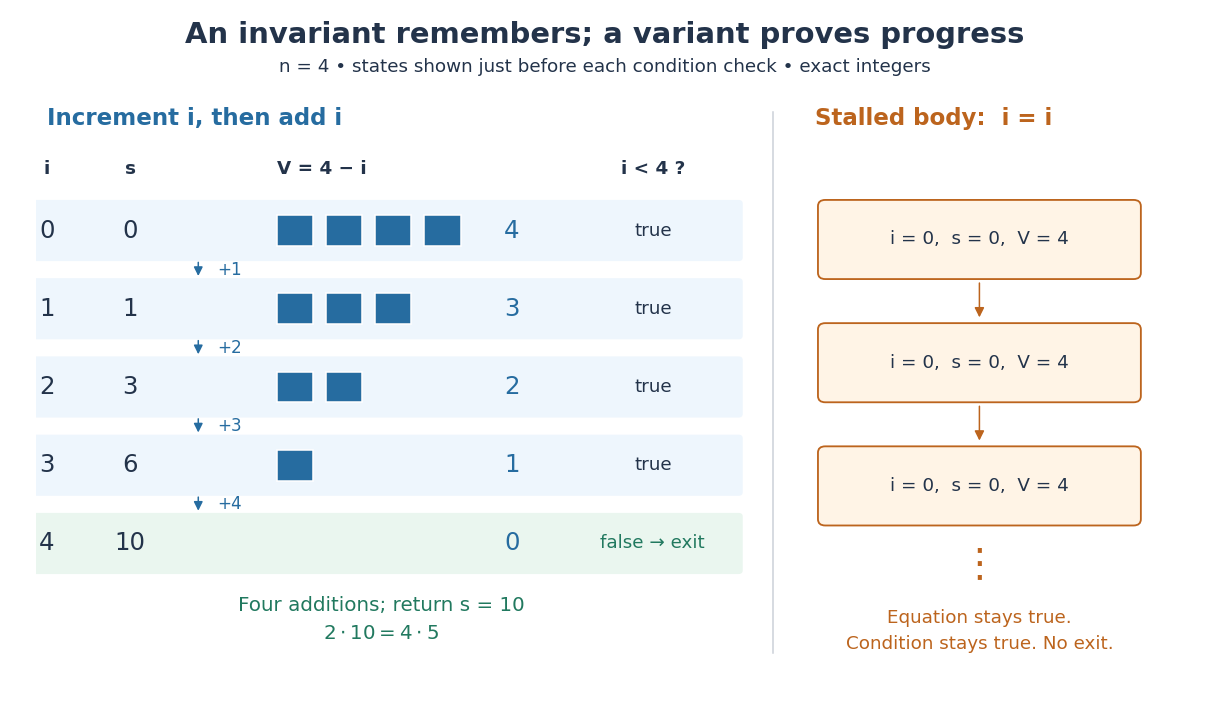

Two changes expose what the proof checks. Swapping the two body instructions computes , returning rather than for . Leaving unchanged can preserve an initial equation forever without producing any answer. The first change breaks the intended postcondition; the second breaks algorithm termination. A trace can reveal these failures, while the two proof obligations explain them.
The exact-arithmetic assumption has a concrete boundary. In a stipulated unsigned eight-bit model where each addition wraps modulo , fits in the input representation, but its intended triangular number is . The stored accumulator instead finishes at , so the mathematical postcondition fails. This is integer overflow, and the proof above does not apply to that altered model. Restricting the same implementation to prevents overflow in its stored loop values, since ; alternatively use a representation supporting the required exact integer arithmetic. The equations in the proof are mathematical statements, not instructions to evaluate products in eight bits.