Vieta's formulas connect two descriptions of a polynomial: its coefficients and its roots of a polynomial. They let us read the sum and product of the roots of a polynomial without finding the individual roots of a polynomial, and turn a proposed factorization of polynomials into checkable coefficient identities. The key is that coefficients encode elementary symmetric polynomials, which are unchanged by a permutation of the roots of a polynomial.
For a polynomial of polynomial degree , with nonzero leading coefficient , write its factorization of polynomials in a splitting field asList every root of a polynomial according to its multiplicity of a root. ThenIn particular, and . With coefficients in the real numbers or complex numbers, the fundamental theorem of algebra ensures that a list of roots of a polynomial in the complex numbers exists when multiplicity of a root is counted.[ref]
For a monic polynomial, this is the familiar conventionwhere is the th elementary symmetric polynomial in the roots of a polynomial; in particular, . The ratio by in the general statement matters: multiplying every coefficient by the same nonzero scalar preserves both the roots of a polynomial and these ratios.
A short derivation explains every alternating sign. In the product , a term of polynomial degree arises by choosing from distinct factor positions and from the others. Summing the resulting products gives . Values at different positions may coincide: the selection is of positions, not distinct root values. Matching coefficients gives the formula. This is the distributive property organized by the number of chosen root factors.
Take the stipulated polynomial roots . Their first three elementary symmetric polynomials areTheir monic polynomial is thereforeThe constant coefficient is , while the product of the three roots of a polynomial is : for a cubic polynomial, these have opposite signs. Expanding the factors directly verifies the same polynomial identity.
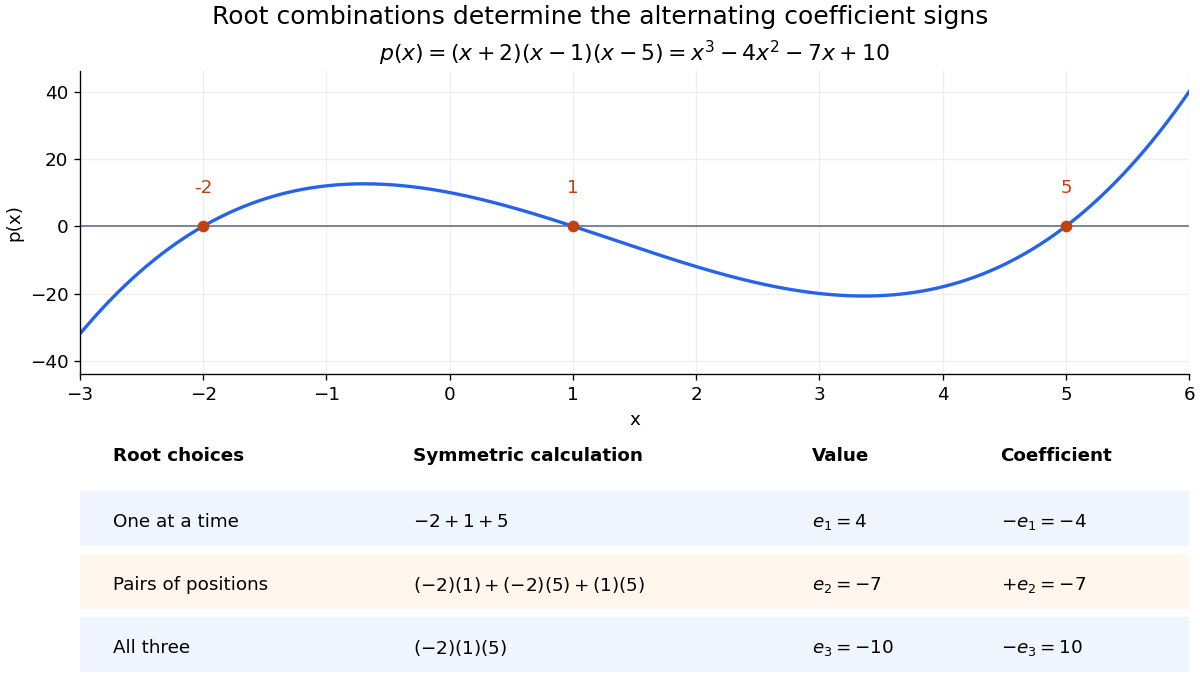
For the nonmonic polynomial , the same ratios give sum , pairwise-product sum , and product . It is times the monic polynomial above, so its roots of a polynomial are the same. Checking only the sum and product would leave the middle elementary symmetric polynomial unchecked; all three are needed to recover a monic polynomial of polynomial degree three.
For the polynomial , the root list is , not . Its elementary symmetric polynomials areThe zero coefficient of is accounted for by the cancellation in . Omitting one occurrence of the double root of a polynomial loses both the polynomial degree and the correct coefficients. Multiplicity of a root is part of the root data.
For the quadratic polynomial , the discriminant is , so its roots of a polynomial are the complex conjugatesTheir sum is , and their product is , matching the constant coefficient divided by the leading coefficient. More revealingly, : the product is the square of a complex modulus. Coefficients in the real numbers therefore need not imply polynomial roots in the real numbers.
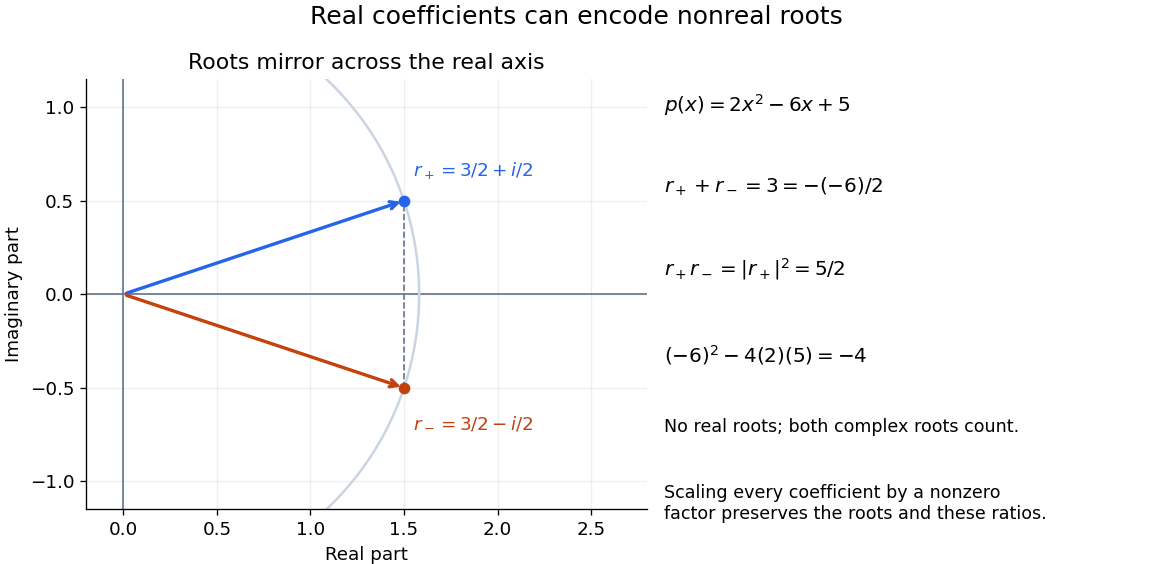
For any polynomial with coefficients in the real numbers, . Thus a nonreal root of a polynomial brings its complex conjugate along with the same multiplicity of a root. This follows by applying complex conjugation to the polynomial expression and its factors. It explains why sums of complex conjugate terms can produce coefficients in the real numbers.
François Viète studied the connection between positive roots of a polynomial and the coefficients of the powers of the unknown. His 1591 presentation of algebraic notation used letters for both known and unknown quantities, with consonants for known quantities and vowels for unknown quantities. That move makes it possible to express a relation for whole families of polynomials, rather than only a numerical instance. His historical setting concerned positive roots and expressions satisfying dimensional homogeneity; the modern splitting field formulation above is a broader statement.[ref]
François Viète by John Joseph O'Connor and Edmund Frederick Robertson. MacTutor, François Viète: paragraphs on the 1591 algebraic notation, known and unknown quantities, and positive roots and coefficients
Articles by others on the same topic



Vieta's formulas are a set of relations in algebra that relate the coefficients of a polynomial to sums and products of its roots. They are particularly useful in the context of polynomial equations.