Willis Lamb and Robert Curtis Retherford measured a small separation between hydrogen energy levels that the simplest relativistic quantum mechanics placed at equal energy. Their 1947 experiment used microwave transitions involving metastable atoms, rather than trying to resolve the separation in an ordinary optical line. The Lamb shift required improved quantum electrodynamics, including the interaction of an electron with the quantized electromagnetic field. A small spectral discrepancy thereby became a quantitative test of the theory.[ref]
Fine Structure of the Hydrogen Atom by a Microwave Method by Willis Eugene Lamb Jr. and Robert Curtis Retherford. 1947 microwave experiment and measured separation of hydrogen levels
A physicist.[ref]
https://lib.arizona.edu/special-collections/collections/willis-e-lamb-jr-papers. Independent professional profile
[ref]https://optics.arizona.edu/person/willis-lamb-jr. Independent professional profile

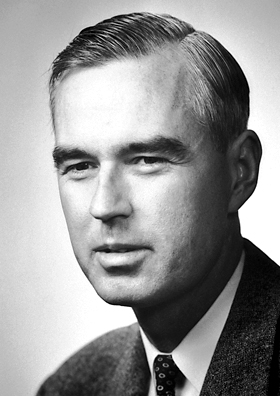
Portrait of Willis Lamb
. Nobel foundation; 1955. Public domain in Sweden (PD-Sweden photograph). Source usage terms, via Wikimedia Commons. Source. Articles by others on the same topic

Willis Lamb is an American physicist known for his significant contributions to quantum mechanics and atomic physics. He is best known for his work on the fine structure of hydrogen spectral lines, which is a crucial aspect of quantum electrodynamics (QED). His research provided experimental evidence that helped to confirm theoretical predictions about the behavior of electrons in atoms. Lamb was awarded the Nobel Prize in Physics in 1955, sharing it with Robert R. Wilson.