The wind correction angle is the difference between the aircraft heading and the desired ground track needed to compensate for a crosswind. A heading points the vehicle; a track describes horizontal travel over the ground. In the horizontal model here, the air-relative velocity is aligned with the heading. Wind-direction statements below specify where the air moves, not the meteorological direction it comes from.[ref]
Relative Velocity by NASA Glenn Research Center. Ground Reference and Wind Speed, reference-frame relation
Let be true airspeed, let be wind along the desired track, and let be wind to its right. Define a positive correction as heading right of the track. Cancelling cross-track velocity and projecting along the track givesFor the branch with a nonnegative along-track air-relative component,The condition permits crosswind cancellation, but forward progress also requires .
In an original example, take , wind rightward and opposite the intended track. Then and . A constant-condition ground leg takes about . With the same headwind, a rightward component of can still be cancelled, but : the resulting track-line motion is backward.
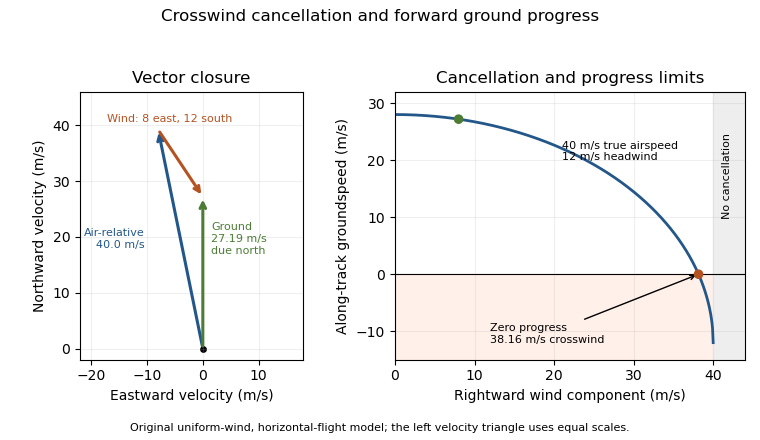
An original wind triangle and forward-progress limit at fixed true airspeed. Cancelling crosswind alone does not guarantee progress against a headwind.
Details. 
The calculation assumes a uniform horizontal wind and a steady true airspeed. Ground-position measurements can test the resulting groundspeed; they cannot determine the correction from air-relative speed alone without wind information. Wind variation and a difference between heading and air-relative velocity require a fuller vector model.
Articles by others on the same topic
There are currently no matching articles.