In group theory, which is a branch of abstract algebra, the concepts of centralizer and normalizer help us understand the structure of groups and their subgroups. Here are the definitions of both: ### Centralizer The centralizer of a subset \( S \) of a group \( G \), denoted as \( C_G(S) \), is the set of all elements in \( G \) that commute with every element of \( S \).
Articles by others on the same topic

Both constructions are stabilizer subgroups for the conjugation action. The centralizer fixes an individual element ; the normalizer preserves a subgroup as a whole, while possibly moving its elements. The centralizer of a subset fixes every member of individually, soFor a cyclic subgroup , commuting with the group generator is equivalent to commuting with all its powers, giving .
In the symmetric group , let and . ThenEvery transposition sends to under conjugation. In particular, for ,Thus belongs to the normalizer of but not to the centralizer of . Preserving the collection of powers allows the two possible directions of its group generator to be exchanged.
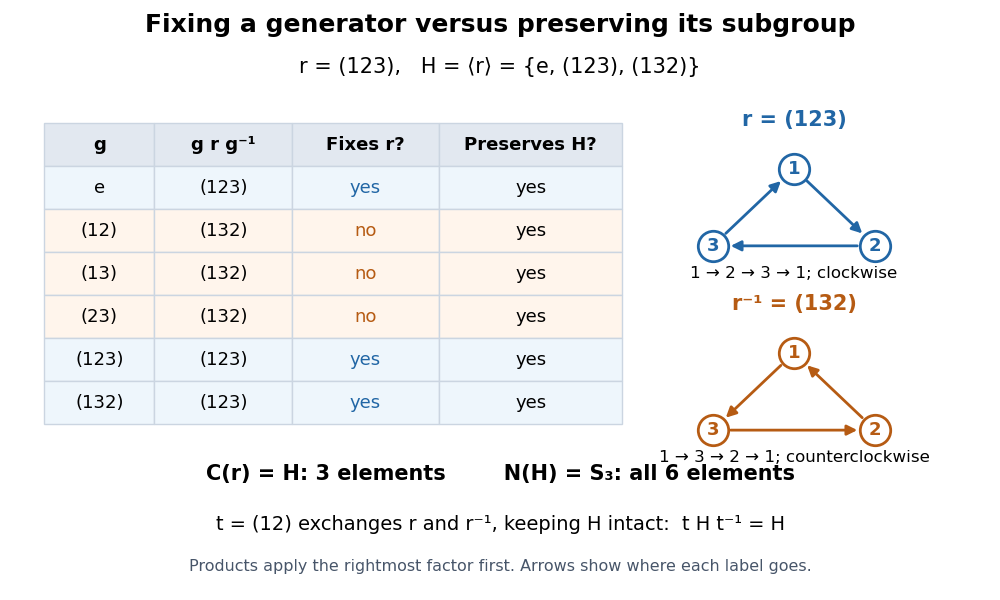

This distinction lets one ask separately which operations leave a chosen operation unchanged and which operations preserve the subgroup it generates. The normalizer also supplies a group homomorphism to the automorphism group of , by ; its group kernel is . In this example the group homomorphism has two possible outputs, fixing or replacing it by . The quotient group is therefore a cyclic group of group order two. Milne develops the normalizer as a stabilizer subgroup in Group Theory (v4.01) by James S. Milne.