Articles by others on the same topic

For a subgroup of a group , a left coset is ; a right coset is . The name refers to the side on which the representative multiplies . Think of a coset as a translated copy of a subgroup: it remembers the relative differences allowed by , while moving the whole collection to another location in the group.
Two left cosets of the same subgroup are either equal or disjoint. Thus distinct left cosets form a partition of a set covering ; the same statement holds separately for right cosets. The useful membership test isThis also defines an equivalence relation: changing a representative by right multiplication with a member of leaves its left coset unchanged. These facts hold even for infinite groups. See MIT's coset notes, definitions 3.6 and 3.9.
For an explicit additive example, take the cyclic group , with modular arithmetic, and the subgroup . Adding each representative to both members gives exactlyRepresentatives repeat these three cosets, respectively. For example, , since . Every residue appears once in the displayed partition of a set. Each coset has two members, so the group order of is and its index of a subgroup is . Left and right cosets coincide here because is an abelian group.
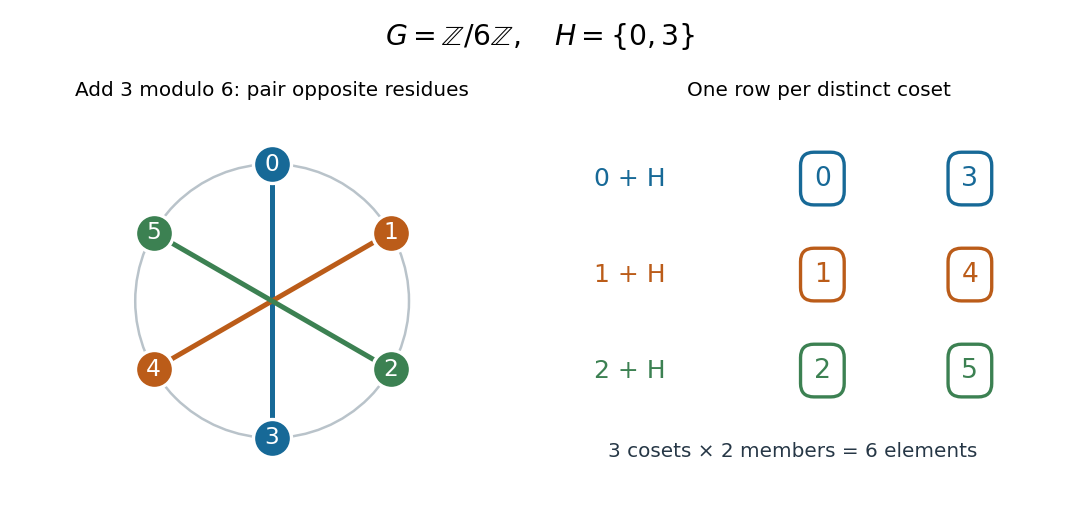
A coset need not be a subgroup. In this example, lacks the identity element , and leaves it. In fact, the only left or right coset of that is a subgroup is itself: a subgroup must contain the identity element, and the coset containing that element is . Equal sizes come instead from the bijection , whose inverse is ; for right cosets, use and .
The nonabelian group , the symmetric group on three letters, separates the two sides. Use function composition with the rightmost permutation applied first, and let . Then but , giving the differing pairThe complete partition of a set into left cosets consists of , and ; the complete partition of a set into right cosets consists of , and . Each lists all six permutations exactly once. Both have three parts of size two, although their parts differ.
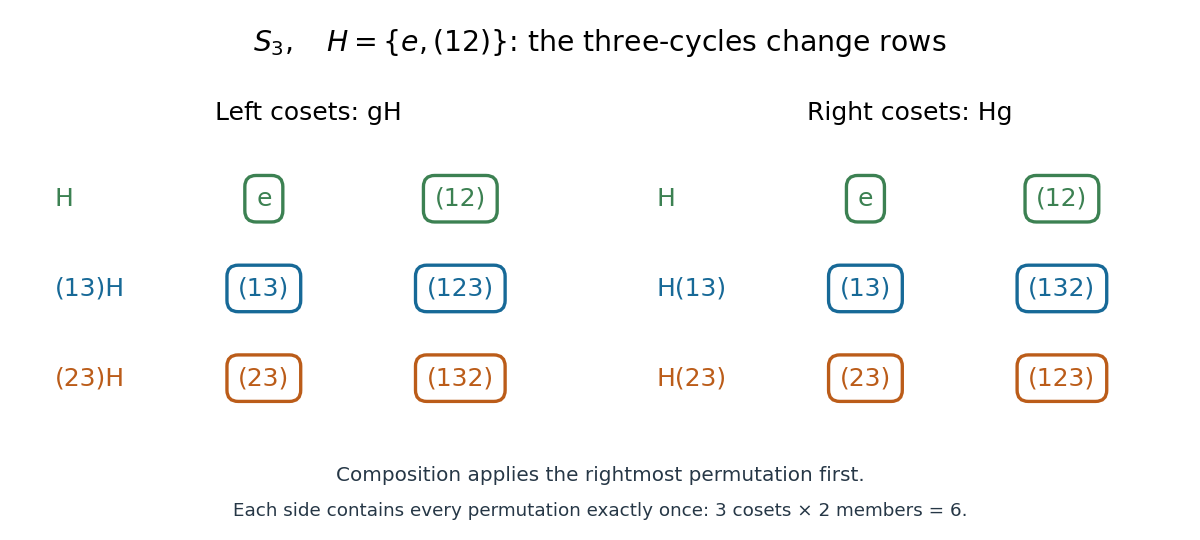


Left cosets support a group action by for every subgroup, as in the coset action. Multiplication of representatives defines a quotient group operation precisely when is a normal subgroup. Otherwise the answer can depend on the representatives: in this example, and represent the same coset , yet and differ. In the additive example, is a normal subgroup, making valid. See MIT's quotient-group notes, theorem 9.1.