A group acts on the left cosets of a subgroup by left multiplication; its kernel is the core of that subgroup.
Let be a subgroup. The notation here means the set of left cosets , even when is not a normal subgroup. DefineThis gives a group action without needing a quotient group structure on .[ref]
Group Actions by Keith Conrad. Example 2.12, printed pages 7–8: left multiplication on left cosets, without normality
The representative check is essential: if , then for some , and . Thus equal input cosets give equal output cosets. The identity element fixes every coset, and associativity gives . Each induced map is a permutation, with inverse induced by . This is a transitive group action because sends to .
The stabilizer subgroup of is itself. At a general coset, the stabilizer subgroup and the group kernel areConsequently the coset action is a faithful group action exactly when the subgroup core is trivial.[ref]
Indeed, exactly when , or . Intersecting these membership conditions over all cosets gives the group kernel. Conjugation permutes the subgroups in this intersection, making it a normal subgroup of contained in . Conversely, any normal subgroup of contained in lies in every . This explains why the subgroup core is the largest such normal subgroup: it is exactly the portion of invisible at every label, rather than merely at the label .
For a normal subgroup , every equals , so . For , the construction is the regular group action behind Cayley's theorem. Between these extremes, a nontrivial subgroup with trivial subgroup core can give a faithful group action on fewer labels. If the index of a subgroup is finite, , the first isomorphism theorem givesThus a subgroup of small index of a subgroup exposes a small permutation group associated with . The two examples below and in nonfaithful coset action of the symmetric group on three letters show exactly which information can survive.
Take the symmetric group and the subgroup of group order two. With the rightmost permutation applied first, its three left cosets areThe subscripts record the image of : every member of sends to . Because is the stabilizer subgroup of in the usual group action, is a bijection onto . It is an equivariant map, since . The coset action therefore becomes the familiar group action on three letters. In particular,
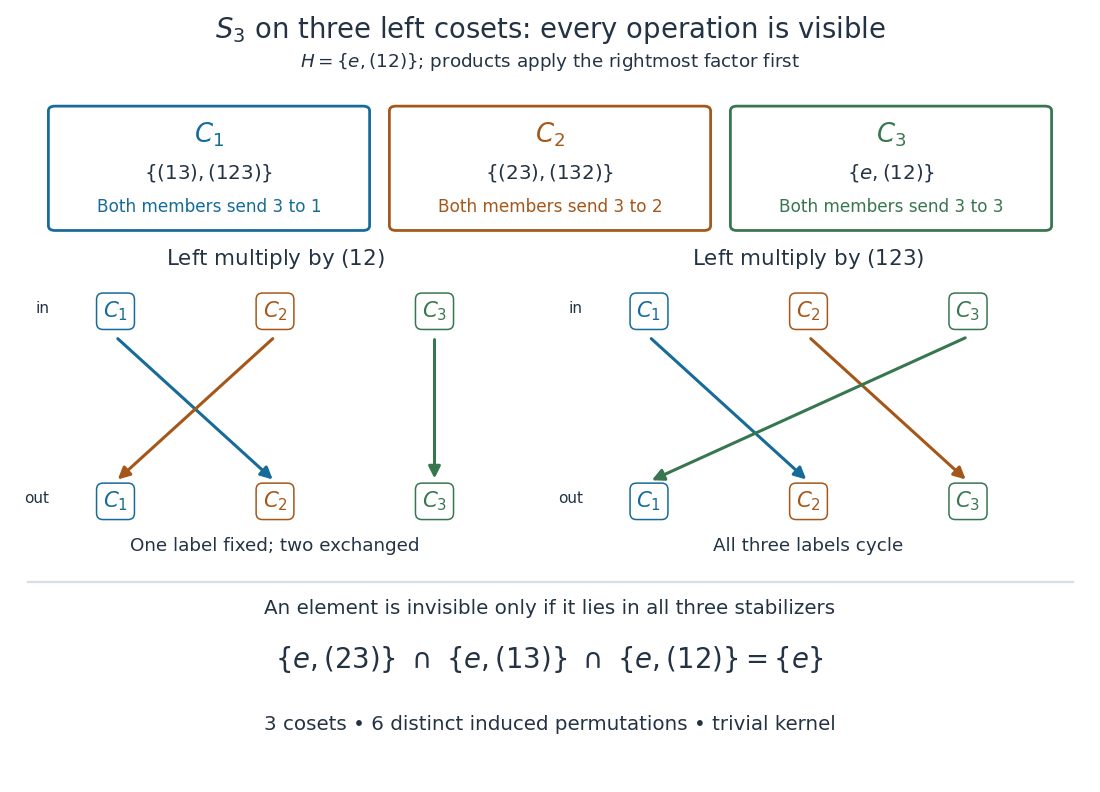

The three stabilizer subgroups areTheir intersection is , so the subgroup core and the group kernel are trivial. This proves that the coset action is a faithful group action even though every point has a nontrivial stabilizer subgroup. The orbit-stabilizer theorem reads , while the induced group homomorphism gives six distinct permutations of the three cosets. For example, and agree at , but disagree at ; inspecting one label would miss their difference.
The subgroup need not be a normal subgroup for the coset action to exist: . Here the group action is informative because the three conjugate stabilizer subgroups have no common nonidentity element. For the normal subgroup instead, nonfaithful coset action of the symmetric group on three letters shows that only the sign of a permutation survives.
Articles by others on the same topic
There are currently no matching articles.