An ellipse is a shape that can be defined in several ways in mathematics and geometry. Here are some key points about ellipses: 1. **Geometric Definition**: An ellipse is the set of all points in a plane where the sum of the distances from two fixed points (called foci) is constant. This characteristic gives rise to its elongated circular shape.
Articles by others on the same topic

An ellipse is the locus of points whose Euclidean distances from two fixed foci of a conic have constant sum . If the distance between the foci of a conic is , the semi-major and semi-minor axes are and . Writing gives the conventional relation .[ref]
10.1 The Ellipse. Precalculus 2e, §10.1, ellipse definition and Deriving the Equation of an Ellipse Centered at the Origin, Figure 5
For an original calculation, choose , , and hence . The ellipsehas foci of a conic and . The point lies on it since . Its focal distances areIts eccentricity of a conic is . The matching directrix of a conic for is , and the perpendicular distance from to that straight line is . Therefore the ratio of focal distance to directrix distance is , agreeing with .
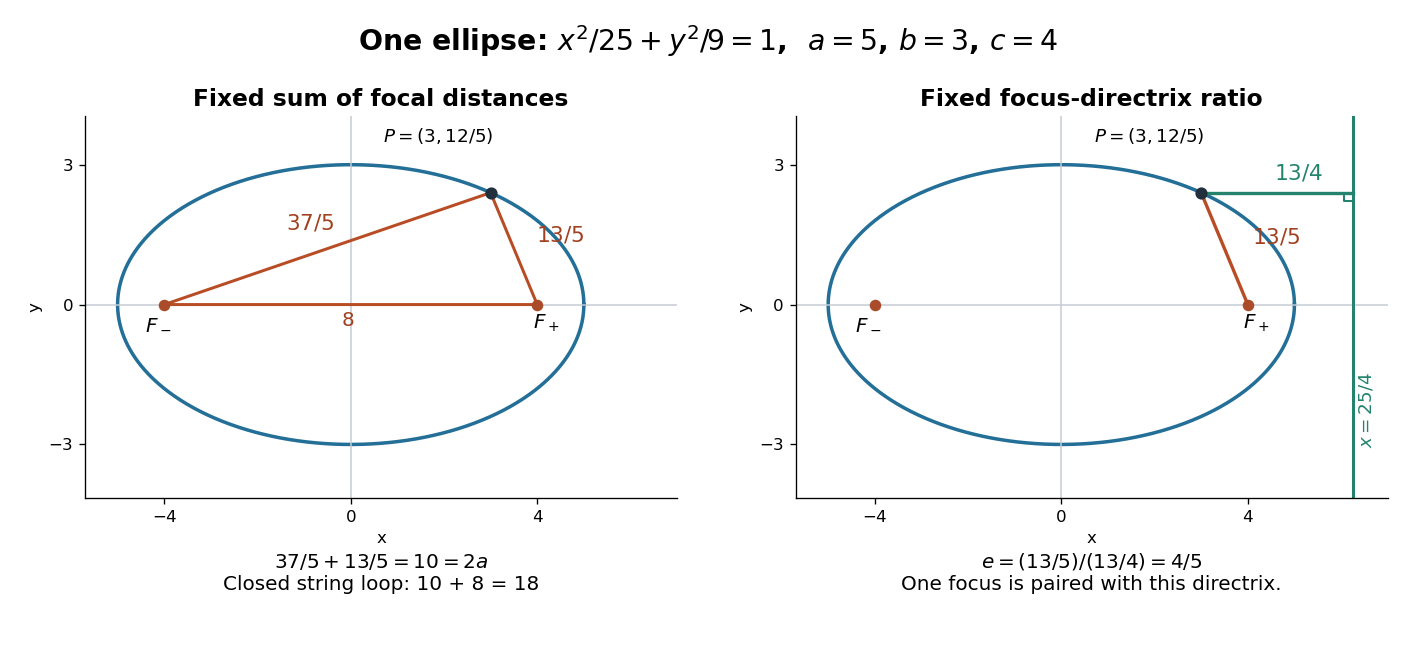

The constant sum can be turned into a construction. Fix a pin at each focus of a conic and pull a closed string loop taut with a pencil. In this example the segment between the pins has length , so a loop of length leaves for the two pencil-to-pin segments. Moving the pencil while keeping that loop taut traces the ellipse. This is a geometric prediction from the length constraint, not an assertion about a measured drawing.
The parametrization , maps the unit circle onto this ellipse. It makes plotting easy, but is an affine map rather than an isometry: horizontal and vertical lengths have different scale factors. An ellipse is not a circle under the original Euclidean metric merely because this map exists. Its two semiaxes and eccentricity of a conic retain the metric information lost by that equivalence.
A useful proof outline begins with . Isolate one square root, square, and then repeat; the resulting quadratic equation is . Since , the quantities isolated before squaring have the required signs, so the reverse implication introduces no extra branch. The condition is essential: at equality the focal-distance locus becomes the line segment between the foci of a conic.