Articles by others on the same topic

A real-valued function that is continuous on a nonempty compact space attains both a global minimum and a global maximum. In particular, for a continuous function on a nonempty closed interval, there are points such thatThe important word is “attains”: the best values occur at actual allowed inputs, rather than merely being approached. The interval version is [ref].
For a worked example, take on . Its global minimum is , and its global maximum is . Nonnegativity gives the first answer; on the specified closed interval gives the second. The endpoint is essential: looking only for a zero derivative would find the minimum and miss the maximum.
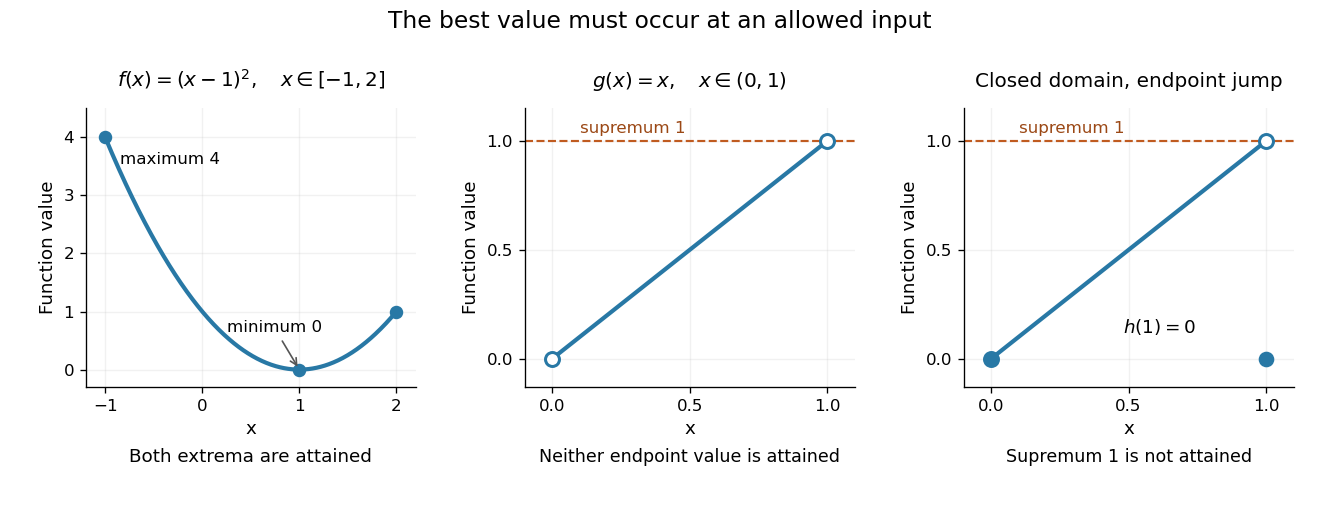
An attained minimum and maximum on a closed interval, compared with excluded endpoints and a discontinuous endpoint value
. Details. 
For comparison, the continuous function on the open interval has infimum and supremum , but neither is a value of . Even a closed domain is insufficient without continuity: define for , and . On , its supremum is , approached by for , but every function value is strictly less than . This endpoint change makes discontinuous, preventing attainment. On the unbounded real line, the continuous function has neither a global minimum nor a global maximum. These examples show what can fail when a hypothesis is dropped; functions outside the hypotheses may still have extrema.
The extreme value theorem is an existence tool for optimization: first establish that a continuous objective function on a nonempty compact feasible set has a best value, then investigate where it occurs. It neither locates the optimizing point nor promises uniqueness or differentiability. For example, the absolute value function on has its global minimum at zero although no derivative exists there; a constant function has every input as a minimizer. This role in optimization is explained in University of Toronto MAT237 notes, section 1.4: compactness and the extreme value theorem.
A short proof outline identifies the mechanism. The continuous image of a compact space is compact; a nonempty compact subset of the real line contains its infimum and supremum. For a closed interval, one can instead choose inputs whose outputs approach the supremum, extract a convergent subsequence by the Bolzano-Weierstrass theorem, and use continuity to make its limiting output equal that supremum. The closed interval retains the limiting input. Repeating the argument for the infimum supplies the minimum.