Gibbs free energy, often denoted as \( G \), is a thermodynamic potential that measures the maximum reversible work obtainable from a system at constant temperature and pressure. It is a crucial concept in chemistry and thermodynamics as it helps determine the spontaneity of processes and the equilibrium position of reactions. The Gibbs free energy is defined by the following equation: \[ G = H - TS \] where: - \( G \) is the Gibbs free energy.
Articles by others on the same topic

The Gibbs free energy iswhere is enthalpy. For a closed system of fixed composition, with only pressure-volume work, spontaneous relaxation at fixed temperature and pressure cannot increase ; stable thermodynamic equilibrium minimizes it over the allowed states. A loaded piston can move while maintaining the imposed pressure, so the enthalpy term includes the displacement cost. Along a smooth equilibrium branch of fixed composition,Thus its temperature slope at fixed pressure is , while its pressure slope at fixed temperature is . See MIT 5.60, Lecture 13, Gibbs free energy and its derivatives.
Consider two illustrative thermodynamic phases, A and B, of the same substance at one fixed pressure. Write B minus A, using quantities per mole:Treat these differences as approximately constant over a limited temperature window. ThenAt , , so A is preferred. At , , so B is preferred. At , both have equal molar Gibbs free energy, permitting phase coexistence in this bulk model. B's greater entropy outweighs its greater enthalpy above the crossing.
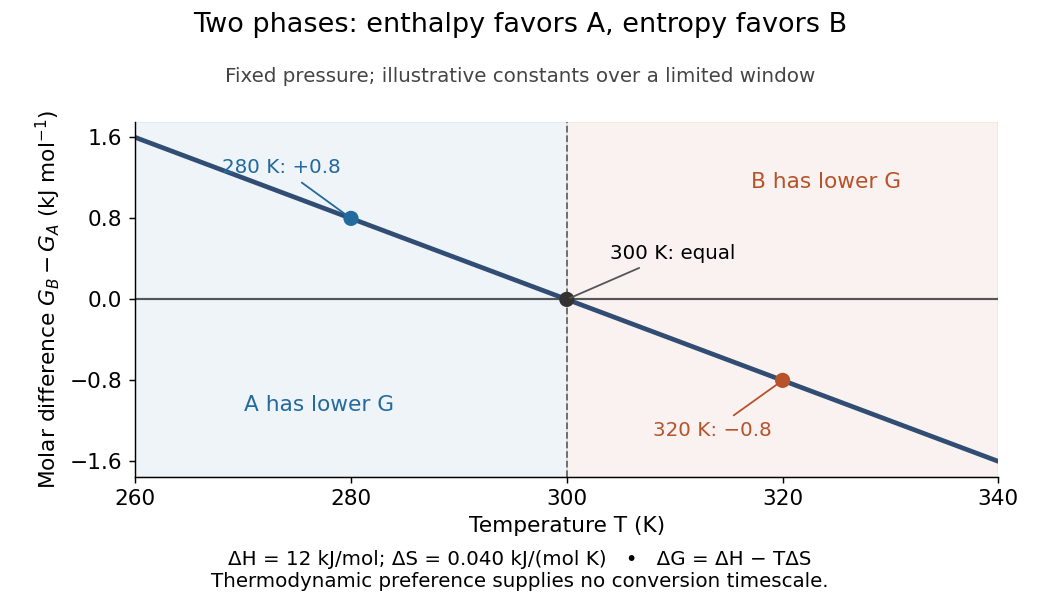
Each plotted point compares alternatives at the same temperature; moving along the curve changes the imposed temperature. The model predicts preference, not instantaneous conversion: nucleation barriers can sustain metastability. Real enthalpy and entropy differences generally vary with temperature through heat capacities, bending this line outside the approximation.
At fixed pressure, the first law of thermodynamics gives under the stated work restriction, so the same thermal reservoir accounting yields . Variable composition restores to ; constrained Gibbs minimization for chemical equilibrium handles those permitted changes.
The historical foundation is Gibbs's [ref]
https://en.wikisource.org/wiki/Scientific_Papers_of_Josiah_Willard_Gibbs,_Volume_1/Chapter_IIIa. On the Equilibrium of Heterogeneous Substances, first part completed in 1876, continued in 1878
. Its equations (87) and (91) introduce the combinations now called Helmholtz free energy and Gibbs free energy, connecting entropy criteria, chemical potentials and phase coexistence within one framework.

At least from the formula we see that:
- the more exothermic, the more likely it is to occur
- if the entropy increases, the higher the temperature, the more likely it is to occur
- otherwise, the lower the temperature the more likely it is to occur
A prototypical example of reaction that is exothermic but does not happen at any temperature is combustion.
Lab 7 - Gibbs Free Energy by MJ Billman (2020)
Source. Shows the shift of equilibrium due to temperature change with a color change in a HCl CoCl reaction. Unfortunately there are no conclusions because its student's homework.