A **normal subgroup** is a special type of subgroup in the context of group theory, which is a branch of abstract algebra. Let's define it more precisely. Given a group \( G \) and a subgroup \( N \) of \( G \): 1. **Subgroup**: A subgroup \( N \) must itself be a group under the operation defined on \( G \).
Articles by others on the same topic

A subgroup is a normal subgroup when for every . In other words, conjugation by any group element preserves the subgroup as a set, although it may exchange its individual elements. Equivalently, for every : the left and right cosets of agree. Write .
Every subgroup of an abelian group is a normal subgroup, because conjugation fixes each element. Normality can also hold in a nonabelian group: in , the three even permutations form the alternating group , a normal subgroup as the group kernel of the sign of a permutation. Its two cosets separate the even and odd permutations.
In contrast, is a subgroup of but is not a normal subgroup. With function composition of permutations acting rightmost first, choose . Thenwhich are different cosets. Also , directly contradicting invariance under conjugation. Thus a subgroup alone does not suffice for quotient group multiplication.
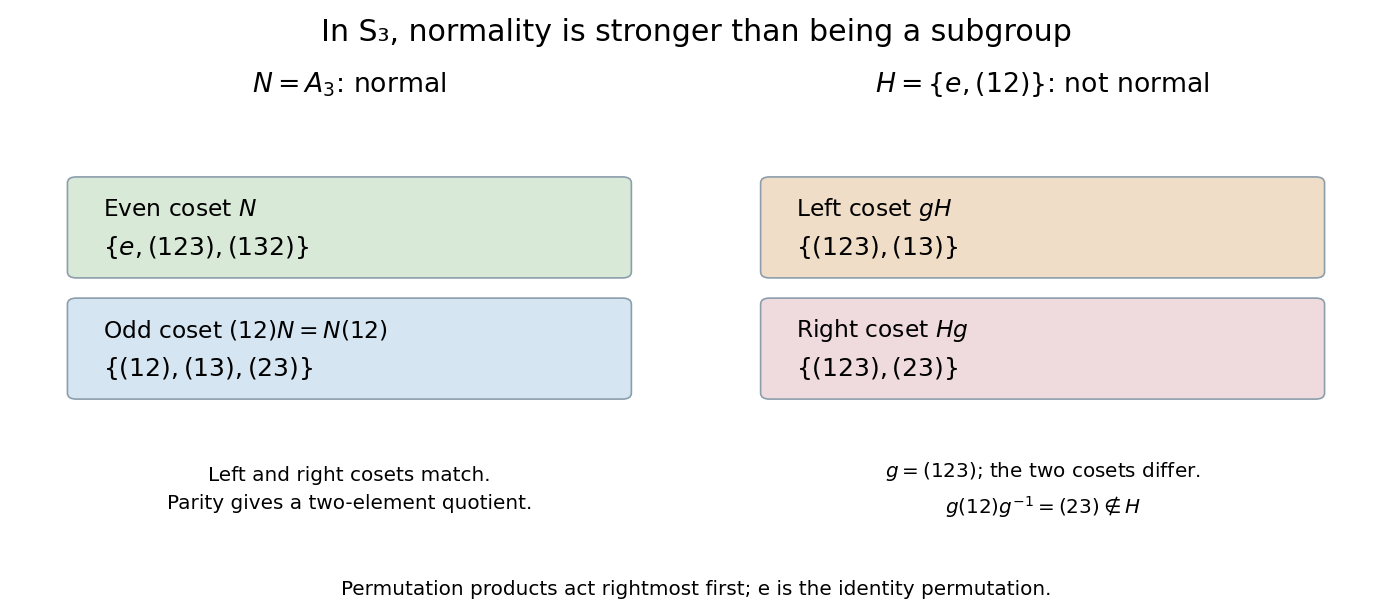
A normal subgroup gives matching left and right cosets, while a nonnormal subgroup can give different ones
. Details. The practical value of normality is coset multiplication is well-defined exactly for normal subgroups. Each coset can act as one element of a quotient group, with results independent of representatives. Conversely every normal subgroup is the group kernel of its quotient map of groups, so normality also identifies which distinctions a group homomorphism can consistently forget.


Ultimate explanation: math.stackexchange.com/questions/776039/intuition-behind-normal-subgroups/3732426#3732426
Only normal subgroups can be used to form quotient groups: their key definition is that they plus their cosets form a group.
One key intuition is that "a normal subgroup is the kernel" of a group homomorphism, and the normal subgroup plus cosets are isomorphic to the image of the isomorphism, which is what the fundamental theorem on homomorphisms says.
Therefore "there aren't that many group homomorphism", and a normal subgroup it is a concrete and natural way to uniquely represent that homomorphism.
The best way to think about the, is to always think first: what is the homomorphism? And then work out everything else from there.