Articles by others on the same topic

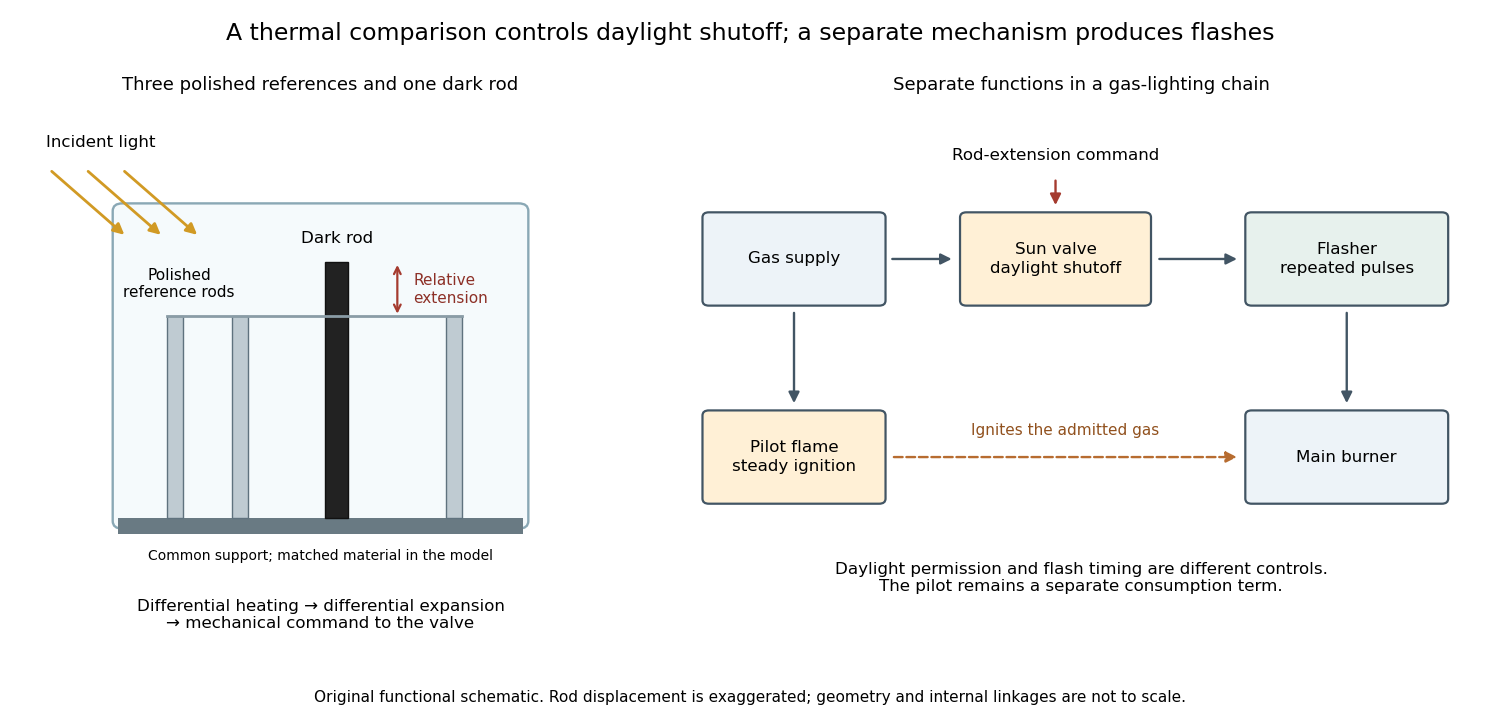
A sun valve automatically restricts a gas light's supply in daylight and allows it again as illumination falls. In Gustaf Dalén's design, a blackened rod and three polished rods respond differently to sunlight. Their relative thermal expansion operates the gas valve through a membrane; a pilot flame permits relighting. The museum dates this design to 1907.[ref]
Gustaf Dalén – Beacon Lighting by Tekniska museet. Sun valve: date, black rod, three polished rods, membrane and daylight/night operation
The useful comparison is between two thermal responses. Both kinds of rod expand when warmed; a dark surface can absorb more incident radiant power, so its temperature rises more. Comparing their extensions can reject a common ambient-temperature change while responding to illumination. The mechanism converts light into heat, heat into a difference of length, and that difference into a change of gas flow. Differential thermal model of a sun valve makes those assumptions quantitative.