A system of linear equations is a collection of two or more linear equations that involve the same set of variables. The goal is to find the values of these variables that satisfy all the equations in the system simultaneously. Systems of linear equations can be classified based on their number of solutions: 1. **Consistent and Independent**: The system has exactly one solution. The lines represented by the equations intersect at a single point.
Articles by others on the same topic

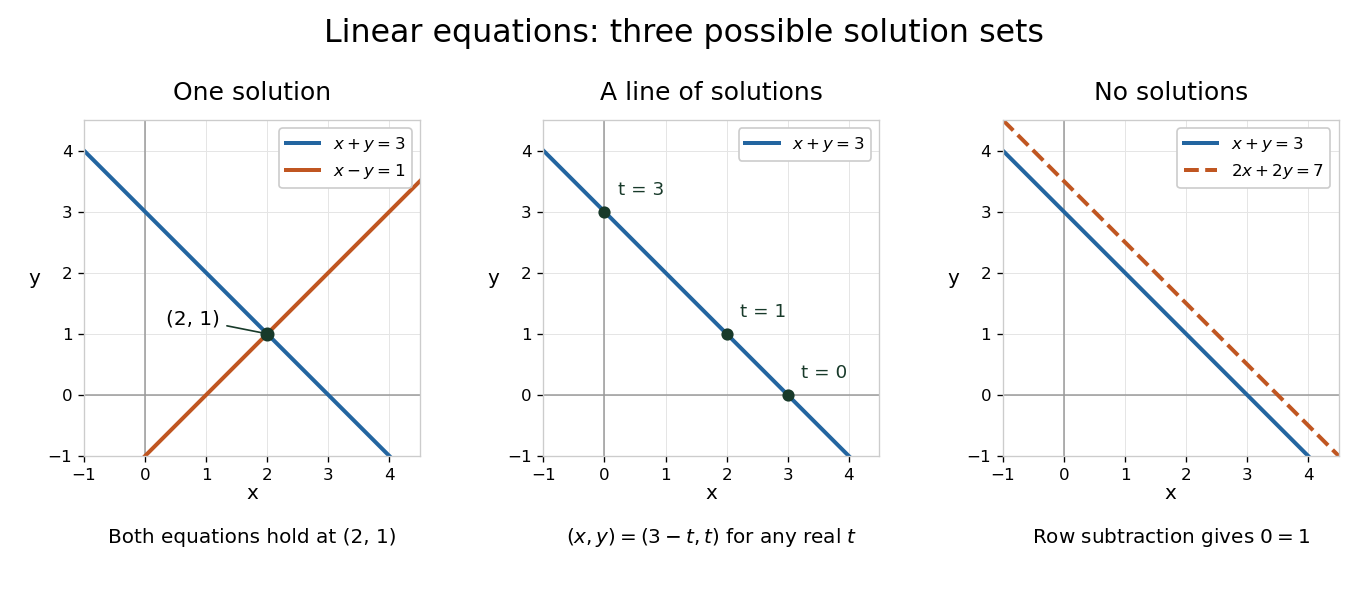
A system of linear equations imposes several linear equations on the same unknowns. In the compact form , the matrix contains their coefficients, the vector contains the unknowns, and the vector contains the required outputs. Over the real numbers, the following examples exhibit the three possible outcomes: one solution, infinitely many solutions, or no solution.
For and , adding the two linear equations gives , hence and . Each linear equation describes a line in the plane; the two lines meet only at . Substitution checks both requirements: and . The two measurements together determine both unknowns.
Keeping only leaves a whole line of solutions:For instance, gives . The direction belongs to the kernel of the linear map : its two contributions cancel. Moving in that direction changes the unknowns without changing their measured sum. The solution line is an affine space, translated away from the origin.
For and , the second linear equation instead demands . The parallel lines never meet. In the augmented matrix, subtracting twice the first row from the second is an elementary row operation that exposes the contradiction:The last row says . A zero row of coefficients is harmless only when its appended entry is also zero.
The column viewpoint unifies these pictures. If are the columns of , then : a linear combination of those columns. A linear system is consistent precisely when lies in the column space, the image of a linear map represented by . Once one solution is known, every solution is with , since . Conversely, subtracting any two solutions gives an element of the kernel. Thus the kernel measures freedom, while the image of a linear map decides existence. A consistent linear system has a unique solution exactly when its kernel is .[ref]
Counting linear equations alone does not tell us how much information is present. If the second requirement were , it would repeat , so the two linear equations would still leave the same solution line. The matrix rank counts independent requirements. For a consistent linear system with unknowns and matrix rank , the rank-nullity theorem gives as the dimension of the kernel. This is the number of independent directions in which a solution can move. In the single-measurement example, one measured combination leaves one direction of freedom; in the sum-and-difference example, neither unknown can change without changing an output.

