Topics (206k) Articles (211k) Users (295) Discussions (237) Comments (383) Files (715) New article
The half-life of radioactive decay, which as discovered a few years before quantum mechanics was discovered and matured, was a major mystery. Why do some nuclei fission in apparently random fashion, while others don't? How is the state of different nuclei different from one another? This is mentioned in Inward Bound by Abraham Pais (1988) Chapter 6.e Why a half-life?
The term also sees use in other areas, notably biology, where e.g. RNAs spontaneously decay as part of the cell's control system, see e.g. mentions in E. Coli Whole Cell Model by Covert Lab.
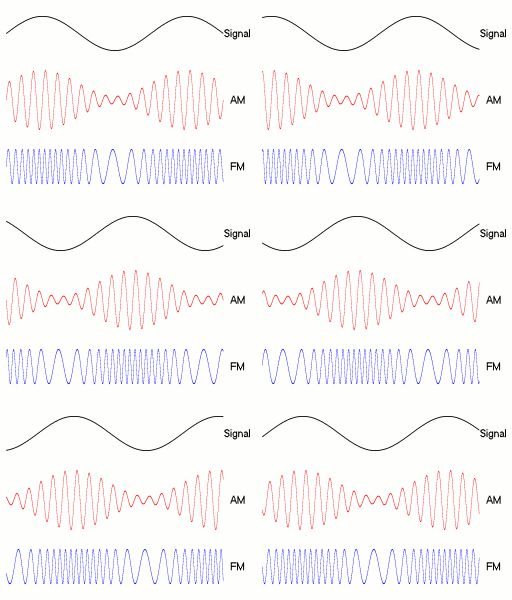
But now people want to send voice. How to do it?
It would not be practical without modulation: Why can't you send voice without modulation?
The mantra of the computer simulation engineer.
Amazingly confirms the wave particle duality of quantum mechanics.
The effect is even more remarkable when done with individual particles such individual photons or electrons.
Richard Feynman liked to stress how this experiment can illustrate the core ideas of quantum mechanics. Notably, he night have created the infinitely many slits thought experiment which illustrates the path integral formulation.
Quantum version of the Hall effect.
As you increase the magnetic field, you can see the Hall resistance increase, but it does so in discrete steps.

Gotta understand this because the name sounds cool. Maybe also because it is used to define the fucking ampere in the 2019 redefinition of the SI base units.
At least the experiment description itself is easy to understand. The hard part is the physical theory behind.
The effect can be separated into two modes:
- Integer quantum Hall effect: easier to explain from first principles
- Fractional quantum Hall effect: harder to explain from first principles
- Fractional quantum Hall effect for : 1998 Nobel Prize in Physics
- Fractional quantum Hall effect for : one of the most important unsolved physics problems as of 2023
Introductory Quantum Mechanics by Richard Fitzpatrick (2020) by  Ciro Santilli 40 Updated 2025-07-16
Ciro Santilli 40 Updated 2025-07-16This LibreTexts book does have some interest!
MIT 8.06 Quantum Physics III, Spring 2018 by Barton Zwiebach by Ciro Santilli 40 Updated 2025-07-16
Ciro Santilli 40 Updated 2025-07-16Instructor: Barton Zwiebach.
Free material from university courses:
- physics.weber.edu/schroeder/quantum/QuantumBook.pdf (archive) "Notes on Quantum Mechanics" pusbliehd by Daniel V. Schroeder (2019) The author is from from Weber State University.
Pinned article: Introduction to the OurBigBook Project
Welcome to the OurBigBook Project! Our goal is to create the perfect publishing platform for STEM subjects, and get university-level students to write the best free STEM tutorials ever.
Everyone is welcome to create an account and play with the site: ourbigbook.com/go/register. We belive that students themselves can write amazing tutorials, but teachers are welcome too. You can write about anything you want, it doesn't have to be STEM or even educational. Silly test content is very welcome and you won't be penalized in any way. Just keep it legal!
Intro to OurBigBook
. Source. We have two killer features:
- topics: topics group articles by different users with the same title, e.g. here is the topic for the "Fundamental Theorem of Calculus" ourbigbook.com/go/topic/fundamental-theorem-of-calculusArticles of different users are sorted by upvote within each article page. This feature is a bit like:
- a Wikipedia where each user can have their own version of each article
- a Q&A website like Stack Overflow, where multiple people can give their views on a given topic, and the best ones are sorted by upvote. Except you don't need to wait for someone to ask first, and any topic goes, no matter how narrow or broad
This feature makes it possible for readers to find better explanations of any topic created by other writers. And it allows writers to create an explanation in a place that readers might actually find it.
Figure 1. Screenshot of the "Derivative" topic page. View it live at: ourbigbook.com/go/topic/derivativeVideo 2. OurBigBook Web topics demo. Source. - local editing: you can store all your personal knowledge base content locally in a plaintext markup format that can be edited locally and published either:This way you can be sure that even if OurBigBook.com were to go down one day (which we have no plans to do as it is quite cheap to host!), your content will still be perfectly readable as a static site.
- to OurBigBook.com to get awesome multi-user features like topics and likes
- as HTML files to a static website, which you can host yourself for free on many external providers like GitHub Pages, and remain in full control

Figure 2. You can publish local OurBigBook lightweight markup files to either OurBigBook.com or as a static website.
Figure 3. Visual Studio Code extension installation.
Figure 5. . You can also edit articles on the Web editor without installing anything locally. Video 3. Edit locally and publish demo. Source. This shows editing OurBigBook Markup and publishing it using the Visual Studio Code extension. 
- Infinitely deep tables of contents:




All our software is open source and hosted at: github.com/ourbigbook/ourbigbook
Further documentation can be found at: docs.ourbigbook.com
Feel free to reach our to us for any help or suggestions: docs.ourbigbook.com/#contact