Topics (266k) Articles (272k) Users (338) Discussions (237) Comments (383) Files (2k) New article
CIA 2010 covert communication websites 2013 DNS Census virtual host cleanup by  Ciro Santilli 40 Updated 2025-07-16
Ciro Santilli 40 Updated 2025-07-16We've noticed that often when there is a hit range:and that this does not seem to be that common. Let's see if that is a reasonable fingerprint or not.
- there is only one IP for each domain
- there is a range of about 20-30 of those
Note that although this is the most common case, we have found multiple hits that viewdns.info maps to the same IP.
First we create a table The
u (unique) that only have domains which are the only domain for an IP, let's see by how much that lowers the 191 M total unique domains:time sqlite3 u.sqlite 'create table t (d text, i text)'
time sqlite3 av.sqlite -cmd "attach 'u.sqlite' as u" "insert into u.t select min(d) as d, min(i) as i from t where d not like '%.%.%' group by i having count(distinct d) = 1"not like '%.%.%' removes subdomains from the counts so that CGI comms are still included, and distinct in count(distinct is because we have multiple entries at different timestamps for some of the hits.Let's start with the 208 subset to see how it goes:OK, after we fixed bugs with the above we are down to 4 million lines with unique domain/IP pairs and which contains all of the original hits! Almost certainly more are to be found!
time sqlite3 av.sqlite -cmd "attach 'u.sqlite' as u" "insert into u.t select min(d) as d, min(i) as i from t where i glob '208.*' and d not like '%.%.%' and (d like '%.com' or d like '%.net') group by i having count(distinct d) = 1"This data is so valuable that we've decided to upload it to: archive.org/details/2013-dns-census-a-novirt.csv Format:The numbers of the first column are the IPs as a 32-bit integer representation, which is more useful to search for ranges in.
8,chrisjmcgregor.com
11,80end.com
28,fine5.net
38,bestarabictv.com
49,xy005.com
50,cmsasoccer.com
80,museemontpellier.net
100,newtiger.com
108,lps-promptservice.com
111,bridesmaiddressesshow.comTo make a histogram with the distribution of the single hostname IPs:Which gives the following useless noise, there is basically no pattern: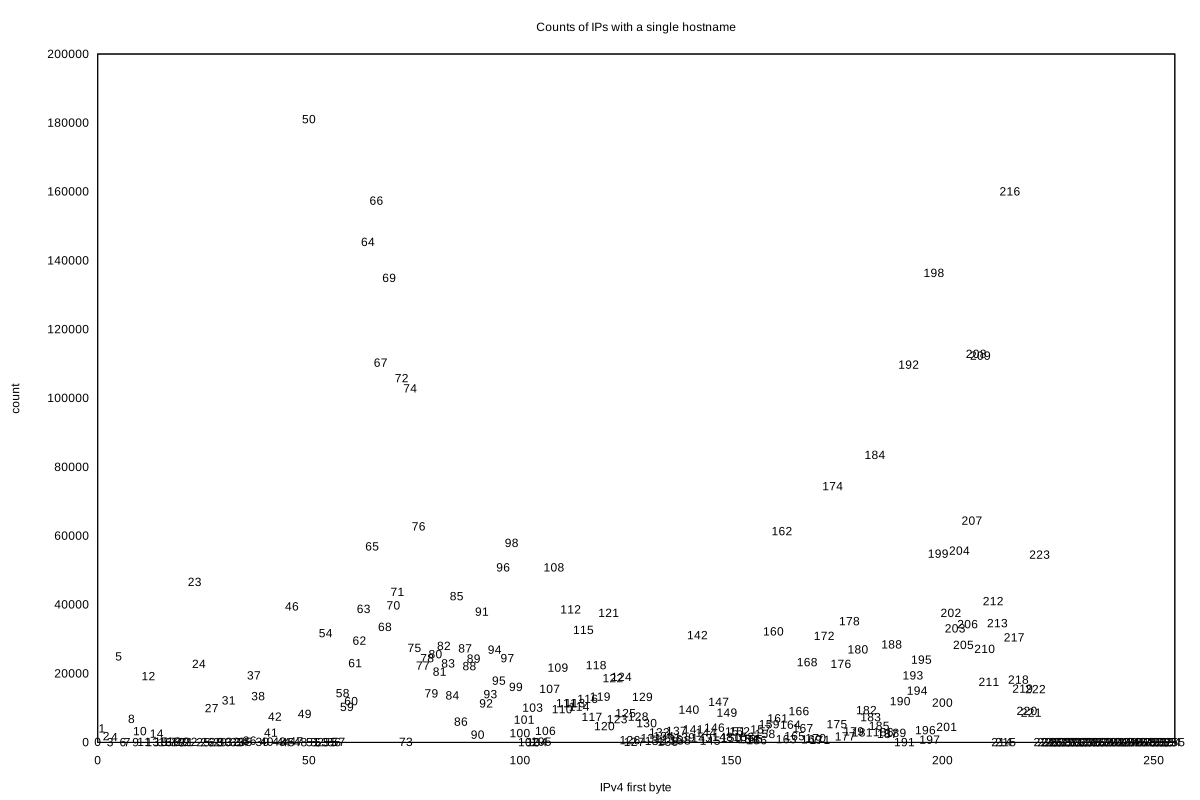
#!/usr/bin/env bash
bin=$((2**24))
sqlite3 2013-dns-census-a-novirt.sqlite -cmd '.mode csv' >2013-dns-census-a-novirt-hist.csv <<EOF
select i, sum(cnt) from (
  select floor(i/${bin}) as i,
         count(*) as cnt
    from t
    group by 1
  union
  select *, 0 as cnt from generate_series(0, 255)
)
group by i
EOF
gnuplot \
  -e 'set terminal svg size 1200, 800' \
  -e 'set output "2013-dns-census-a-novirt-hist.svg"' \
  -e 'set datafile separator ","' \
  -e 'set tics scale 0' \
  -e 'unset key' \
  -e 'set xrange[0:255]' \
  -e 'set title "Counts of IPs with a single hostname"' \
  -e 'set xlabel "IPv4 first byte"' \
  -e 'set ylabel "count"' \
  -e 'plot "2013-dns-census-a-novirt-hist.csv" using 1:2:1 with labels' \
;The CGI comms websites contain the only occurrence of HTTPS, so it might open up the door for a certificate fingerprint as proposed by user joelcollinsdc at: news.ycombinator.com/item?id=36280801!
crt.sh appears to be a good way to look into this:They all appear to use either of:
- backstage.musical-fortune.net:
- clients.smart-travel-consultant.com
- members.it-proonline.com
- members.metanewsdaily.com
- miembros.todosperuahora.com
- secure.altworldnews.com
- secure.driversinternationalgolf.com
- secure.freshtechonline.com
- secure.globalnewsbulletin.com
- secure.negativeaperture.com
- secure.riskandrewardnews.com
- secure.theworld-news.net
- secure.topbillingsite.com
- secure.worldnewsandent.com
- ssl.beyondnetworknews.com
- ssl.newtechfrontier.com
- www.businessexchangetoday.com
- heal.conquermstoday.com
- Go Daddy
- Thawte DV SSL CA
- Starfield Technologies, Inc.
crt.sh/?q=globalnewsbulletin.com has a hit to: crt.sh/?id=774803. With login we can see: search.censys.io/certificates/5078bce356a8f8590205ae45350b27f58f4ac04478ed47a389a55b539065cee8. Issued by www.thawte.com/repository/index.html. No hits for certificates with same public key: search.censys.io/search?resource=certificates&q=parsed.subject_key_info.fingerprint_sha256%3A+714b4a3e8b2f555d230a92c943ced4f34b709b39ed590a6a230e520c273705af or any other "same" queries though.
Let's try another one for secure.altworldnews.com: search.censys.io/certificates/e88f8db87414401fd00728db39a7698d874dbe1ae9d88b01c675105fabf69b94. Nope, no direct mega hits here either.
Later on, we've also come across some stylistic hits in IP ranges with apparent slight variations of the CGI comms pattern:
Since these are so rare, it is still a bit hard to classify them for sure, but they are of great interest no doubt, as as we start to notice these patterns more tend to come if it is a thing.
They can't even make this basic stuff just work!
By default, the setup runs on CPU only, not GPU, as could be seen by running htop. But by the magic of PyTorch, modifying the program to run on the GPU is trivial:and leads to a faster runtime, with less
cat << EOF | patch
diff --git a/run.py b/run.py
index 104d363..20072d1 100644
--- a/run.py
+++ b/run.py
@@ -24,7 +24,8 @@ data_test = MNIST('./data/mnist',
 data_train_loader = DataLoader(data_train, batch_size=256, shuffle=True, num_workers=8)
 data_test_loader = DataLoader(data_test, batch_size=1024, num_workers=8)

-net = LeNet5()
+device = 'cuda'
+net = LeNet5().to(device)
 criterion = nn.CrossEntropyLoss()
 optimizer = optim.Adam(net.parameters(), lr=2e-3)

@@ -43,6 +44,8 @@ def train(epoch):
     net.train()
     loss_list, batch_list = [], []
     for i, (images, labels) in enumerate(data_train_loader):
+        labels = labels.to(device)
+        images = images.to(device)
         optimizer.zero_grad()

         output = net(images)
@@ -71,6 +74,8 @@ def test():
     total_correct = 0
     avg_loss = 0.0
     for i, (images, labels) in enumerate(data_test_loader):
+        labels = labels.to(device)
+        images = images.to(device)
         output = net(images)
         avg_loss += criterion(output, labels).sum()
         pred = output.detach().max(1)[1]
@@ -84,7 +89,7 @@ def train_and_test(epoch):
     train(epoch)
     test()

-    dummy_input = torch.randn(1, 1, 32, 32, requires_grad=True)
+    dummy_input = torch.randn(1, 1, 32, 32, requires_grad=True).to(device)
     torch.onnx.export(net, dummy_input, "lenet.onnx")

     onnx_model = onnx.load("lenet.onnx")
EOFuser as now we are spending more time on the GPU than CPU:real 1m27.829s
user 4m37.266s
sys 0m27.562s
Note that:
- the images must be drawn with white on black. If you use black on white, it the accuracy becomes terrible. This is a good very example of brittleness in AI systems!
- images must be converted to 32x32 for
lenet.onnx, as that is what training was done on. The training step converted the 28x28 images to 32x32 as the first thing it does before training even starts
We can try the code adapted from thenewstack.io/tutorial-using-a-pre-trained-onnx-model-for-inferencing/ at lenet/infer.py:and it works pretty well! The program outputs:as desired.
cd lenet
cp ~/git/LeNet-5/lenet.onnx .
wget -O 9.png https://raw.githubusercontent.com/cirosantilli/media/master/Digit_9_hand_drawn_by_Ciro_Santilli_on_GIMP_with_mouse_white_on_black.png
./infer.py 9.png9We can also try with images directly from Extract MNIST images.and the accuracy is great as expected.
infer_mnist.py lenet.onnx mnist_png/out/testing/1/*.pngThey actually have two The Oxford Student and Cherwell. As brilliantly highlighted in this first of April piece:
Related:
- www.thestudentroom.co.uk/showthread.php?t=1167619 "OxStu vs. Cherwell"
E.g.: thecollegestore.co.uk/products/ladies-oxford-college-puffer-jacket?variant=40590030864549 Black with 5 rows, on left chest "colege name", logo, "Oxford", and right chest optional initials (or sometimes other identifiers/nicknames) to help distinguish from all the other people's identical clothes.
This has a whitelabel version: www.workweargiant.co.uk/product/result-urban-holkham-down-feel-jacket/, the name appears to be "Holkham Down Feel Jacket".
If you look 20 and wear one of those, it's almost an ID, you can get anywhere that does not require a key card, porters won't look at you twice!
- www.oxfordstudent.com/2019/03/25/in-opposition-to-stash/ In opposition to stash by Morgan Jones (2019), basically because university is your last chance to wear what you want on many professions.
Bibliography:
Like the U.S.' summer term.
E-learning system prior to Canvas: weblearn.ox.ac.uk/portal. Appears fully custom and closed source?
Like the U.S.' spring term.
Pinned article: Introduction to the OurBigBook Project
Welcome to the OurBigBook Project! Our goal is to create the perfect publishing platform for STEM subjects, and get university-level students to write the best free STEM tutorials ever.
Everyone is welcome to create an account and play with the site: ourbigbook.com/go/register. We belive that students themselves can write amazing tutorials, but teachers are welcome too. You can write about anything you want, it doesn't have to be STEM or even educational. Silly test content is very welcome and you won't be penalized in any way. Just keep it legal!
Intro to OurBigBook
. Source. We have two killer features:
- topics: topics group articles by different users with the same title, e.g. here is the topic for the "Fundamental Theorem of Calculus" ourbigbook.com/go/topic/fundamental-theorem-of-calculusArticles of different users are sorted by upvote within each article page. This feature is a bit like:
- a Wikipedia where each user can have their own version of each article
- a Q&A website like Stack Overflow, where multiple people can give their views on a given topic, and the best ones are sorted by upvote. Except you don't need to wait for someone to ask first, and any topic goes, no matter how narrow or broad
This feature makes it possible for readers to find better explanations of any topic created by other writers. And it allows writers to create an explanation in a place that readers might actually find it.
Figure 1. Screenshot of the "Derivative" topic page. View it live at: ourbigbook.com/go/topic/derivativeVideo 2. OurBigBook Web topics demo. Source. - local editing: you can store all your personal knowledge base content locally in a plaintext markup format that can be edited locally and published either:This way you can be sure that even if OurBigBook.com were to go down one day (which we have no plans to do as it is quite cheap to host!), your content will still be perfectly readable as a static site.
- to OurBigBook.com to get awesome multi-user features like topics and likes
- as HTML files to a static website, which you can host yourself for free on many external providers like GitHub Pages, and remain in full control

Figure 2. You can publish local OurBigBook lightweight markup files to either OurBigBook.com or as a static website.
Figure 3. Visual Studio Code extension installation.
Figure 5. . You can also edit articles on the Web editor without installing anything locally. Video 3. Edit locally and publish demo. Source. This shows editing OurBigBook Markup and publishing it using the Visual Studio Code extension. 
- Infinitely deep tables of contents:


All our software is open source and hosted at: github.com/ourbigbook/ourbigbook
Further documentation can be found at: docs.ourbigbook.com
Feel free to reach our to us for any help or suggestions: docs.ourbigbook.com/#contact