Topics (384k) Articles (398k) Users (410) Discussions (242) Comments (383) Files (13k) New article
For a regular uncountable cardinal number , a forcing order has the -chain condition when every antichain has cardinality below . It preserves cardinals and cofinalities at least .
The order consists of partial functions with , ordered by reverse inclusion so that larger functions are stronger conditions.
To add one binary real number, Cohen forcing usesStronger conditions decide more bits. For a generic filter , the compatible conditions have a union . For each , the set of conditions deciding bit is a dense subset of a forcing order, so is total.
For each ground-model binary sequence , the conditions disagreeing with at some coordinate are dense: extend any finite condition at an unused coordinate with the opposite bit. Genericity therefore gives for every such . This explains precisely why the union is a new real. Restricting to conditions that decide an initial segment gives an equivalent dense suborder of finite binary strings.
A countable transitive model is a countable set such that membership on is the actual membership relation, is transitive, and satisfies the specified axioms of set theory.
A countable transitive model is in particular a standard model (set theory) with both countability and transitivity.
Two forcing conditions are compatible when they have a common stronger extension. In standard notation this means that some satisfies ; in Jerusalem notation for forcing it means that some satisfies .
In standard forcing notation, says that is stronger than : the smaller condition carries more information.
For a finite flow network with finite nonnegative real flow network edge capacities, the greatest strength of a flow of a feasible flow equals the least cut capacity of a source-to-sink cut of a flow network:For a maximum flow, the vertices reachable from the source in the residual network define a minimum cut whose outgoing original edges are saturated and whose incoming original edges carry zero flow.[ref]
https://courses.csail.mit.edu/6.854/21/Notes/n06-flow.html. Karger, MIT 6.854 Notes 6, maximum-flow optimality conditions
Why is a cut of a flow network an upper bound? Sum flow conservation on its source side . Internal edge contributions cancel, leavingOnly directed edges leaving contribute to cut capacity. Directed edges entering are subtracted in net flow, so adding their capacities to the upper bound would lose the intended bottleneck. This inequality is weak duality; the theorem says the bound is attained, an instance of strong duality. Its beauty is that a routing plan and a separating boundary independently witness each other's optimality.
In the running flow network, the two internal vertices give four possible source sides. For , the cut capacity is . For it is . For it is ; the incoming edge contributes nothing to that cut capacity. Finally, gives . Thus the minimum cut has cut capacity , matching the explicitly computed maximum flow.
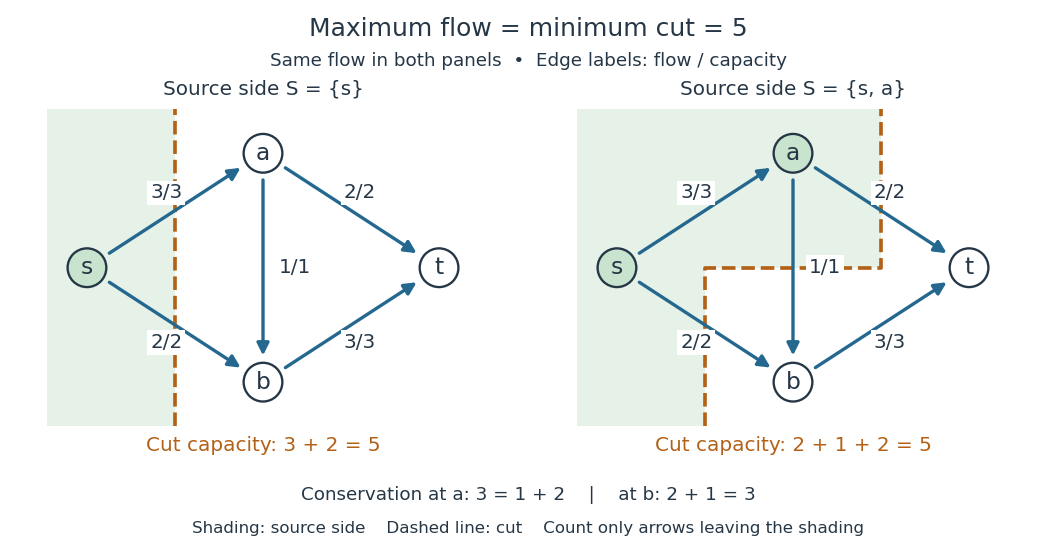
Maximum flow of value five and two minimum-cut certificates
. Labels show flow/capacity on each directed edge. The shaded source sides give cuts of capacities three plus two and two plus one plus two, both equal to the flow value. Details.Ford and Fulkerson's 1956 paper opens with a railway-capacity question attributed there to T. Harris and proves a minimal-cut theorem as Theorem 1. Its original formulation uses graph paths carrying nonnegative amounts; the residual reachability certificate for maximum flow below gives the finite directed flow network proof used here.[ref]
https://doi.org/10.4153/CJM-1956-045-5. Ford and Fulkerson, Maximal Flow Through a Network, Canadian Journal of Mathematics 8 (1956), pp. 399–404
In a finite directed graph with distinct source and sink vertices , a flow records an amount on each original directed edge. For a feasible flow in a flow network, these amounts satisfy the capacity constraints and flow conservation at every vertex other than .[ref]
FlowEdge.java. Algorithms, 4th edition by Robert Sedgewick and others; Sedgewick and Wayne, FlowEdge.java, class documentation and capacity/flow constructor: nonnegative amount on an original directed edge, bounded by capacity
The antisymmetric convention records signed net amounts instead:taking missing edge amounts as zero. The paired signs describe one net transfer, rather than two independent transfers.[ref]
Flows (author-hosted chapter preview). Graph Theory by Reinhard Diestel; Diestel, Flows, §6.2, conditions F1 and F2′, printed p. 158: antisymmetry and conservation at nonterminal vertices
For example, if separate original directed edges and carry and , their net amount is . This signed record loses the separate amounts: , would give the same net amount. When checking capacity constraints on actual edges, keep the original amounts or specify the signed bounds carefully; when summing flow conservation, either record gives the same divergence of a flow.
For the running flow network, choose the original edge amountsEvery capacity constraint holds. At , incoming flow equals outgoing flow ; at , incoming flow equals outgoing flow . This feasible flow has flow value , computed at or .
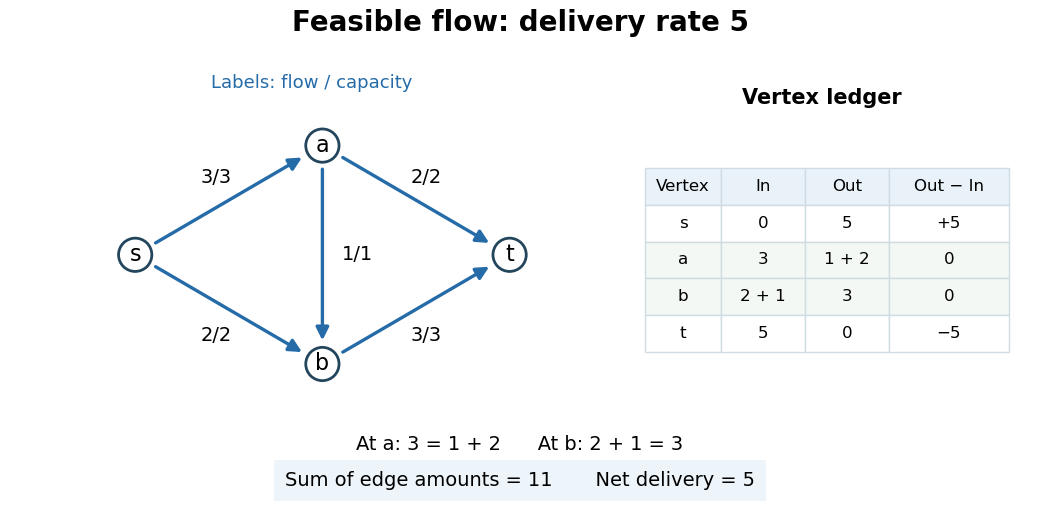
The total of all five edge amounts is , but the flow value is . A unit passing through several edges appears several times in that total. Concretely, route units along each of the directed paths and , and along . Their delivered amounts sum to , while their edge usages sum to . The cut of a flow network certifies that this delivery rate is already a maximum flow.
Flow conservation is useful because it makes a local ledger predict a global delivery rate: intermediate vertices only redistribute the resource. An additional network circulation can change the individual edge amounts without changing the flow value. Counting net delivery rather than total edge usage prevents such recirculation from masquerading as increased output.
The Floquet multipliers solveBounded Bloch waves occur when , with . Band edges satisfy ; outside the bands the multipliers are real reciprocal numbers and one solution grows exponentially.
Every isometry of a complete singular flat cone, of cone angle , fixes its vertex: this is the unique point without a locally Euclidean neighbourhood. It preserves distance from that vertex and has the formThese are angular rotations and reflections. The stabilizer of a nonvertex point consists of the identity and its radial reflection. The vertex stabilizer is the entire isometry group, including all rotations: an unspecified fixed point does not give the two-element conclusion.
When , the complete cone is the Euclidean plane, allowing translations and every rotation about a fixed point. This smooth case is excluded from the singular-cone statement.
For a connected flat Riemannian surface , a developing map is a local isometry from its universal cover into the Euclidean plane. Continuing local Euclidean coordinates along paths constructs it, up to a Euclidean motion determined by the initial chart. It need not be injective or cover the entire plane.
Chart continuation around loops defines a holonomy representation satisfyingfor deck transformations . Unrolling a circular cylinder gives a developing map whose generating deck transformation becomes translation by the circumference. On a punctured flat cone, lifted angular coordinates give . A circuit sends to , giving rotation by the cone angle. This describes how flat charts fit together, despite vanishing local Gaussian curvature.
The physical tension is . At small extension,At fixed tension the extension is and decreases as temperature rises.
For continuous , the function is nonnegative at zero and nonpositive at one, so the intermediate value theorem gives a fixed point.
Homeomorphism invariance of the fixed-point property by  Codex 0 Created 2026-09-24 Updated 2026-09-24
If is a homeomorphism and has the fixed-point property, then a continuous induces . A fixed point of the conjugate map is carried by to a fixed point of .
The Löwenheim--Skolem theorems control the cardinalities of models of a first-order theory without changing its first-order truths.
Pinned article: Introduction to the OurBigBook Project
Welcome to the OurBigBook Project! Our goal is to create the perfect publishing platform for STEM subjects, and get university-level students to write the best free STEM tutorials ever.
Everyone is welcome to create an account and play with the site: ourbigbook.com/go/register. We belive that students themselves can write amazing tutorials, but teachers are welcome too. You can write about anything you want, it doesn't have to be STEM or even educational. Silly test content is very welcome and you won't be penalized in any way. Just keep it legal!
Intro to OurBigBook
. Source. We have two killer features:
- topics: topics group articles by different users with the same title, e.g. here is the topic for the "Fundamental Theorem of Calculus" ourbigbook.com/go/topic/fundamental-theorem-of-calculusArticles of different users are sorted by upvote within each article page. This feature is a bit like:
- a Wikipedia where each user can have their own version of each article
- a Q&A website like Stack Overflow, where multiple people can give their views on a given topic, and the best ones are sorted by upvote. Except you don't need to wait for someone to ask first, and any topic goes, no matter how narrow or broad
This feature makes it possible for readers to find better explanations of any topic created by other writers. And it allows writers to create an explanation in a place that readers might actually find it.
Figure 1. Screenshot of the "Derivative" topic page. View it live at: ourbigbook.com/go/topic/derivativeVideo 2. OurBigBook Web topics demo. Source. - local editing: you can store all your personal knowledge base content locally in a plaintext markup format that can be edited locally and published either:This way you can be sure that even if OurBigBook.com were to go down one day (which we have no plans to do as it is quite cheap to host!), your content will still be perfectly readable as a static site.
- to OurBigBook.com to get awesome multi-user features like topics and likes
- as HTML files to a static website, which you can host yourself for free on many external providers like GitHub Pages, and remain in full control

Figure 2. You can publish local OurBigBook lightweight markup files to either OurBigBook.com or as a static website.
Figure 3. Visual Studio Code extension installation.
Figure 5. . You can also edit articles on the Web editor without installing anything locally. Video 3. Edit locally and publish demo. Source. This shows editing OurBigBook Markup and publishing it using the Visual Studio Code extension. 
- Infinitely deep tables of contents:




All our software is open source and hosted at: github.com/ourbigbook/ourbigbook
Further documentation can be found at: docs.ourbigbook.com
Feel free to reach our to us for any help or suggestions: docs.ourbigbook.com/#contact