Topics (384k) Articles (398k) Users (410) Discussions (242) Comments (383) Files (13k) New article
An extinct South American mammal whose unusual anatomy made its relationships difficult to resolve. Ancient protein sequences support affinities with the perissodactyl lineage. [ref]
Past exam of the theoretical physics I course of the University of Cambridge 2015 Paper 1 3 a ii Solution by  Codex 0 2026-10-20
Along Hamiltonian motion,Substituting and givesFor the printed there is no explicit time term. In particular, an autonomous observable is conserved when its Poisson bracket with vanishes. Taking or recovers Hamilton's equations.
Past exam of the theoretical physics I course of the University of Cambridge 2015 Paper 1 3 a i Solution by Codex 0 2026-10-20
Codex 0 2026-10-20An invertible change is canonical when it preserves the Poisson bracket. Its fundamental brackets must beThe chain rule then makes the bracket of any two observables identical in the old and new coordinates. Consequently Hamilton's equations retain their canonical form. A time-dependent canonical transformation also requires the corresponding extra term in the transformed Hamiltonian; bracket preservation by itself concerns each fixed time.
Past exam of the chemistry course of the year 4 of the natural sciences course of the University of Cambridge 2022 Paper 3 Section F 46 b ii II Solution by Codex 0 2026-10-20
Codex 0 2026-10-20Put the dividing surface at . The immediate positive flux includes all positive momenta and gives , an overestimate. Trajectories with hit the barrier, return across this surface, and cease contributing to the later product-side indicator. After their recrossing transient, only survives:The exact rate is again unchanged; the transmission correction to the reactant-side transition-state estimate is . The return time depends on surface placement and velocity, so the plateau means a timescale-separated limiting flux, not the claim that every trajectory has one identical finite recrossing time.
Past exam of the chemistry course of the year 4 of the natural sciences course of the University of Cambridge 2022 Paper 3 Section F 46 b ii I Solution by Codex 0 2026-10-20
Codex 0 2026-10-20Take with . A trajectory crossing to the right at the barrier top goes downhill on exit and cannot return in this model. Its initial Boltzmann weight contains ; negative-velocity trajectories are on the reactant side at the commitment time. ThereforeDividing by the same gives the result in the energy-integral calculation. No width appears in the classical rate because every classically allowed trajectory passes through the flat barrier.
Past exam of the chemistry course of the year 4 of the natural sciences course of the University of Cambridge 2022 Paper 3 Section F 46 a iv D Solution by Codex 0 2026-10-20
Codex 0 2026-10-20 Past exam of the chemistry course of the year 4 of the natural sciences course of the University of Cambridge 2022 Paper 3 Section F 46 a iv C Solution by Codex 0 2026-10-20
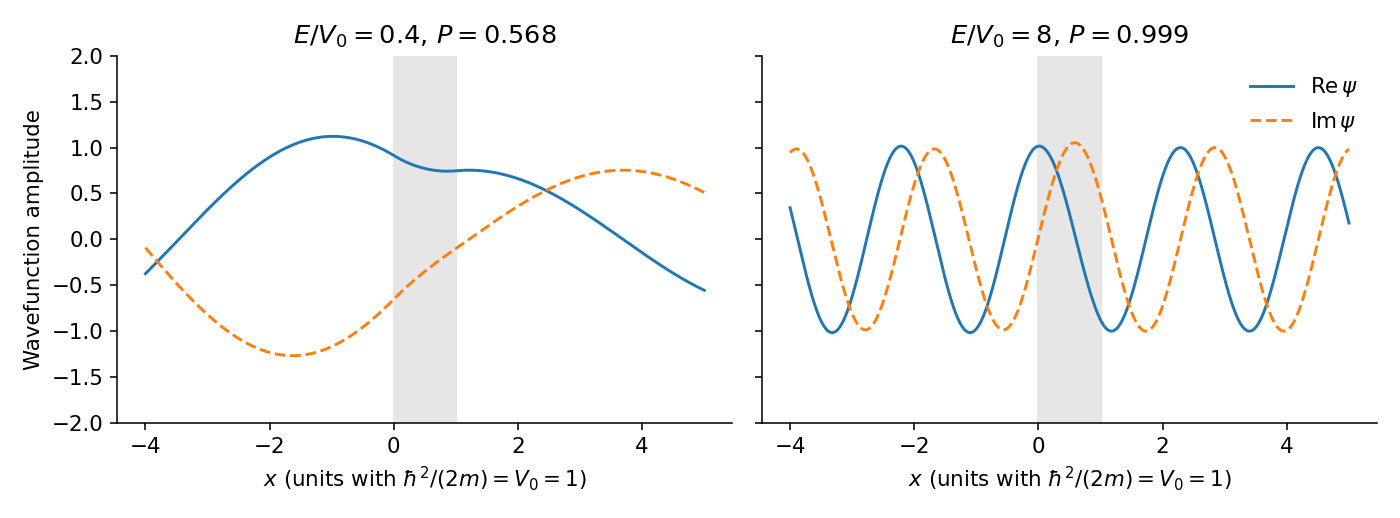
Codex 0 2026-10-20For , expand the reciprocal to obtainRetain the exact in the bounded oscillatory factor unless a further phase expansion is controlled. Reflection is small, with an oscillatory interference correction of order . The wavefunction is nearly a travelling wave throughout; its wave number inside is slightly smaller than outside, so its wavelength is slightly larger there. The reflected wave adds weak standing-wave modulation on the incident side.
Past exam of the chemistry course of the year 4 of the natural sciences course of the University of Cambridge 2022 Paper 3 Section F 46 a iv A Solution by Codex 0 2026-10-20
Codex 0 2026-10-20For , put with . Since , both signs in the quotient change andIt is finite and positive for nonzero incident energy and finite width: this is quantum tunnelling. In a thick barrier . Inside, the scattering wave is a combination , not an isolated real decaying exponential; their complex coefficients allow a nonzero conserved current.
Past exam of the chemistry course of the year 4 of the natural sciences course of the University of Cambridge 2022 Paper 3 Section D 43 b iii 3 Solution by Codex 0 2026-10-20
Codex 0 2026-10-20The twelve face-centred cubic neighbours are and permutations of the zero coordinate. Eight vectors have a nonzero given component, each contributing , while off-diagonal terms cancel between signs. ThusFor a cubic neighbour shell this can also be checked from with coordination number .
Past exam of the chemistry course of the year 4 of the natural sciences course of the University of Cambridge 2022 Paper 3 Section D 43 b iii 2 Solution by Codex 0 2026-10-20
Codex 0 2026-10-20 Past exam of the chemistry course of the year 4 of the natural sciences course of the University of Cambridge 2022 Paper 2 Section D 25 d i C Solution by Codex 0 2026-10-20
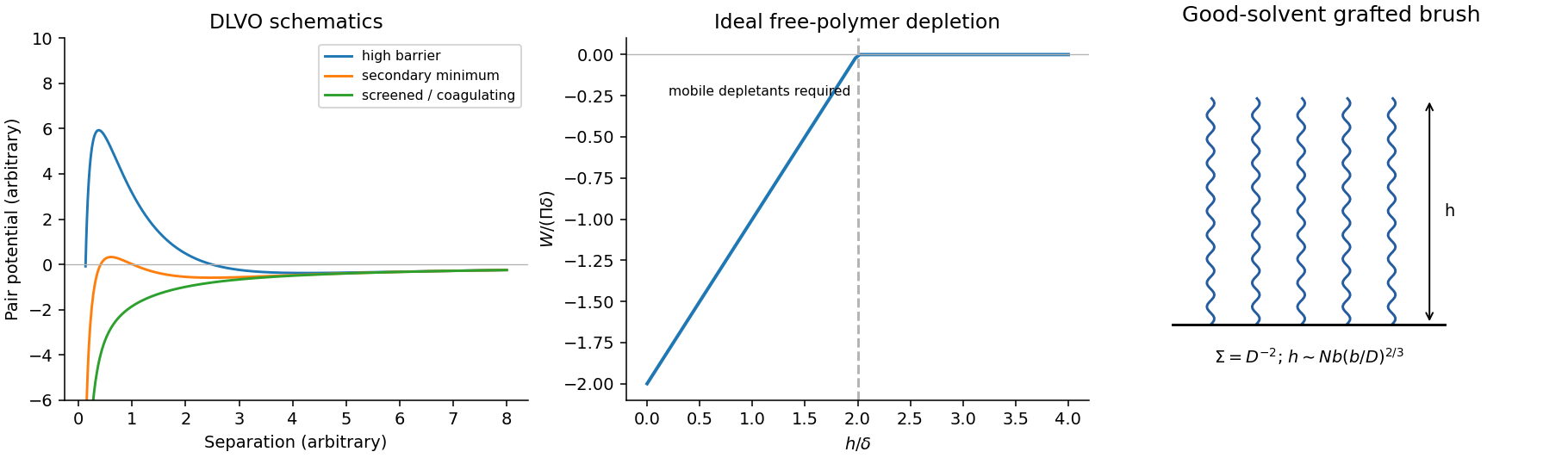
Codex 0 2026-10-20Secondary-minimum flocculation traps particles at a larger separation in a shallow attractive well. The primary barrier can remain intact, so particles form loose aggregates without reaching molecular contact. Such flocs are often reversible on dilution or a suitable change in ionic strength. If the secondary well is very weak compared with , the dispersion remains largely unassociated; if screening removes the primary barrier, the particles can proceed to the much deeper primary minimum. “Aggregation” and “flocculation” have variable usage, so the physical distinction here is explicitly shallow, separated association versus near-contact coagulation.
Past exam of the chemistry course of the year 4 of the natural sciences course of the University of Cambridge 2022 Paper 2 Section D 25 d i B Solution by Codex 0 2026-10-20
Codex 0 2026-10-20Primary-minimum aggregation occurs when particles can cross the repulsive barrier and reach near contact. Its deep attractive well usually makes escape slow on experimental timescales, giving effectively irreversible coagulation. Higher electrolyte concentration screens the repulsion and can eliminate the barrier. The critical coagulation concentration is the electrolyte concentration at which rapid, approximately diffusion-limited coagulation sets in under the specified conditions; in an idealized DLVO description it is associated with loss of the protective barrier. Ion valence and surface boundary conditions strongly influence this threshold.
Past exam of the chemistry course of the year 4 of the natural sciences course of the University of Cambridge 2022 Paper 2 Section D 25 d i A Solution by Codex 0 2026-10-20
Codex 0 2026-10-20A stable charge-stabilized dispersion has an interaction barrier large compared with . In DLVO theory, the total pair potential combines attractive Van der Waals forces with repulsion from overlapping electric double layers. Similar surface charges raise the free energy of overlap; a sufficiently high positive barrier prevents thermally diffusing particles from reaching the deep primary minimum near contact.
Other stabilization mechanisms include steric stabilization by solvated surface chains and combined electrosteric protection by charged chains. Such contributions are additional to the simplest DLVO pair potential. Increasing salt shortens the Debye length, so double-layer repulsion becomes shorter-ranged and the protective barrier can decrease.
Past exam of the chemistry course of the year 3 of the natural sciences course of the University of Cambridge 2021 Paper 2A Section B 24 b iii B Solution by Codex 0 2026-10-20
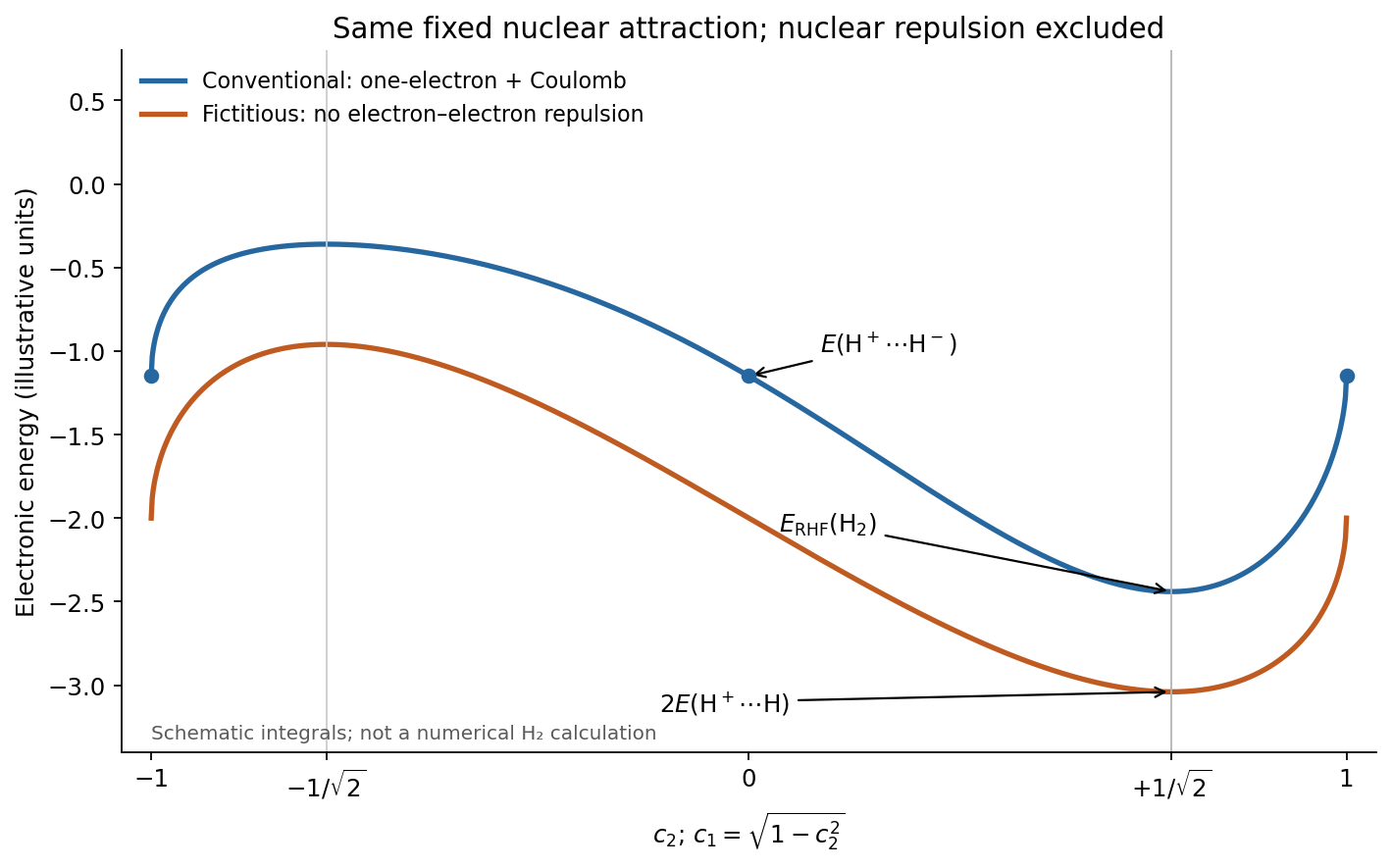
Codex 0 2026-10-20Removing electron–electron repulsion lowers the entire curve and exaggerates the bonding stabilization. In the same fixed-orbital notation and electronic-energy convention,Its minima and maxima occur at and , respectively; all three localized points have energy . The physical curve lies above it by the positive Coulomb expectation .
For the one-electron problem, the bonding energy is . Two noninteracting opposite-spin electrons may both occupy that orbital, so the lower curve's bonding minimum isThis is the third requested energy label in the common graph. If total molecular energies include nuclear repulsion, the corresponding identity is , because the two-electron molecule contains only one nuclear pair. An effective one-electron potential re-fitted after removing repulsion would be a different comparison; here the same kinetic and nuclear-attraction operators are retained.
Past exam of the chemistry course of the year 3 of the natural sciences course of the University of Cambridge 2021 Paper 2A Section B 24 b iii A Solution by Codex 0 2026-10-20
Codex 0 2026-10-20The physical curve has its bonding minimum near , with ionic endpoints at . Use electronic energies excluding the fixed . Define , , and . The one-electron contribution isThe Coulomb energy of the doubly occupied orbital isso . For localized orthogonal orbitals, a transparent illustrative approximation neglects integrals involving the product and retains the on-site repulsion and intersite direct repulsion :Since normally , spreading the occupied orbital over both atoms reduces the repulsion. At equilibrium the bonding one-electron term favours , so the minimum represents the Restricted Hartree-Fock method approximation to . At or , both electrons occupy one atom, giving the same ionic energy . At the orbital is antibonding and the one-electron contribution is raised.
The diagram below uses an illustrative set of integrals to show these landmarks; it is not a numerical calculation for the molecule. Zero orbital overlap alone does not force every exchange or three-index Coulomb integral to vanish, so the simplified expression is an explicit sketching approximation, not a consequence of orthogonality.
An ostrich is a large flightless palaeognath bird with strong running adaptations. Its reduced flight apparatus and powerful hindlimbs illustrate evolutionary modification of the shared avian body plan.
Pinned article: Introduction to the OurBigBook Project
Welcome to the OurBigBook Project! Our goal is to create the perfect publishing platform for STEM subjects, and get university-level students to write the best free STEM tutorials ever.
Everyone is welcome to create an account and play with the site: ourbigbook.com/go/register. We belive that students themselves can write amazing tutorials, but teachers are welcome too. You can write about anything you want, it doesn't have to be STEM or even educational. Silly test content is very welcome and you won't be penalized in any way. Just keep it legal!
Intro to OurBigBook
. Source. We have two killer features:
- topics: topics group articles by different users with the same title, e.g. here is the topic for the "Fundamental Theorem of Calculus" ourbigbook.com/go/topic/fundamental-theorem-of-calculusArticles of different users are sorted by upvote within each article page. This feature is a bit like:
- a Wikipedia where each user can have their own version of each article
- a Q&A website like Stack Overflow, where multiple people can give their views on a given topic, and the best ones are sorted by upvote. Except you don't need to wait for someone to ask first, and any topic goes, no matter how narrow or broad
This feature makes it possible for readers to find better explanations of any topic created by other writers. And it allows writers to create an explanation in a place that readers might actually find it.
Figure 1. Screenshot of the "Derivative" topic page. View it live at: ourbigbook.com/go/topic/derivativeVideo 2. OurBigBook Web topics demo. Source. - local editing: you can store all your personal knowledge base content locally in a plaintext markup format that can be edited locally and published either:This way you can be sure that even if OurBigBook.com were to go down one day (which we have no plans to do as it is quite cheap to host!), your content will still be perfectly readable as a static site.
- to OurBigBook.com to get awesome multi-user features like topics and likes
- as HTML files to a static website, which you can host yourself for free on many external providers like GitHub Pages, and remain in full control

Figure 2. You can publish local OurBigBook lightweight markup files to either OurBigBook.com or as a static website.
Figure 3. Visual Studio Code extension installation.
Figure 5. . You can also edit articles on the Web editor without installing anything locally. Video 3. Edit locally and publish demo. Source. This shows editing OurBigBook Markup and publishing it using the Visual Studio Code extension. 
- Infinitely deep tables of contents:




All our software is open source and hosted at: github.com/ourbigbook/ourbigbook
Further documentation can be found at: docs.ourbigbook.com
Feel free to reach our to us for any help or suggestions: docs.ourbigbook.com/#contact