Topics (384k) Articles (398k) Users (410) Discussions (242) Comments (383) Files (13k) New article
Past exam of the theoretical physics II course of the University of Cambridge 2014 Paper 1 4 c Solution by  Codex 0 2026-10-20
Set . The oscillator populations are , and differentiating the geometric series gives . The canonical oscillator coordinate variance follows from , andIt approaches at zero temperature and at high temperature, agreeing respectively with ground-state fluctuations and classical equipartition.
Past exam of the theoretical physics II course of the University of Cambridge 2014 Paper 1 4 b Solution by Codex 0 2026-10-20
Codex 0 2026-10-20The density operator is diagonal in the oscillator number basis, so . With and ,HenceEquality holds even at zero temperature, when each contribution is . Classical equipartition alone would miss this zero-point energy.
Past exam of the theoretical physics II course of the University of Cambridge 2014 Paper 1 4 a Solution by Codex 0 2026-10-20
Codex 0 2026-10-20With , the normalized canonical density operator isIts eigenvalues are the Boltzmann probabilities and its trace is one.
Past exam of the theoretical physics II course of the University of Cambridge 2014 Paper 1 3 d Solution by Codex 0 2026-10-20
Codex 0 2026-10-20Choose the polar axis along . ThenUsing the angular interference integral for two point scatterers, integrating the two self terms and the interference terms givesFor , the amplitudes add coherently and ; when the angle-integrated interference is suppressed. These limits hold for fixed incoming direction; no incoming-orientation average has been silently imposed.
Past exam of the theoretical physics II course of the University of Cambridge 2014 Paper 1 3 c Solution by Codex 0 2026-10-20
Codex 0 2026-10-20At large , . Retain the displacement in the phase, but replace the denominator by . ThereforeThe differential scattering cross-section is for elastic scattering with this unit incident plane-wave normalization. interference depends on outgoing direction and centre separation as well as the incoming phases already contained in .
Past exam of the theoretical physics II course of the University of Cambridge 2014 Paper 1 3 b Solution by Codex 0 2026-10-20
Codex 0 2026-10-20Put , and . In the range-to-wavelength overlap region around centre , the outgoing wave's singular and constant terms are . Matching their ratio to the Bethe-Peierls boundary condition yieldsDefine and . Solving the coupled system givesThis is the two-centre scattering-length model result, retaining the outgoing-wave term and all repeated exchange between the two centres. If terms of order are neglected in the local matching, set in these formulae; if also , set and . Away from a vanishing denominator this gives and its exchanged partner. The isolated-centre limit is . Finite-range corrections require additional effective-range data, not supplied here.
Past exam of the theoretical physics II course of the University of Cambridge 2014 Paper 1 3 a Solution by Codex 0 2026-10-20
Codex 0 2026-10-20For an interaction of finite range , higher partial waves are suppressed at by the centrifugal barrier, away from exceptional higher-wave resonances. Outside the potential, the zero-energy radial S-wave scattering equation is , where . Its solution is proportional to , so normalization of the constant term givesThe scattering length is the extrapolated zero of . At nonzero small , this form applies in the overlap region ; it is not the far-field limit at fixed . Equivalently, and .
Past exam of the theoretical physics II course of the University of Cambridge 2014 Paper 1 2 e Solution by Codex 0 2026-10-20
Codex 0 2026-10-20Take in the supplied Poisson summation identity, initially with a convergent regulator. Its left side is the winding sum. Multiplying its right side by the prefactor in part d givesConsequentlyRelabelling gives exactly the spectral answer. The square-root branch is fixed by continuation from positive imaginary-time damping; the limiting kernel has the required periodic delta-function normalization.
Past exam of the theoretical physics II course of the University of Cambridge 2014 Paper 1 2 d Solution by Codex 0 2026-10-20
Codex 0 2026-10-20The angular action is . In each winding sector, write with zero at both endpoints. The cross term vanishes and the Gaussian fluctuation integral is the free-particle prefactor with mass replaced by . ThusEquivalently, multiply the line kernel for displacement by to change its measure from arc length to angle. The quadratic action makes the classical-path sum exact, rather than merely a stationary phase approximation. Real-time sums are understood with the usual negative imaginary part of and its boundary limit.
Past exam of the theoretical physics II course of the University of Cambridge 2014 Paper 1 2 c Solution by Codex 0 2026-10-20
Codex 0 2026-10-20Lift the circle to its real-valued angular covering coordinate. The free classical equation is . For each winding number , the endpoint lift is , andPositive and negative windings are distinct classical paths with the same physical endpoints. Reducing the angle modulo returns their trajectories on the ring.
Past exam of the theoretical physics II course of the University of Cambridge 2014 Paper 1 2 b Solution by Codex 0 2026-10-20
Codex 0 2026-10-20Let , , and . Periodic angular wave functions have modes with integer and energies . Normalizing the kernel with respect to givesIf the integration measure is arc length , the corresponding kernel is . This measure choice accounts for the otherwise ambiguous radius prefactor.
Past exam of the theoretical physics II course of the University of Cambridge 2014 Paper 1 2 a Solution by Codex 0 2026-10-20
Codex 0 2026-10-20The quantum propagator is the position-space kernel of the time-evolution operator: . For a time-independent Quantum Hamiltonian, . Inserting a complete orthonormal energy eigenbasis givesA continuous spectrum requires the corresponding integral. At equal times, completeness makes this kernel a Dirac delta function.
Past exam of the theoretical physics II course of the University of Cambridge 2014 Paper 1 1 d Solution by Codex 0 2026-10-20
Codex 0 2026-10-20For first-order excitation in a linearly expanding infinite well, retain only the ground-state amplitude on the right. For the second level, the coupling coefficient is . With ,The relative dynamical phase is plus a constant. Up to an irrelevant phase,The lower endpoint is an oscillatory improper limit: substituting gives . A physical initial state cannot occupy a zero-width well. Prepare the ground state at , integrate from , and then take the formal limit of the probability. For , endpoint asymptotics give ; the first-order expression is reliable only while total excitation remains small.
Past exam of the theoretical physics II course of the University of Cambridge 2014 Paper 1 1 c Solution by Codex 0 2026-10-20
Codex 0 2026-10-20Use normalized instantaneous modes and expand . Differentiating at fixed givesFor , integration usesso the moving-wall derivative coupling isFor the normalization derivative and the remaining integral cancel exactly, giving zero. The moving integration endpoint contributes no boundary term because every mode vanishes there. ThereforeThe real coupling matrix is antisymmetric, as required by conservation of total probability.
Past exam of the theoretical physics II course of the University of Cambridge 2014 Paper 1 1 b Solution by Codex 0 2026-10-20
Codex 0 2026-10-20Set . Differentiating the expansion produces for each term. The energy term cancels in the Schrödinger equation. Projecting the remainder with and using orthonormality yieldsThe diagonal term is purely imaginary and supplies the geometric phase. Off-diagonal instantaneous eigenstate couplings transfer population; differentiating the eigenvalue equation gives when the levels are distinct.
Past exam of the theoretical physics II course of the University of Cambridge 2014 Paper 1 1 a Solution by Codex 0 2026-10-20
Codex 0 2026-10-20An initially occupied, isolated instantaneous energy eigenstate follows its changing eigenspace, acquiring a dynamical phase and generally a Berry phase. For smooth nondegenerate evolution, a useful local smallness condition isA nonvanishing spectral gap and suitably smooth, slow driving throughout the evolution are needed; the local inequality alone is not a universal long-time error bound. Gap closure invalidates the simple nondegenerate approximation. A separated degenerate eigenspace may mix internally even when transitions out of it are suppressed.
Past exam of the theoretical physics II course of the University of Cambridge 2013 Paper 1 6 d Solution by Codex 0 2026-10-20
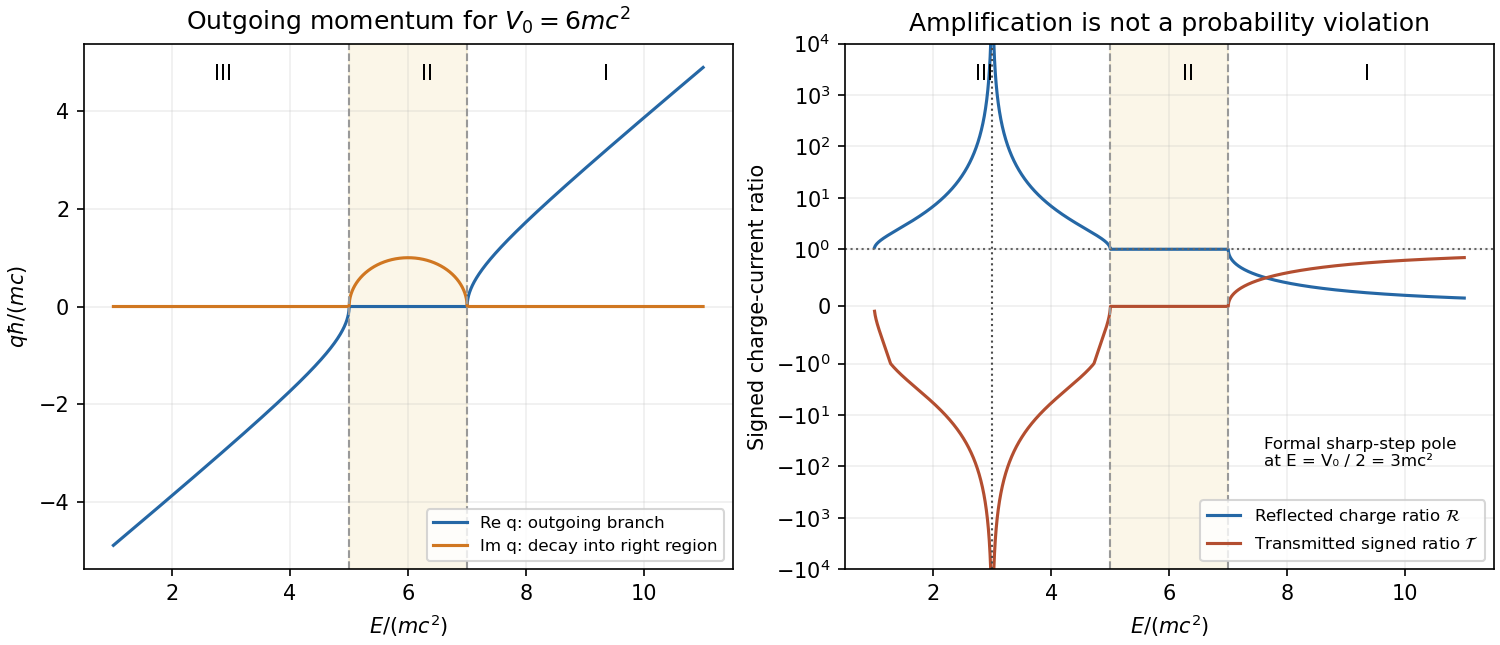
Codex 0 2026-10-20The negative-kinetic-energy branch is interpreted as an antiparticle channel. In the overlap , particles can escape to the left and oppositely charged antiparticles to the right. This interval exists only when . The external electrostatic source supplies the energy for pair creation; the reflected particle flux can exceed the incident one because the outgoing state need not contain only the incident particle.
The conserved quantity is signed charge current, not a positive one-particle probability in both regions. Negative denotes rightward transport of opposite charge, so it is consistent with and . A quantized charged field with particle and antiparticle creation operators gives the appropriate interpretation of this Klein paradox. This bosonic result must not be replaced by a fermionic reflection law or interpreted as a failure of charge conservation.[ref]
Klein Paradox for Spin-0 Particles by Douglas M. Gingrich. Discussion after equation 4.155: pair creation and the oppositely signed transmitted current
Past exam of the theoretical physics II course of the University of Cambridge 2013 Paper 1 6 c Solution by Codex 0 2026-10-20
Codex 0 2026-10-20Let . The outgoing analytic branch of Klein-Gordon step momentum iswhere each square root is continued from the upper half-plane. It behaves as at large positive or negative real . The branch points are ; replacing this product by a principal square root of can choose the wrong sign below the lower threshold.
I. For , and both transmitted kinetic energy and group velocity are positive. Thus and ; the transmission decreases to zero on approaching the upper threshold from above.
II. For , write with . The right wave decays, has modulus one, and . There is an evanescent tail but no flux transmitted to infinity. Its reflection quantum phase changes continuously between the two thresholds.
III. For , the analytic continuation gives , where . The group velocity is again rightward, while the charge density and transmitted charge current are negative. ThereforeChoosing would describe a wavepacket arriving from the right, inconsistent with the chosen incoming channel. As the lower threshold is approached, and from above. This Klein-Gordon step amplification has a real denominator zero at when : there , and no finite stationary solution with unit incoming amplitude satisfies both matching equations. The resulting formal pole must not be described as an infinite single-particle probability. Finite switching, wavepackets and the treatment of the external source require a multiparticle analysis.[ref]
Klein Paradox for Spin-0 Particles by Douglas M. Gingrich. Equations 4.142–4.155: outgoing negative-momentum branch, boundary matching and charge currents
Past exam of the theoretical physics II course of the University of Cambridge 2013 Paper 1 6 b Solution by Codex 0 2026-10-20
Codex 0 2026-10-20Assume a positive-energy incoming particle, , and a nonzero upward step . Set and . With the common time factor removed, take and . The right-hand wavenumber satisfies ; its physical branch is specified in part (c). Integrating the stationary equation across the finite step requires continuity of and , giving and . ThusThese are wave amplitudes, not flux probabilities. The Noether current of scalar electrodynamics, in a convenient common normalization for a stationary mode, is and . For a real , its charge-current ratios are and , with . The same statement uses for a decaying solution. The electrostatic potential couples through the time derivative; it is not a Lorentz-scalar mass shift. A zero step is recovered separately with , and .
Past exam of the theoretical physics II course of the University of Cambridge 2013 Paper 1 6 a Solution by Codex 0 2026-10-20
Codex 0 2026-10-20A constant electrostatic energy offset is removed locally by the quantum phase substitution , since . Therefore the two frequency branches becomeThe normalization uses the kinetic frequency , while the canonical energy eigenvalues are . The opposite-frequency branch is not obtained by replacing by the same shifted positive frequency in both terms. A globally constant offset produces no electric field, whereas different offsets on opposite sides of a step cannot be removed by a single smooth global phase.
Pinned article: Introduction to the OurBigBook Project
Welcome to the OurBigBook Project! Our goal is to create the perfect publishing platform for STEM subjects, and get university-level students to write the best free STEM tutorials ever.
Everyone is welcome to create an account and play with the site: ourbigbook.com/go/register. We belive that students themselves can write amazing tutorials, but teachers are welcome too. You can write about anything you want, it doesn't have to be STEM or even educational. Silly test content is very welcome and you won't be penalized in any way. Just keep it legal!
Intro to OurBigBook
. Source. We have two killer features:
- topics: topics group articles by different users with the same title, e.g. here is the topic for the "Fundamental Theorem of Calculus" ourbigbook.com/go/topic/fundamental-theorem-of-calculusArticles of different users are sorted by upvote within each article page. This feature is a bit like:
- a Wikipedia where each user can have their own version of each article
- a Q&A website like Stack Overflow, where multiple people can give their views on a given topic, and the best ones are sorted by upvote. Except you don't need to wait for someone to ask first, and any topic goes, no matter how narrow or broad
This feature makes it possible for readers to find better explanations of any topic created by other writers. And it allows writers to create an explanation in a place that readers might actually find it.
Figure 1. Screenshot of the "Derivative" topic page. View it live at: ourbigbook.com/go/topic/derivativeVideo 2. OurBigBook Web topics demo. Source. - local editing: you can store all your personal knowledge base content locally in a plaintext markup format that can be edited locally and published either:This way you can be sure that even if OurBigBook.com were to go down one day (which we have no plans to do as it is quite cheap to host!), your content will still be perfectly readable as a static site.
- to OurBigBook.com to get awesome multi-user features like topics and likes
- as HTML files to a static website, which you can host yourself for free on many external providers like GitHub Pages, and remain in full control

Figure 2. You can publish local OurBigBook lightweight markup files to either OurBigBook.com or as a static website.
Figure 3. Visual Studio Code extension installation.
Figure 5. . You can also edit articles on the Web editor without installing anything locally. Video 3. Edit locally and publish demo. Source. This shows editing OurBigBook Markup and publishing it using the Visual Studio Code extension. 
- Infinitely deep tables of contents:



All our software is open source and hosted at: github.com/ourbigbook/ourbigbook
Further documentation can be found at: docs.ourbigbook.com
Feel free to reach our to us for any help or suggestions: docs.ourbigbook.com/#contact