Topics (384k) Articles (398k) Users (410) Discussions (242) Comments (383) Files (13k) New article
Past exam of the chemistry course of the year 3 of the natural sciences course of the University of Cambridge 2022 Paper 3 39 e Solution by  Codex 0 2026-10-20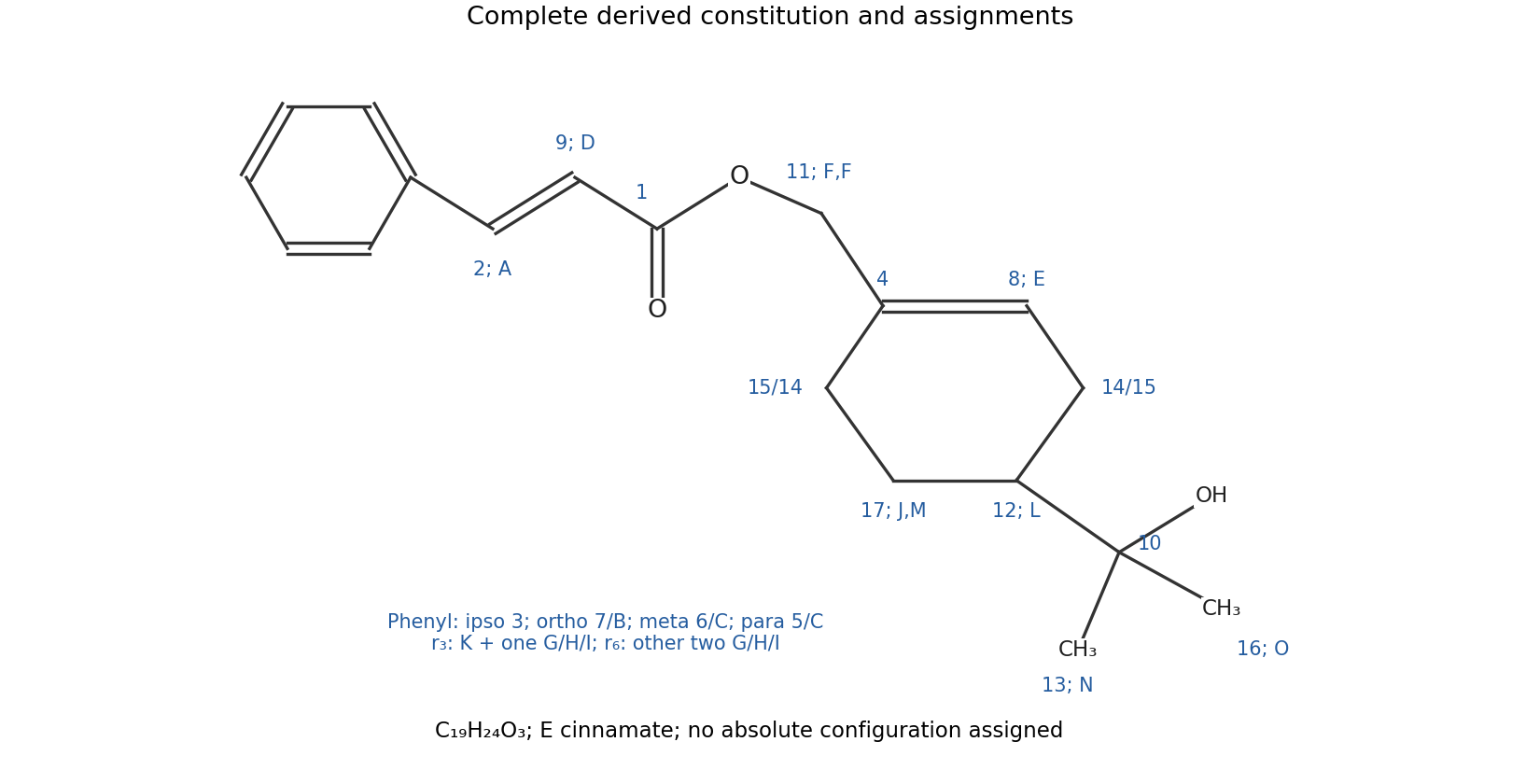
Complete constitution: cinnamoyloxymethyl at cyclohexene position 1 and a tertiary-alcohol substituent at position 4
. Details. The constitution is [4-(2-hydroxypropan-2-yl)cyclohex-1-en-1-yl]methyl (E)-3-phenylprop-2-enoate, with absolute configuration at the saturated substituted ring carbon unspecified.
The OCH side chain is attached to the unprotonated alkene carbon 4: F correlates through the ring junction to the alkene carbons and an allylic methylene, while its correlation to 1 fixes the ester linkage. The side chain is attached to methine carbon 12, as shown by the methyl-to-12 HMBC correlations and the contiguous ring COSY network.
The formula check gives 19 carbons and 24 hydrogens including OH. Its degree of unsaturation is eight: four from phenyl, one ester carbonyl, one cinnamate C=C, one cyclohexene C=C and one ring. No additional double bond or hidden second carbonyl is needed.
Past exam of the chemistry course of the year 3 of the natural sciences course of the University of Cambridge 2022 Paper 3 39 d Solution by Codex 0 2026-10-20
Codex 0 2026-10-20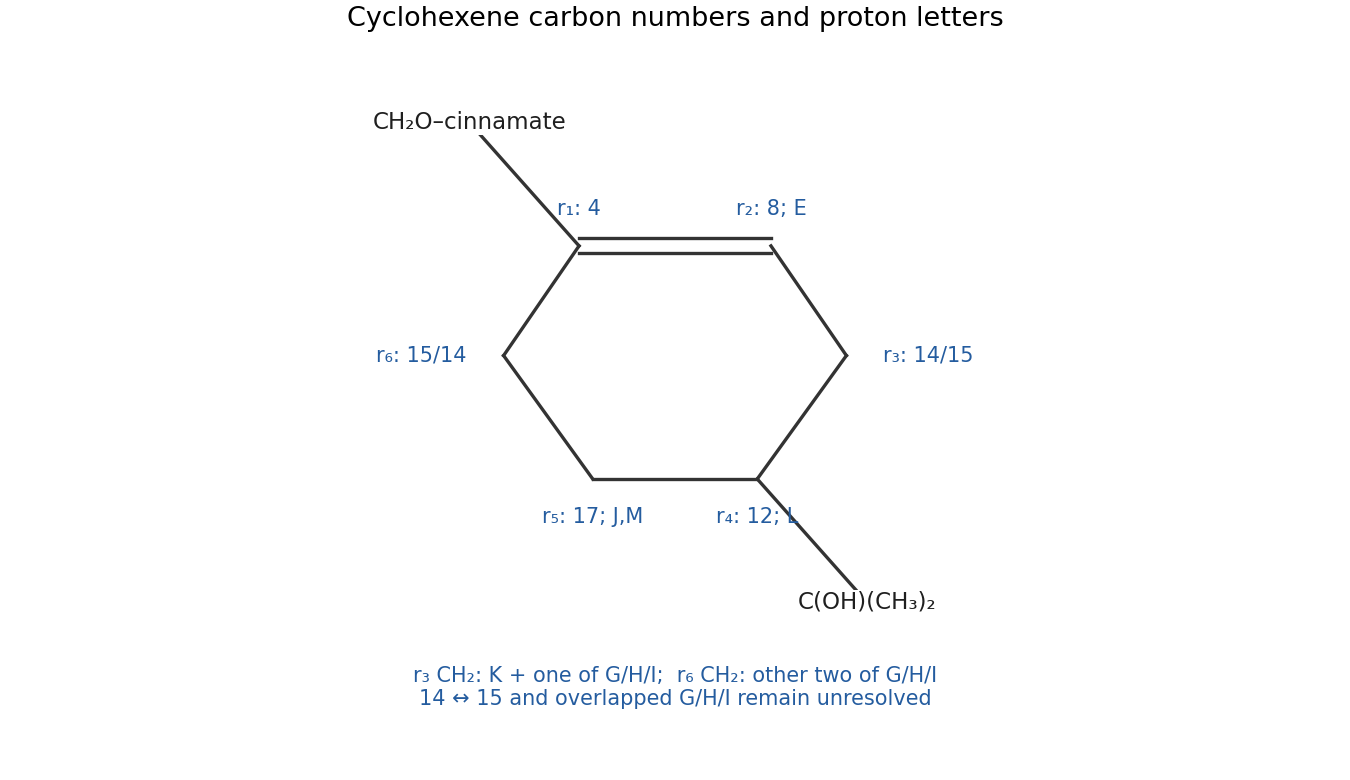
Cyclohexene assignments with explicit ambiguity for the overlapping allylic methylenes
. Details. Number ring positions through around the ring, with the double bond. These auxiliary ring-position labels are distinct from the printed carbon-signal numbers.
- : quaternary alkene carbon 4, attached to the OCH side chain.
- : alkene CH 8, proton E.
- : allylic CH, one of carbon signals 14/15; its protons are K and one of G/H/I.
- : methine 12, proton L, attached to the tertiary-alcohol carbon 10.
- : CH 17, protons J and M.
- : the other allylic CH 15/14, carrying the remaining two of G/H/I.
The HSQC pairs J and M with 17 and places L on 12. It also places K and one unresolved member of G/H/I on one of the closely spaced allylic carbons, with the other two G/H/I protons on the other. COSY connects the vinylic E to the adjacent allylic part and connects the methine L to its neighboring methylenes; HMBC links F to the substituted alkene end and the gem-dimethyl group to the methine end.
The printed overlap does not justify a unique assignment of every G/H/I letter or a forced 14-versus-15 assignment to those two ring positions. The drawing retains those alternatives explicitly. In the half-chair, L is pseudoaxial; the resolved large/small couplings are consistent with pseudoaxial/pseudoequatorial methylene partners, but exact axial letter labels within the overlapped group remain uncertain.
Past exam of the chemistry course of the year 3 of the natural sciences course of the University of Cambridge 2022 Paper 3 39 c Solution by Codex 0 2026-10-20
Codex 0 2026-10-20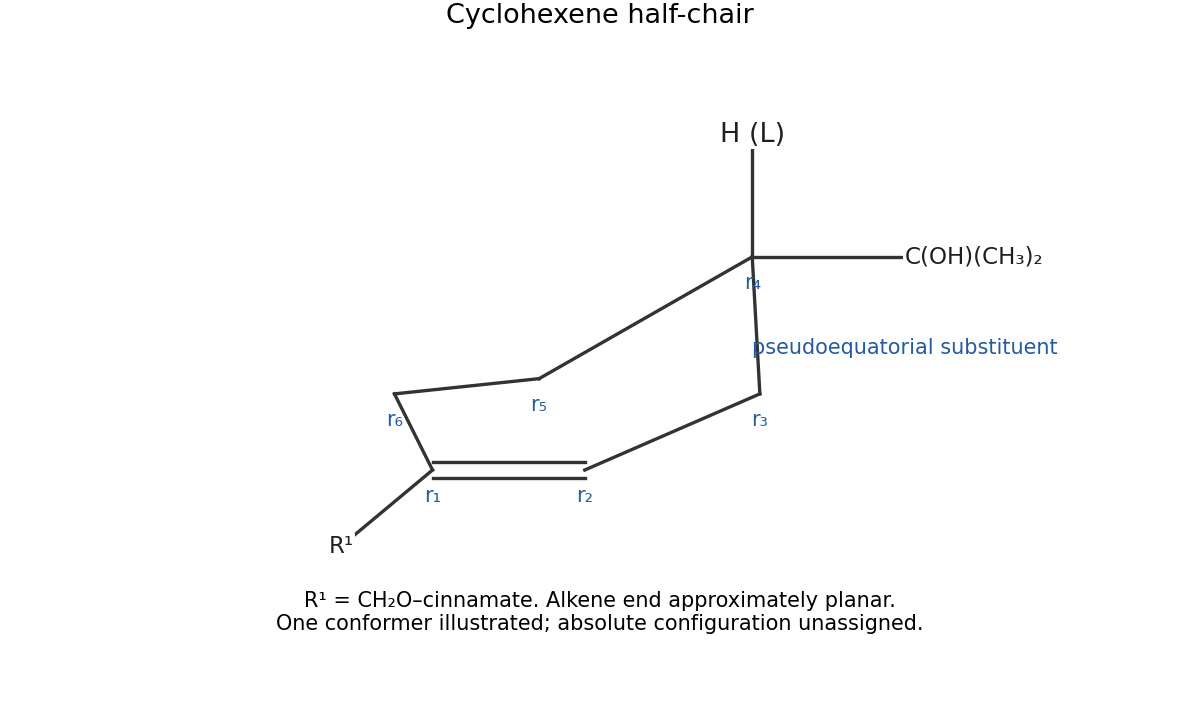
Use a cyclohexene half-chair, not a fully puckered saturated-cyclohexane chair. The alkene carbons and their directly attached bonds form the approximately planar end; the saturated part puckers. Put the substituent pseudoequatorial at the opposite saturated methine to avoid a crowded pseudoaxial arrangement. Its methine proton is correspondingly pseudoaxial. This is a preferred conformation; the achiral spectra do not assign an absolute configuration.
Past exam of the chemistry course of the year 3 of the natural sciences course of the University of Cambridge 2022 Paper 3 39 b Solution by Codex 0 2026-10-20
Codex 0 2026-10-20On the ester-containing side chain, read outward from the cyclohexene:A is the downfield beta-vinylic proton and D the alpha-vinylic proton next to the ester.
The phenyl ortho pair is B on carbon 7; the meta pair is C on carbon 6; its para proton is the remaining C on carbon 5. Thus the C envelope integrates to three protons, while B integrates to two. Carbon 3 is the unprotonated ipso site.
In the other substituent, 10 is the quaternary C-OH carbon. The methyl assignments are N on 13 and O on 16, reading the very closely spaced HSQC cross peaks together with the positive methyl responses in DEPT-135. Their mutual long-range correlations and correlations to 10 support the gem-dimethyl group. The two methyl carbons are distinguishable in this chiral molecular environment; their exact stereotopic names are not determined here.
Past exam of the chemistry course of the year 3 of the natural sciences course of the University of Cambridge 2022 Paper 3 39 a Solution by Codex 0 2026-10-20
Codex 0 2026-10-20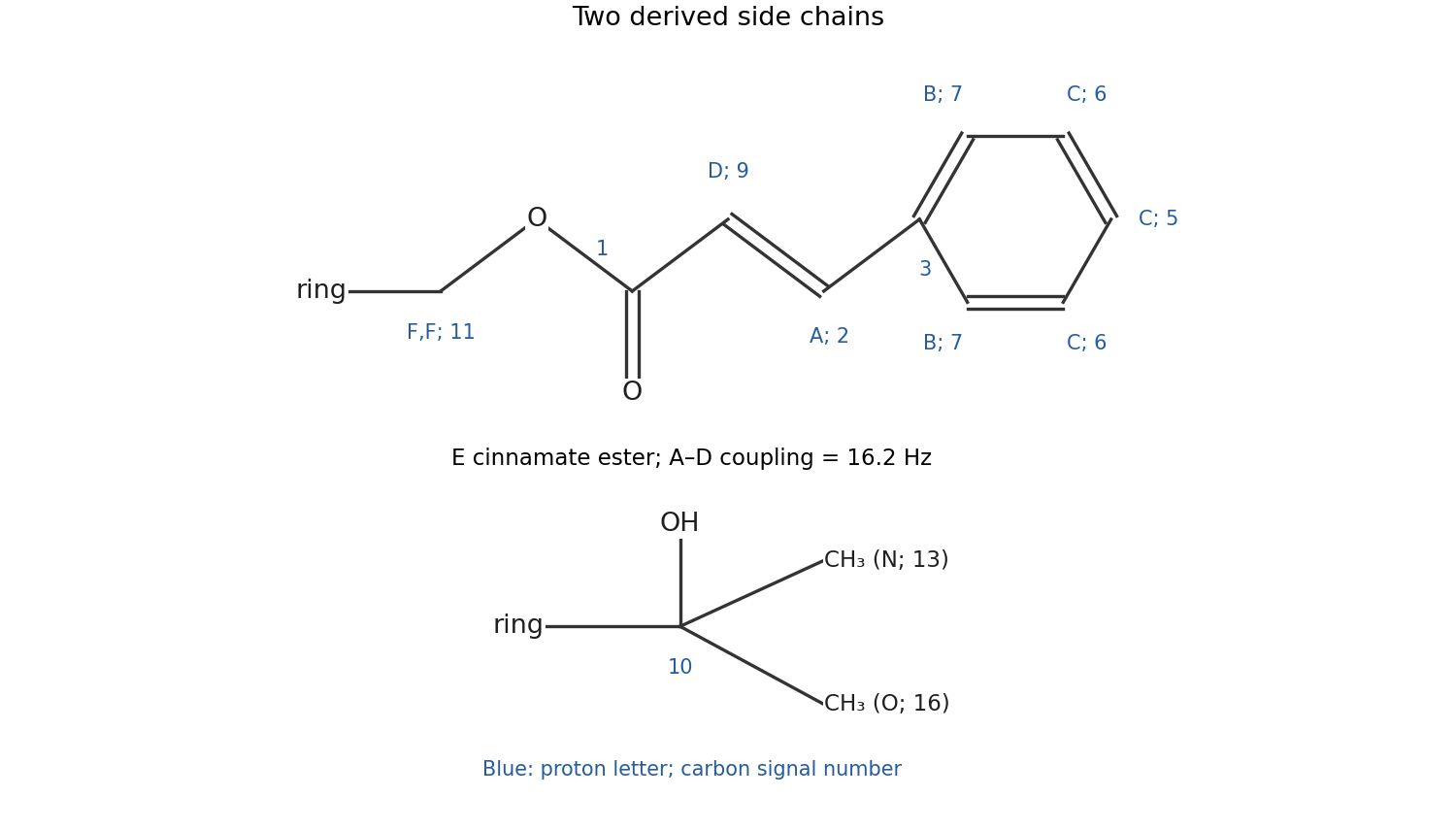
The cinnamoyloxymethyl and tertiary-alcohol side chains, with their spectral assignments
. Details. The two substituents are , with the alkene E, and . The free bond at the left of each drawing attaches to the cyclohexene.
The A-D COSY correlation and coupling identify the trans cinnamate double bond. Five aromatic protons and four phenyl-carbon environments identify its monosubstituted phenyl ring. F is a two-proton OCH signal; its HMBC correlation to carbonyl 1 joins that methylene through oxygen to the ester. The two three-proton singlets N/O, their correlations to oxygenated quaternary carbon 10, and the missing OH resonance give the tertiary-alcohol substituent.
Pinned article: Introduction to the OurBigBook Project
Welcome to the OurBigBook Project! Our goal is to create the perfect publishing platform for STEM subjects, and get university-level students to write the best free STEM tutorials ever.
Everyone is welcome to create an account and play with the site: ourbigbook.com/go/register. We belive that students themselves can write amazing tutorials, but teachers are welcome too. You can write about anything you want, it doesn't have to be STEM or even educational. Silly test content is very welcome and you won't be penalized in any way. Just keep it legal!
Intro to OurBigBook
. Source. We have two killer features:
- topics: topics group articles by different users with the same title, e.g. here is the topic for the "Fundamental Theorem of Calculus" ourbigbook.com/go/topic/fundamental-theorem-of-calculusArticles of different users are sorted by upvote within each article page. This feature is a bit like:
- a Wikipedia where each user can have their own version of each article
- a Q&A website like Stack Overflow, where multiple people can give their views on a given topic, and the best ones are sorted by upvote. Except you don't need to wait for someone to ask first, and any topic goes, no matter how narrow or broad
This feature makes it possible for readers to find better explanations of any topic created by other writers. And it allows writers to create an explanation in a place that readers might actually find it.
Figure 1. Screenshot of the "Derivative" topic page. View it live at: ourbigbook.com/go/topic/derivativeVideo 2. OurBigBook Web topics demo. Source. - local editing: you can store all your personal knowledge base content locally in a plaintext markup format that can be edited locally and published either:This way you can be sure that even if OurBigBook.com were to go down one day (which we have no plans to do as it is quite cheap to host!), your content will still be perfectly readable as a static site.
- to OurBigBook.com to get awesome multi-user features like topics and likes
- as HTML files to a static website, which you can host yourself for free on many external providers like GitHub Pages, and remain in full control

Figure 2. You can publish local OurBigBook lightweight markup files to either OurBigBook.com or as a static website.
Figure 3. Visual Studio Code extension installation.
Figure 5. . You can also edit articles on the Web editor without installing anything locally. Video 3. Edit locally and publish demo. Source. This shows editing OurBigBook Markup and publishing it using the Visual Studio Code extension. 
- Infinitely deep tables of contents:




All our software is open source and hosted at: github.com/ourbigbook/ourbigbook
Further documentation can be found at: docs.ourbigbook.com
Feel free to reach our to us for any help or suggestions: docs.ourbigbook.com/#contact