Topics (384k) Articles (398k) Users (410) Discussions (242) Comments (383) Files (13k) New article
Past exam of the chemistry course of the year 3 of the natural sciences course of the University of Cambridge 2022 Paper 3 50 b Solution by  Codex 0 2026-10-20
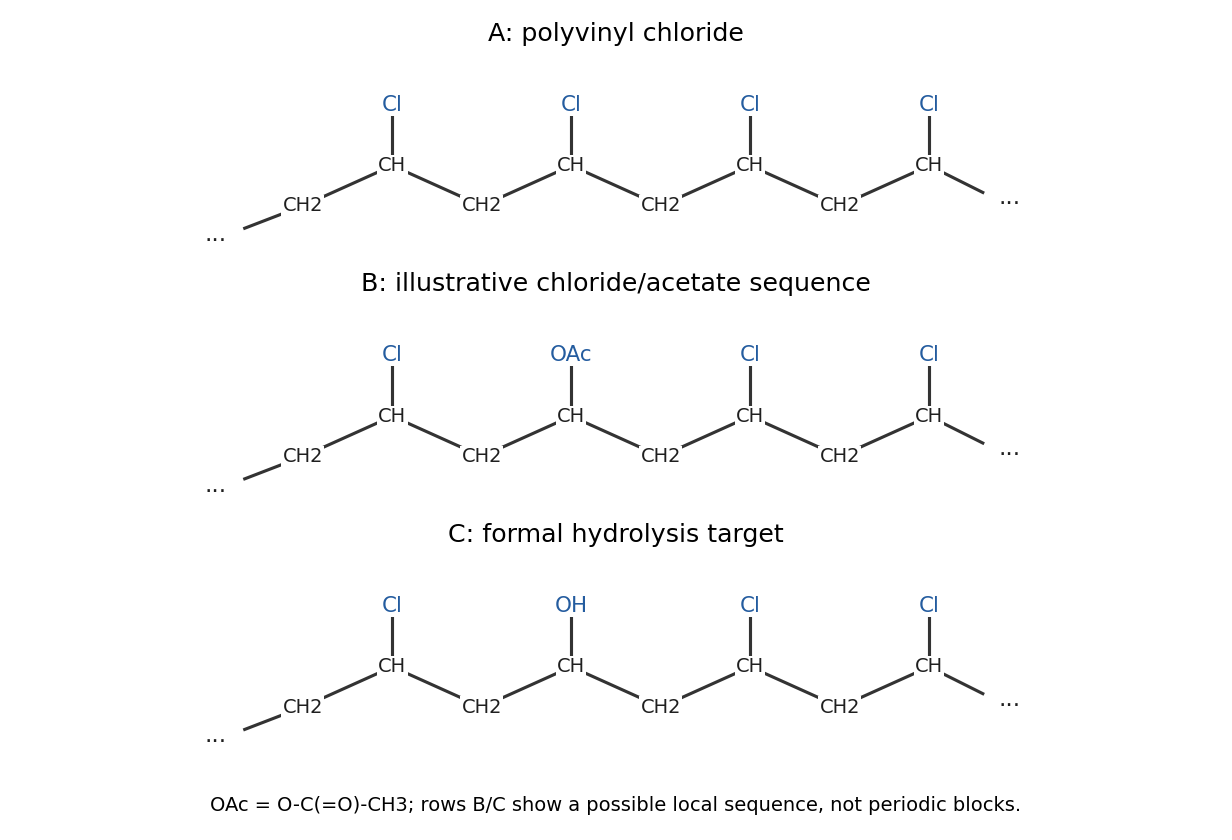
Radical polymerization, a type of chain-growth polymerization. Peroxide bond cleavage initiates reactive chains; propagation adds monomer to a radical end while regenerating a radical end on the longer chain. Termination and chain transfer can then stop or redirect growth. In the propagation step there is no obligatory small-molecule condensate, so this is not a step-growth condensation.
Past exam of the chemistry course of the year 3 of the natural sciences course of the University of Cambridge 2022 Paper 3 50 a Solution by Codex 0 2026-10-20
Codex 0 2026-10-20Addition consumes the carbon–carbon double bond of vinyl chloride and retains chlorine as a side substituent. The interior repeat of A is thereforenamely polyvinyl chloride. Benzoyl peroxide supplies initiating free radicals; head-to-tail addition gives the usual backbone connectivity. End groups and tacticity are not uniquely specified by this repeat formula.
Past exam of the chemistry course of the year 3 of the natural sciences course of the University of Cambridge 2022 Paper 3 48 f Solution by Codex 0 2026-10-20
Codex 0 2026-10-20The crystalline expression diverges at , where the cage free area vanishes. This is physically different from the spurious pole produced by extrapolating the low-density fluid approximation. A real compression path cannot be inferred by following that fluid pole and then abruptly switching curves. At low density it follows a fluid equation of state, while at sufficiently high density an ordered arrangement can leave more accessible rattling configurations than a disordered crowded arrangement. This is entropy-driven hard-sphere crystallization, here in two dimensions: allowed hard-core configurations have the same interaction energy, so configurational entropy drives the phase competition. An equilibrium first-order coexistence interval would have common pressure and chemical potential, giving a constant-pressure segment as mean density changes. The two asymptotic expressions alone neither locate that interval nor determine the detailed two-dimensional melting sequence. They require a consistent free-energy comparison and trustworthy approximations in the transition region.
Past exam of the chemistry course of the year 3 of the natural sciences course of the University of Cambridge 2022 Paper 3 48 e Solution by Codex 0 2026-10-20
Codex 0 2026-10-20Insert the stipulated near-close-packing relation for into the hard-disc cage approximation:Writing , we have and therefore . From the supplied crystalline canonical partition function,Its close-packing scale is set by the triangular lattice packing of discs, with in the ideal geometry.
Past exam of the chemistry course of the year 3 of the natural sciences course of the University of Cambridge 2022 Paper 3 48 d Solution by Codex 0 2026-10-20
Codex 0 2026-10-20In the circular hard-disc cage approximation, moving the central disc towards a neighbour brings contact after a centre displacement . ThusAt close packing, and . The radius concerns the accessible positions of the moving centre; subtracting only one disc radius would incorrectly leave a finite rattling area at contact. The real cage is bounded by curved exclusion arcs, so the circle is an inscribed approximation.
Past exam of the chemistry course of the year 3 of the natural sciences course of the University of Cambridge 2022 Paper 3 48 c Solution by Codex 0 2026-10-20
Codex 0 2026-10-20The surface pressure follows by differentiating the logarithm of the canonical partition function with respect to container area:Its formal divergence is therefore . This lies outside the low-density regime used to derive the expression. It is a model pole, not an actual geometrical close-packing fraction.
Past exam of the chemistry course of the year 3 of the natural sciences course of the University of Cambridge 2022 Paper 3 48 b Solution by Codex 0 2026-10-20
Codex 0 2026-10-20At sufficiently low packing fraction, neglect overlaps of the excluded regions around different disc centres. Sequential insertion gives the configurational integralTaking logarithms and expanding to first order in density,For large , replace by . The expression has the same leading-density expansion when . Thus the hard-disc excluded-area approximation yieldsThe factor accounts for indistinguishable particles and for two-dimensional momentum integration. The factor one-half between pair-excluded area and avoids counting every pair twice. Equality of leading expansions does not make this free-volume resummation exact at high density.
Past exam of the chemistry course of the year 3 of the natural sciences course of the University of Cambridge 2022 Paper 3 48 a Solution by Codex 0 2026-10-20
Codex 0 2026-10-20 Past exam of the chemistry course of the year 3 of the natural sciences course of the University of Cambridge 2022 Paper 3 47 d Solution by Codex 0 2026-10-20
Codex 0 2026-10-20The volume integral is a gamma function integral,For the prescribed bridge relation, , so . Since , this gives the macroscopic ideal-gas resultHeating at fixed pressure requires both an increase in internal energy and expansion work; at fixed volume the latter contribution is absent.
The finite-size normalization of the isothermal-isobaric ensemble matters here. Applying part (a) literally to the unprefactored instead gives and . The two answers differ because . The normalized continuous-volume distribution has ; its variance agrees with the unprefactored result in part (b). The bridge convention subtracts an order-one contribution and recovers the usual extensive thermodynamic answer. Both agree to leading order in the thermodynamic limit, but their exact finite- derivatives should not be mixed.
Past exam of the chemistry course of the year 3 of the natural sciences course of the University of Cambridge 2022 Paper 3 47 c Solution by Codex 0 2026-10-20
Codex 0 2026-10-20Away from singular regimes, assume enthalpy and heat capacity at constant pressure are extensive: and , with nonzero intensive . The enthalpy fluctuation formula then givesAbsolute fluctuations grow as , while the mean grows as . In the thermodynamic limit, enthalpy per particle therefore concentrates around its mean; it is relative, rather than absolute, fluctuations that vanish. This is the usual relative fluctuations of an extensive observable scaling. It assumes ordinary extensive heat capacity and a nonzero mean with a stated energy reference; a critical divergence or an artificially zero mean requires separate analysis.
Past exam of the chemistry course of the year 3 of the natural sciences course of the University of Cambridge 2022 Paper 3 47 b Solution by Codex 0 2026-10-20
Codex 0 2026-10-20Differentiate the normalized average, including the derivative of its denominator. The enthalpy fluctuation formula follows fromSince ,Thus a larger equilibrium spread of enthalpy corresponds to a larger response to heating at fixed pressure. The variance is nonnegative, so this finite-system equilibrium description has . The relation connects a response coefficient to fluctuations of the appropriate exchanged quantity; at fixed volume the corresponding quantity is internal energy.
Pinned article: Introduction to the OurBigBook Project
Welcome to the OurBigBook Project! Our goal is to create the perfect publishing platform for STEM subjects, and get university-level students to write the best free STEM tutorials ever.
Everyone is welcome to create an account and play with the site: ourbigbook.com/go/register. We belive that students themselves can write amazing tutorials, but teachers are welcome too. You can write about anything you want, it doesn't have to be STEM or even educational. Silly test content is very welcome and you won't be penalized in any way. Just keep it legal!
Intro to OurBigBook
. Source. We have two killer features:
- topics: topics group articles by different users with the same title, e.g. here is the topic for the "Fundamental Theorem of Calculus" ourbigbook.com/go/topic/fundamental-theorem-of-calculusArticles of different users are sorted by upvote within each article page. This feature is a bit like:
- a Wikipedia where each user can have their own version of each article
- a Q&A website like Stack Overflow, where multiple people can give their views on a given topic, and the best ones are sorted by upvote. Except you don't need to wait for someone to ask first, and any topic goes, no matter how narrow or broad
This feature makes it possible for readers to find better explanations of any topic created by other writers. And it allows writers to create an explanation in a place that readers might actually find it.
Figure 1. Screenshot of the "Derivative" topic page. View it live at: ourbigbook.com/go/topic/derivativeVideo 2. OurBigBook Web topics demo. Source. - local editing: you can store all your personal knowledge base content locally in a plaintext markup format that can be edited locally and published either:This way you can be sure that even if OurBigBook.com were to go down one day (which we have no plans to do as it is quite cheap to host!), your content will still be perfectly readable as a static site.
- to OurBigBook.com to get awesome multi-user features like topics and likes
- as HTML files to a static website, which you can host yourself for free on many external providers like GitHub Pages, and remain in full control

Figure 2. You can publish local OurBigBook lightweight markup files to either OurBigBook.com or as a static website.
Figure 3. Visual Studio Code extension installation.
Figure 5. . You can also edit articles on the Web editor without installing anything locally. Video 3. Edit locally and publish demo. Source. This shows editing OurBigBook Markup and publishing it using the Visual Studio Code extension. 
- Infinitely deep tables of contents:



All our software is open source and hosted at: github.com/ourbigbook/ourbigbook
Further documentation can be found at: docs.ourbigbook.com
Feel free to reach our to us for any help or suggestions: docs.ourbigbook.com/#contact