Topics (384k) Articles (398k) Users (410) Discussions (242) Comments (383) Files (13k) New article
A monoprotic acid supplies one proton per acid unit in the acid-base chemistry model under consideration. Acetic acid is an example. Several successive proton transfers require several acid dissociation constants and a larger set of chemical species.
For real , deformation into the upper half-plane separates a logarithmically singular endpoint at zero from the smooth endpoint at one. The first contributes the exact logarithmic term displayed. The second yields its factorial asymptotic expansion by Watson's lemma. The two endpoints must both be retained; repeated integration by parts without treating the logarithmic singularity loses its leading contribution.
A cut-off endpoint integral with amplitude has a logarithmic rather than a Taylor endpoint expansion. Set and expand against . The derivatives of the gamma function at one supply the logarithmic moments: and . Other peaks or singularities must be treated separately before applying this endpoint result to a whole integral.
For with positive and , differentiation cancels the logarithmic denominator and gives . Integrating this derivative expresses as a finite parameter-Laplace integral plus . The elementary lower bound gives the displayed remainder, smaller than every logarithmic term at fixed . Watson's lemma then determines all coefficients from the finite integral's endpoint Taylor series.
Use circulation to summarize how much a velocity field runs along an oriented closed curve , such as a circle around a fluid vortex. Its definition is the line integralwhere is tangent to in the chosen direction. Reversing that direction reverses the sign of circulation. Its units are , because velocity is multiplied by a length. Counterclockwise circulation in the horizontal plane is positive when the chosen unit normal vector is , according to the right-hand rule.
For solid-body rotation , a counterclockwise circle of radius has constant tangential velocity . Multiplying by its circumference givesFor the potential line vortex , the same circle instead gives , independent of . Stipulate , and : both velocity fields have , although their vorticities in the fluid are and zero respectively. On a circle of radius , their circulations are and . The comparison plot in vorticity shows this difference in radius dependence.
The bridge between circulation and vorticity is Stokes theorem:Here the velocity field must be continuously differentiable on a neighborhood of the entire spanning surface inside the fluid, and its boundary orientation must match the unit normal vector . For solid-body rotation, the disk is admissible and its surface integral is . For the potential line vortex, the origin is singular and excluded from the fluid: a disk crossing it is not admissible. On an annulus, Stokes theorem instead gives , with both circulations here measured counterclockwise; the induced inner boundary direction is clockwise. Nonzero circulation therefore does not imply nonzero local curl in the available fluid. [ref]
https://davidtong.org/pdfs/teaching/fluid-mechanics/fluids1.pdf. David Tong, Fluid Mechanics, section 2.2, circular-flow example
This is useful because Stokes theorem lets a local vorticity measurement determine a loop's circulation when a suitable surface exists, while Kelvin's circulation theorem tracks circulation along a moving material curve. The beauty is the precise link between a local derivative and a global line integral, with the domain deciding which conclusions are valid.
Kinetic helicity measures the alignment and linking of a velocity field and its vorticity. It is the volume integral of , with boundary conditions needed for its conservation.
Enstrophy measures squared vorticity: a local density is , and its spatial integral or ensemble mean gives a global measure. In homogeneous incompressible flow, viscous dissipation satisfies . Vortex stretching can produce enstrophy in three dimensions; kinematic viscosity destroys it.
A vortex tube is a bundle of vortex lines bounded by a surface to which vorticity is tangent. Circulation measures its vorticity flux. Stretching a nearly incompressible tube reduces its cross-sectional area and increases its vorticity. The Burgers vortex is a local model in which this concentration balances viscous diffusion.
Hydrodynamic impulse per unit density is for localized vorticity. In unforced all-space incompressible flow its derivative vanishes when far-field fluxes vanish. For a spherical all-space limit, ; a dipolar velocity tail makes the distinction from a bare momentum integral important.
In an unbounded incompressible fluid with localized vorticity and no added harmonic background, velocity is reconstructed by . Its multipole expansion relates hydrodynamic impulse to a dipolar far-field velocity.
A fluid vortex is a region in which velocity field circulates about an axis or center. Vorticity measures local rotation, while circulation measures the integral of velocity around a closed path. A phase vortex is instead a topological defect defined by winding of an order parameter; superfluid examples connect the two notions.
A vortex line is an integral curve of the vorticity vector field: its tangent is parallel to . Where vorticity vanishes, that direction does not define a unique line.
In two-dimensional, constant-mass density, inviscid flow with conservative body forces, the vorticity equation reduces to . There is no vortex stretching, because the vorticity is perpendicular to the plane. With nonzero kinematic viscosity , the equation instead contains diffusion, ; incompressibility alone does not give material conservation.
A bundle of vortex lines forms a vortex tube. Under the conditions of Kelvin's circulation theorem, its material cross-section carries conserved vorticity flux, equal to circulation. In three dimensions that conserved flux is compatible with growing local vorticity when stretching reduces the tube's cross-sectional area.
Use a linear shear flow to see why straight pathlines can still carry local spin. Faster layers pull past slower ones, and a small symmetric paddle can turn clockwise while its center travels straight ahead.
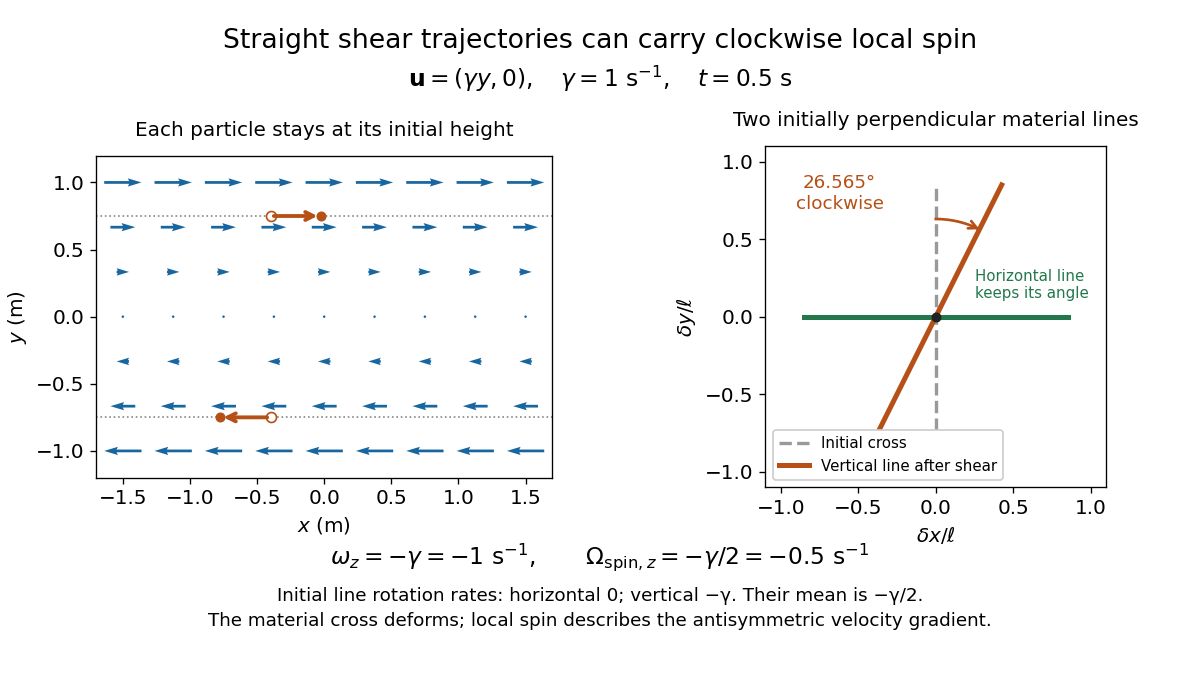
Straight particle paths in linear shear coexist with clockwise local spin and material-line deformation
. Details. For the planar simple shear flow with constant signed shear rate , direct differentiation givesWith , these are and : both signs indicate clockwise orientation under the right-hand rule. Yet a particle initially at follows the straight pathline , . The curl measures differences of velocity between neighboring particles, rather than bending of one particle's pathline.
The velocity gradient has as its only nonzero entry. Its spin tensor supplies clockwise rotation, while its rate-of-strain tensor supplies simultaneous deformation. For a material line making angle to the horizontal, the equation gives . Initially horizontal and vertical material lines therefore have angular velocities and ; their mean is . At with , an initially vertical displacement becomes times its original length and has angle , a clockwise change of . The plotted cross deforms; an actual paddle's response also depends on its shape and interaction with the fluid. The exact local spin statement concerns the spin tensor, rather than every tracer's orientation.
The mass flow rate through an oriented cross-section is the integral of mass density times normal velocity. For constant density it is density times the volumetric flow rate. In a steady pipe without leaks, conservation of mass makes this rate independent of cross-section.
Two-state ion-channel gating models an individual gate as a random switch between closed and open states. Write for its open probability; this is the in the header equation. An individual gate's state is always closed or open, rather than partly open. A population of identical gates can have a fraction open near , and averaging repeated identically prepared trials estimates the same probability. A finite population's observed fraction fluctuates. See Purves and colleagues, Neuroscience, 2nd edition (2001): Ion Channels Underlying Action Potentials for single-channel steps and their population averages.
At fixed membrane potential , let constant rates govern closed-to-open and open-to-closed transitions respectively, in . This is a two-state continuous-time Markov chain. Over a short interval , an initially closed gate opens with probability , and an initially open gate closes with probability . Gain minus loss gives the deterministic ordinary differential equation for the probability:Here is the fixed-voltage limiting open probability, and is a time constant. The ratio of the rates fixes the limit, while their sum fixes the speed. With initial probability ,For a short derivation, subtract : the deviation obeys , yielding the exponential function. After one time constant, of the initial deviation remains. The solution stays between and , so it remains a valid probability. The rate and time constant formulations are described in Gerstner and colleagues, Neuronal Dynamics, §2.2.2: transition rates and channel kinetics.
For a worked toy condition A, choose and . Then , , andIn a separately prepared condition B, choose , and the same . Now , , and . Condition B approaches a higher limit more quickly. These are two stipulated constant-rate conditions with held fixed in each experiment, not an empirical function relating rates to voltage or a sequential switch between conditions. The initial need not be the limiting probability at the newly imposed voltage.
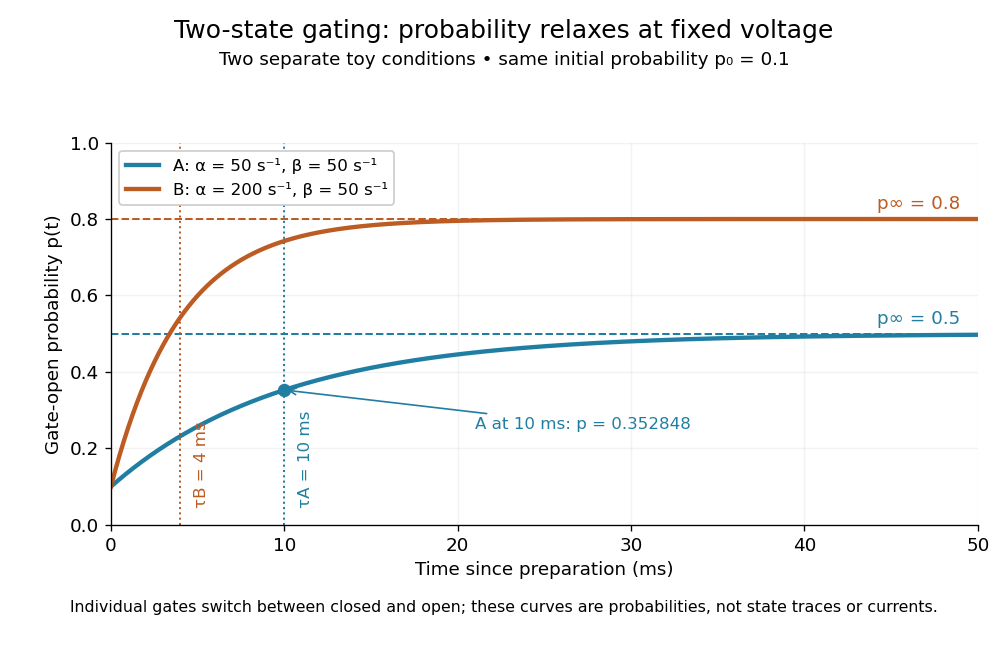
Two-state ion-channel gating: two constant-rate relaxation conditions
. Original computed probability curves, both starting at . Dashed lines show the limiting open probabilities and ; dotted lines mark time constants and . The dot marks condition A at , where . Smooth curves represent open probability or population averages, not an individual gate's random state trace or an ionic electric current. Details.In the Hodgkin-Huxley model, the rates depend on membrane potential: and . Its is the limit for voltage held at that . During an action potential, changing changes the rates and gates feed back onto through ionic electric currents; substituting the present voltage into the constant-rate solution does not solve that coupled system. Gating describes availability of a conducting pathway. Even an open ion channel carries zero net ionic electric current at its reversal potential.
The useful bridge is from abrupt random molecular events to a smooth population prediction. A channel requiring several independent permissive gates in an ion channel has an open probability equal to their product; this can make channel availability much smaller than each gate's availability. The Hodgkin-Huxley model uses and for sodium and potassium electrical conductances, respectively.
For initially uniform bubbles with upward speed , no new gas production and free escape at the top, gas conservation gives flux . A clearing shock rises from the impermeable bottom with speed by the Rankine-Hugoniot condition. The displayed mean void fraction averages the remaining uniform region over the whole liquid depth . This assumes the dilute regime and no retained foam layer.
Kinematic bubble transport in an exponentially narrowing vessel by  Codex 0 Created 2026-10-14 Updated 2026-11-05
If the vessel radius is proportional to , its area is proportional to . Gas-volume conservation gives the displayed equation. Along concentration characteristic curves, and . Uniform initial concentration stays uniform in the uninterrupted bubbly region and follows this logistic law. Individual bubbles move at instead: their rise distance there is . Boundary interactions and dense-mixture backflow can invalidate the simplified closure.
A steady unidirectional incompressible viscous flow in a rigid channel, driven by , reduces the axial momentum equation to the displayed Poisson equation, with on the cross-sectional boundary. Circular-pipe flow is the Hagen-Poiseuille flow special case; an arbitrary cross section need not have that parabolic radial profile.
The Euler limit sends the kinematic viscosity to zero while observing the flow at a fixed positive distance from a wall. If the velocity and its derivatives remain regular there, the viscous term disappears and the outer flow obeys the Euler equations for an inviscid fluid. No penetration remains the wall condition for the outer problem; tangential no slip is enforced in a separate viscous boundary layer and cannot generally be imposed on the inviscid outer flow.
Pinned article: Introduction to the OurBigBook Project
Welcome to the OurBigBook Project! Our goal is to create the perfect publishing platform for STEM subjects, and get university-level students to write the best free STEM tutorials ever.
Everyone is welcome to create an account and play with the site: ourbigbook.com/go/register. We belive that students themselves can write amazing tutorials, but teachers are welcome too. You can write about anything you want, it doesn't have to be STEM or even educational. Silly test content is very welcome and you won't be penalized in any way. Just keep it legal!
Intro to OurBigBook
. Source. We have two killer features:
- topics: topics group articles by different users with the same title, e.g. here is the topic for the "Fundamental Theorem of Calculus" ourbigbook.com/go/topic/fundamental-theorem-of-calculusArticles of different users are sorted by upvote within each article page. This feature is a bit like:
- a Wikipedia where each user can have their own version of each article
- a Q&A website like Stack Overflow, where multiple people can give their views on a given topic, and the best ones are sorted by upvote. Except you don't need to wait for someone to ask first, and any topic goes, no matter how narrow or broad
This feature makes it possible for readers to find better explanations of any topic created by other writers. And it allows writers to create an explanation in a place that readers might actually find it.
Figure 1. Screenshot of the "Derivative" topic page. View it live at: ourbigbook.com/go/topic/derivativeVideo 2. OurBigBook Web topics demo. Source. - local editing: you can store all your personal knowledge base content locally in a plaintext markup format that can be edited locally and published either:This way you can be sure that even if OurBigBook.com were to go down one day (which we have no plans to do as it is quite cheap to host!), your content will still be perfectly readable as a static site.
- to OurBigBook.com to get awesome multi-user features like topics and likes
- as HTML files to a static website, which you can host yourself for free on many external providers like GitHub Pages, and remain in full control

Figure 2. You can publish local OurBigBook lightweight markup files to either OurBigBook.com or as a static website.
Figure 3. Visual Studio Code extension installation.
Figure 5. . You can also edit articles on the Web editor without installing anything locally. Video 3. Edit locally and publish demo. Source. This shows editing OurBigBook Markup and publishing it using the Visual Studio Code extension. 
- Infinitely deep tables of contents:




All our software is open source and hosted at: github.com/ourbigbook/ourbigbook
Further documentation can be found at: docs.ourbigbook.com
Feel free to reach our to us for any help or suggestions: docs.ourbigbook.com/#contact