Topics (384k) Articles (398k) Users (410) Discussions (242) Comments (383) Files (13k) New article

For , a downstream WKB approximation at fixed frequency has local wavenumber . The next-order amplitude equation is , giving the stated envelope. For small , it reduces to to first order in frequency. The approximation requires positive slowly varying width and separation from the double root at .
For a slowly varying oscillator with rapidly decaying forcing, first construct the localized particular solution . Apply the initial conditions to the residual to determine its WKB approximation amplitude and phase constants. Ignoring the early forcing because it later becomes small loses the permanent free oscillations it excites. In , the particular expansion is , whose initial value shifts the first homogeneous cosine coefficient by .
For fixed and , the incident pole in the scattered transform cancels the analytic continuation of the incident plane wave. Near , the remaining transform is proportional to , so the total outgoing field has the displayed inverse-square-root cylindrical decay. A claim of square-root growth at negative infinity is incompatible with this outgoing solution.
Perforated patch recording obtains intracellular electrical access through pores in the patch under the patch pipette, with less open exchange of large cytoplasmic components than conventional whole-cell recording. Pore selectivity matters: retaining some components does not guarantee unchanged ion concentrations. Monitor patch-clamp series resistance as access develops and distinguish a perforated patch from accidental full rupture.
Cytosol dialysis is exchange between the cytosol and pipette solution through the opening used in conventional whole-cell recording. Diffusion can change ion concentrations and dilute soluble regulators of ion channels. A diminishing response can therefore reflect the recording's alteration of the biological cell, rather than the experimental treatment.
A direct motivating example is the 1988 article Muscarinic activation of ionic currents measured by a new whole-cell recording method. In rat lacrimal gland biological cells, the acetylcholine response in conventional whole-cell recording lasted about five minutes. With a pore-forming substance in the patch pipette instead of open break-in, the response remained undiminished after one hour. The readout was activation of calcium-activated potassium and ion electric currents; preserving the response supported a role for retained cytoplasmic components. The authors also tested the substance extracellularly and observed reversible increases in cation electrical conductance. This comparison motivates perforated patch recording, but does not show that every intracellular constituent or every ion channel response is preserved. [ref]
Practical controls are matched pipette and bath compositions, recording elapsed time after break-in, time-matched untreated preparations, and tracking both patch-clamp series resistance and baseline leakage. Comparing conventional whole-cell recording with perforated patch recording can separate loss of soluble components from an intended treatment effect, but only if electrical access is characterized in both. These are controls suggested by the mechanisms above, not a new set of measured results.
The space clamp problem is the failure to maintain the commanded membrane potential throughout a spatially extended biological cell. A soma voltage clamp can coexist with substantial voltage changes in distant dendrites or an axon. Reducing patch-clamp series resistance improves access at the recording site, but does not eliminate electrical separation within the neuron.
Membrane capacitance is the capacitance associated with separated electric charge across cell membrane. A local ideal capacitor has charging electric current . If a known actual membrane voltage change is , integrating the charging transient after subtracting sustained ionic and leak components gives . Pipette capacitance, finite patch-clamp series resistance and imperfect transient subtraction can bias the estimate. A capacitive transient is not by itself an ion channel opening.
Patch-clamp series resistance, also called patch-clamp access resistance, is the effective electrical resistance between the pipette's sensed voltage and the cell interior. It includes tip access and any remaining obstruction after break-in. For injected electric current into the biological cell, an ideal resistive access path givesThus through produces a difference: a substantial possible voltage clamp error. The electric current in this equation is the access-path current, excluding any bypass seal leak current. In current clamp, the same access drop contaminates the pipette voltage during injection. Bridge compensation subtracts an estimated ; an estimate that changes during recording leaves an error.
An independent passive voltage clamp calculation makes both speed and error visible. Write and , with fixed leak reversal potential , constant membrane electrical resistance and membrane capacitance . Assume an ideal command at the pipette node and omit seal leak current and pipette capacitance. Electric charge conservation givesFor a step from , the ordinary differential equation givesWith the figure's parameters and , the time constant is , the final membrane rise is , and access-path electric current falls from to . Only when does the time constant approach and the final voltage approach the command. Actual voltage clamp also depends on amplifier feedback control and the space clamp problem.
The originator credited by Charles Wheatstone in his 1843 exposition of the Wheatstone bridge.[ref]
Wheatstone Collection by King's College London. Wheatstone Collection, “Wheatstone's contributions to electricity”: inventor credited by Wheatstone
Physicist whose 1843 exposition gave the Wheatstone bridge its familiar name while crediting Samuel Hunter Christie.[ref]
Wheatstone Collection by King's College London. Wheatstone Collection, opening biographical dates and “Wheatstone's contributions to electricity”
PHYWE's documented experiment uses a one-metre slide wire, a connection box, an unknown resistor, a known comparison resistor, a supply, and a digital multimeter in steady-current mA mode as the null detector. Its two yellow detector leads join the fixed-resistor junction and the slider. Move the slider until the indicated electric current vanishes; read the two wire lengths on the ruler and infer the unknown electrical resistance from their ratio. The guide advises changing the comparison resistor if no null is reachable or the slider lies near an end.[ref]
The inference requires uniform electrical resistivity and wire cross-sectional area, so the two wire electrical resistances have the ratio of their lengths, by . Retaining PHYWE's labeling, its equation (6) is , where is the comparison electrical resistance. This is a different arm placement from our schematic. The guide's example table reports larger discrepancies near wire ends.[ref]
Useful additional controls distinguish a true null measurement from an insensitive or disconnected detector. Check the detector zero with the supply off, then move the adjustable arm slightly to either side of the candidate balance and verify opposite detector signs. Reconnect the unknown with short, secure leads and repeat the balance. Any lead or contact electrical resistance included in that arm contributes to the inferred value, even though a detector lead carries no electric current at exact balance. For very small unknown electrical resistances, four-terminal sensing addresses this separate connection problem; a detector null alone does not remove it.
Check for Joule heating by repeating at lower supply electric potential difference and with shorter powered intervals, holding ambient temperature fixed. At balance the unknown still dissipates powerHalving quarters this power while halving ideal detector sensitivity. A balance that moves with excitation or elapsed time suggests changing electrical resistance, including self-heating; it is not explained by passive detector loading alone. These are proposed controls, not claimed outcomes of PHYWE's experiment. Standard-resistor accuracy, wire uniformity, contact reproducibility and finite detector resolution still limit the electrical measurement. Large electrical resistances also make unwanted leakage paths consequential.
A real voltmeter has finite input electrical resistance ; a galvanometer also has a finite winding electrical resistance. Away from balance, its electric current changes both intermediate electric potentials. This is voltmeter loading when the detector is a voltmeter. Model the detector as a passive resistor, with no offset or injected electric current. Thévenin's theorem supplies the full response without pretending the connected bridge remains two independent voltage dividers.
With the detector removed, the equivalent source is . Replace the ideal supply by a wire to calculate the source electrical resistance seen between : nodes merge, making parallel and parallel. ConsequentlySince the attenuation factor is strictly positive for , the null remains . A smaller detector electrical resistance reduces the measured electric potential difference off balance but does not shift the ideal null. Its electric current sensitivity instead depends on ; detector gain and resolution also matter in deciding how closely a null can be located.
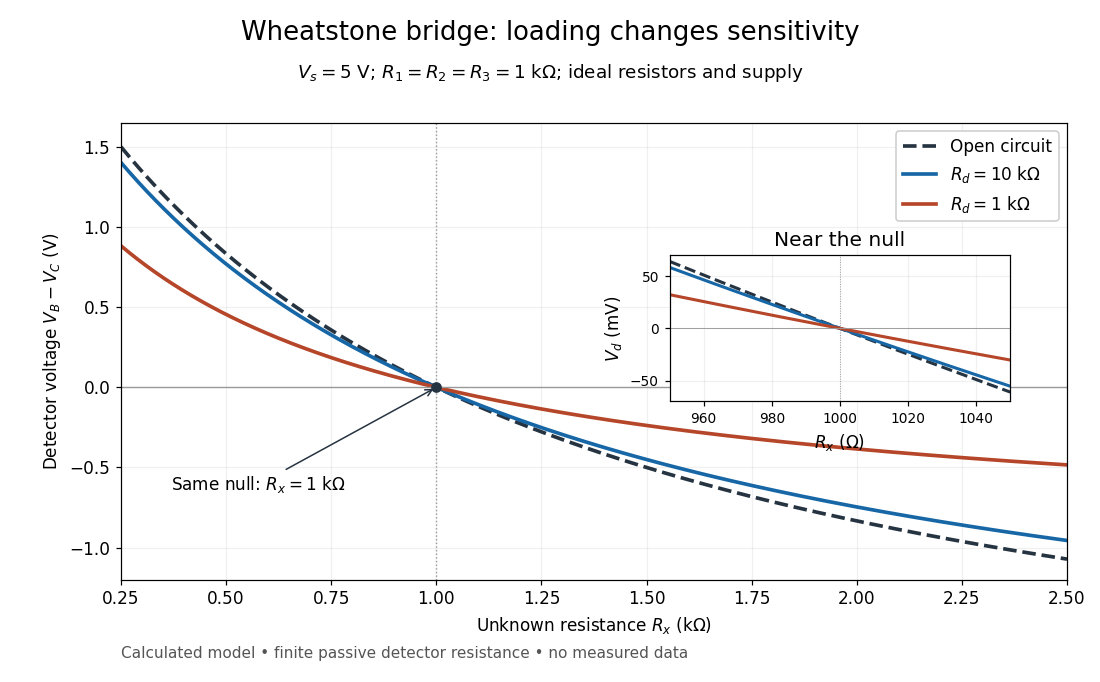
Finite detector resistance reduces bridge voltage sensitivity while preserving the null
. Calculated curves use and . All cross zero at ; the inset resolves their different slopes. These curves are a model, not measured data. Source. Details.In the plotted example, gives and . A detector with instead reads . Using that loaded reading in the unloaded voltage divider formula would underestimate the deviation of from . Balancing the bridge avoids this particular systematic measurement error.
The local derivative makes the sensitivity explicit. For and , the first-order Taylor expansion isAt the plotted null, the open-circuit slope is , compared with for . Increasing the supply improves this ideal sensitivity but also increases Joule heating. A finite source electrical resistance requires recomputing ; the displayed parallel-pair expression assumes an ideal supply.
First disconnect the detector. Each side is a voltage divider. Ohm's law and Kirchhoff's voltage law give the open-circuit intermediate electric potentials and their difference:Setting this difference to zero and cross-multiplying givesThe balance compares ratios, not necessarily equal arm values or equal branch electric currents. At balance the detector carries no electric current, so Kirchhoff's current law again makes the electric current constant along each two-arm path.[ref]
For a worked null measurement, suppose and , and the detector null occurs at adjustable . ThenFor , both intermediate electric potentials are . The left branch carries and the right branch : the zero detector reading does not mean that the unknown carries no electric current. These are stipulated ideal values illustrating the calculation, not experimental observations.
A Western blot membrane is a thin protein-binding support that receives the separated pattern. It is a laboratory support, distinct from a cell membrane. Retaining proteins on its surface makes them accessible for Western blot antibody detection.
A known target-containing sample is a positive comparison for Western blot antibody detection. A matched sample with gene deletion supplies a negative comparison: disappearance of the proposed band supports the assignment, while a persisting band indicates binding unrelated to the deleted target. Deletion must actually remove the recognized protein; changes in other proteins can complicate the comparison. Omitting the primary antibody checks binding or background from the secondary antibody and detection reagents, but cannot exclude binding of the primary antibody to an unintended protein. Independent antibodies recognizing different epitopes add evidence. [ref]
Considerations when quantitating protein abundance by immunoblot by Alicia A. McDonough and others. McDonough and others, “Consider the Specificity of the Antibody for the Target”, Figure 2: positive tissue, knockout tissue and antibodies to different termini
A Western blot transfer control tests retention after Western blot transfer. Total-protein staining of the Western blot membrane can reveal uneven lanes or blank patches; staining the gel after transfer tests what remained behind. Transferred reference bands check selected positions, not recovery of every target. A pretransfer loading image alone cannot establish the amount retained on the receiving sheet.
A Western blot loading control estimates lane-to-lane sample differences. A reference protein, such as actin, must have stable abundance and detection responsive to amount. Equal saturated bands fail to establish equal loading. [ref]
Considerations when quantitating protein abundance by immunoblot by Alicia A. McDonough and others. McDonough and others, “Consider the Loading Controls”, Figure 4: sample doubling changes claudin detection but not the actin signal
A pH measurement becomes evidence for a weak acid chemical equilibrium when paired with a known analytical concentration and a calibrated glass electrode. For the pure-weak acid model, measured pH estimates only in the ideal thermodynamic activity approximation. Then , , , and . Require ; values outside that range signal inconsistent measurements or an inadequate model. Repeating this reconstruction across a dilution series tests whether one acid dissociation constant describes the data, rather than merely fitting one point.
The Analytical Sciences Digital Library's Potentiometric Titration of an Unknown Weak Monoprotic Acid provides a complementary acid-base titration experiment. Its apparatus includes a glass electrode and meter, a stirring magnet, a volumetric flask, pipettes, and a burette containing standardized sodium hydroxide. Prepare an aqueous acid stock of known analytical concentration, transfer a measured portion, and stir gently with the glass electrode clear of the magnet. Record added volume and stable pH after each addition; use a preliminary run to locate the steep region and smaller additions there on a fresh portion. The readout is the pH versus added volume curve, not a visual count of dissociated molecules.
Calibrate with fresh standard buffer solutions bracketing the pH range being interpreted. Use their assigned values at the actual temperature; a pair near pH and can cover the midpoint of many weak acid examples, but does not cover an entire alkaline endpoint region. Rinse between standards and samples to limit carryover, keep the sensing bulb and reference electrode junction immersed, and wait for a stable reading. These instrument practices are documented in HI5221 & HI5222 Instruction Manual: pH and mV and ISE and Temperature Bench Meters by Hanna Instruments (pp. 45–47, 49–50 and 73–74: calibration, measurement, rinsing and electrode conditioning).
Locate the acid-base titration equivalence region from the steepest change of pH with added volume. For one-to-one neutralization, standardized sodium hydroxide concentration times equivalence volume estimates the initial amount of substance of acid. Half that volume gives approximately equal and only when subsequent chemical equilibrium redistribution is small. The Henderson-Hasselbalch equation then gives . Unequal activity coefficients or appreciable hydronium or hydroxide inventories can shift this estimate. The full chemical equilibrium curve supplies a stronger consistency check than its midpoint alone.
Useful controls for this model test are a fresh independently prepared acid portion, a water blank, a check standard after measurement to detect instrument drift, and fixed recorded temperature. A blank diagnoses contamination but should not be subtracted directly from pH, which is a logarithm. Keep exposure to atmospheric carbon dioxide comparable, especially at high dilution, and record any background salt that changes ionic strength. These are experimental-design controls suggested by the model's assumptions. The observed curve and its uncertainty determine whether the model is adequate; the diagrams here contain no experimental readouts. An aqueous acid dissociation constant cannot be inferred unchanged from a sample requiring a different solvent mixture, and a nearly neutral dilute sample makes the difference particularly sensitive to pH error.
Consider only neutral added to pure water, at fixed temperature, with ideal dilute thermodynamic activities, water thermodynamic activity approximated by one, and no added salts or other chemical species. Normalize every concentration by :Conservation of acid units and zero net electric charge, respectively, requireThe second equation balances positive hydronium against negative conjugate base and hydroxide. It would need all additional ions if salts or a chemical base were added. Together with acid dissociation constant and the self-ionization of water relation , these giveThis is exact within the stated ideal model, including depletion and self-ionization of water. Multiplication by yields the cubic equationFor positive , the unmultiplied left-hand side increases strictly from negative to positive values as increases from zero to infinity; its derivative is . There is therefore exactly one positive root of a polynomial. A bisection method can find it without choosing an unphysical root of a polynomial.
If , neglect hydroxide, so and the quadratic equation retaining acid depletion givesThe last form avoids subtracting nearly equal numbers. If also , neglect depletion to obtainCheck both conditions after computing: measures the fraction lost from the initial undissociated weak acid inventory, while measures the omitted hydroxide contribution to electric charge balance. A depletion criterion is a chosen tolerance, not a universal boundary. Keeping depletion does not cure the neglect of self-ionization of water. These weak acid mass and charge balances also explain why the square root estimate cannot be extended to arbitrarily dilute chemical solutions.
For a monoprotic acid with analytical concentration , define the dimensionless weak acid dissociation fractionThis counts acid units in the conjugate base form. Identifying it with additionally requires negligible self-ionization of water and no other sources of electric charge. In the ideal dilute chemical solution model, with , the acid dissociation constant gives . Thus lowering hydronium thermodynamic activity favors the conjugate base.
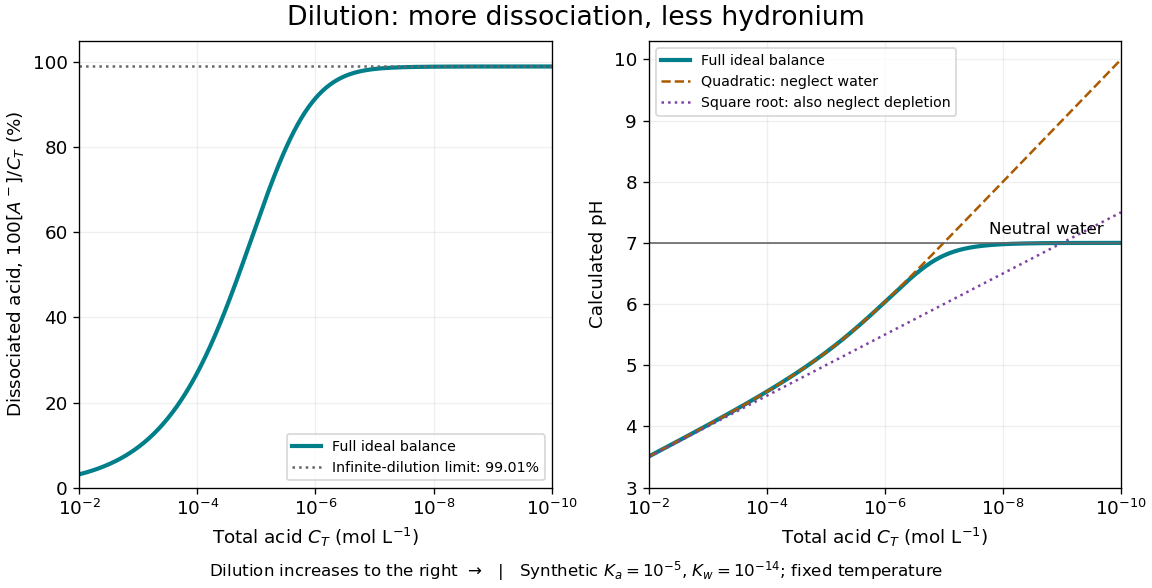
Dilution increases the weak acid dissociation fraction while raising pH in a synthetic aqueous chemical equilibrium
. Details. The diagram uses stipulated dimensionless acid dissociation constant and self-ionization of water ion product at fixed temperature; these are model inputs, not measurements of a named substance. It solves the weak acid mass and charge balances. At , the calculated weak acid dissociation fraction is about and pH about ; at , they are about and . More acid units are dissociated as a fraction of the total, yet fewer hydronium ions occur per volume.
At extreme dilution, self-ionization of water makes approach , so pH approaches for the chosen model. The limiting weak acid dissociation fraction is , rather than exactly one. The calculation assumes pure added water, a neutral monoprotic acid, and no competing chemical reactions; actual contamination becomes increasingly important as falls.
Pinned article: Introduction to the OurBigBook Project
Welcome to the OurBigBook Project! Our goal is to create the perfect publishing platform for STEM subjects, and get university-level students to write the best free STEM tutorials ever.
Everyone is welcome to create an account and play with the site: ourbigbook.com/go/register. We belive that students themselves can write amazing tutorials, but teachers are welcome too. You can write about anything you want, it doesn't have to be STEM or even educational. Silly test content is very welcome and you won't be penalized in any way. Just keep it legal!
Intro to OurBigBook
. Source. We have two killer features:
- topics: topics group articles by different users with the same title, e.g. here is the topic for the "Fundamental Theorem of Calculus" ourbigbook.com/go/topic/fundamental-theorem-of-calculusArticles of different users are sorted by upvote within each article page. This feature is a bit like:
- a Wikipedia where each user can have their own version of each article
- a Q&A website like Stack Overflow, where multiple people can give their views on a given topic, and the best ones are sorted by upvote. Except you don't need to wait for someone to ask first, and any topic goes, no matter how narrow or broad
This feature makes it possible for readers to find better explanations of any topic created by other writers. And it allows writers to create an explanation in a place that readers might actually find it.
Figure 1. Screenshot of the "Derivative" topic page. View it live at: ourbigbook.com/go/topic/derivativeVideo 2. OurBigBook Web topics demo. Source. - local editing: you can store all your personal knowledge base content locally in a plaintext markup format that can be edited locally and published either:This way you can be sure that even if OurBigBook.com were to go down one day (which we have no plans to do as it is quite cheap to host!), your content will still be perfectly readable as a static site.
- to OurBigBook.com to get awesome multi-user features like topics and likes
- as HTML files to a static website, which you can host yourself for free on many external providers like GitHub Pages, and remain in full control

Figure 2. You can publish local OurBigBook lightweight markup files to either OurBigBook.com or as a static website.
Figure 3. Visual Studio Code extension installation.
Figure 5. . You can also edit articles on the Web editor without installing anything locally. Video 3. Edit locally and publish demo. Source. This shows editing OurBigBook Markup and publishing it using the Visual Studio Code extension. 
- Infinitely deep tables of contents:




All our software is open source and hosted at: github.com/ourbigbook/ourbigbook
Further documentation can be found at: docs.ourbigbook.com
Feel free to reach our to us for any help or suggestions: docs.ourbigbook.com/#contact