Argon detection in a binary gas mixture
ID: argon-detection-in-a-binary-gas-mixture

Consider an original simplified model containing only nitrogen and argon, with argon mole fraction . Let their molar masses be and . Adding the component masses gives the mixture's mean molar massFor an ideal gas mixture at the same pressure and temperature as a pure-nitrogen reference, the gas density ratio isThe inversion requires known identities, the binary-mixture assumption and . A density ratio cannot uniquely recover an arbitrary multicomponent mixture. Nor should be interpreted as the argon fraction of untreated air: the model sample has only the two specified components.
Choose round model values and . For , the calculated relative density excess isThus a one-percent mole fraction does not mean a one-percent gas density change. In a chosen globe at and , the ideal gas law gives approximately for pure nitrogen and for this mixture: only separates the weighings. These are model calculations with rounded molar masses, not historical measurements.
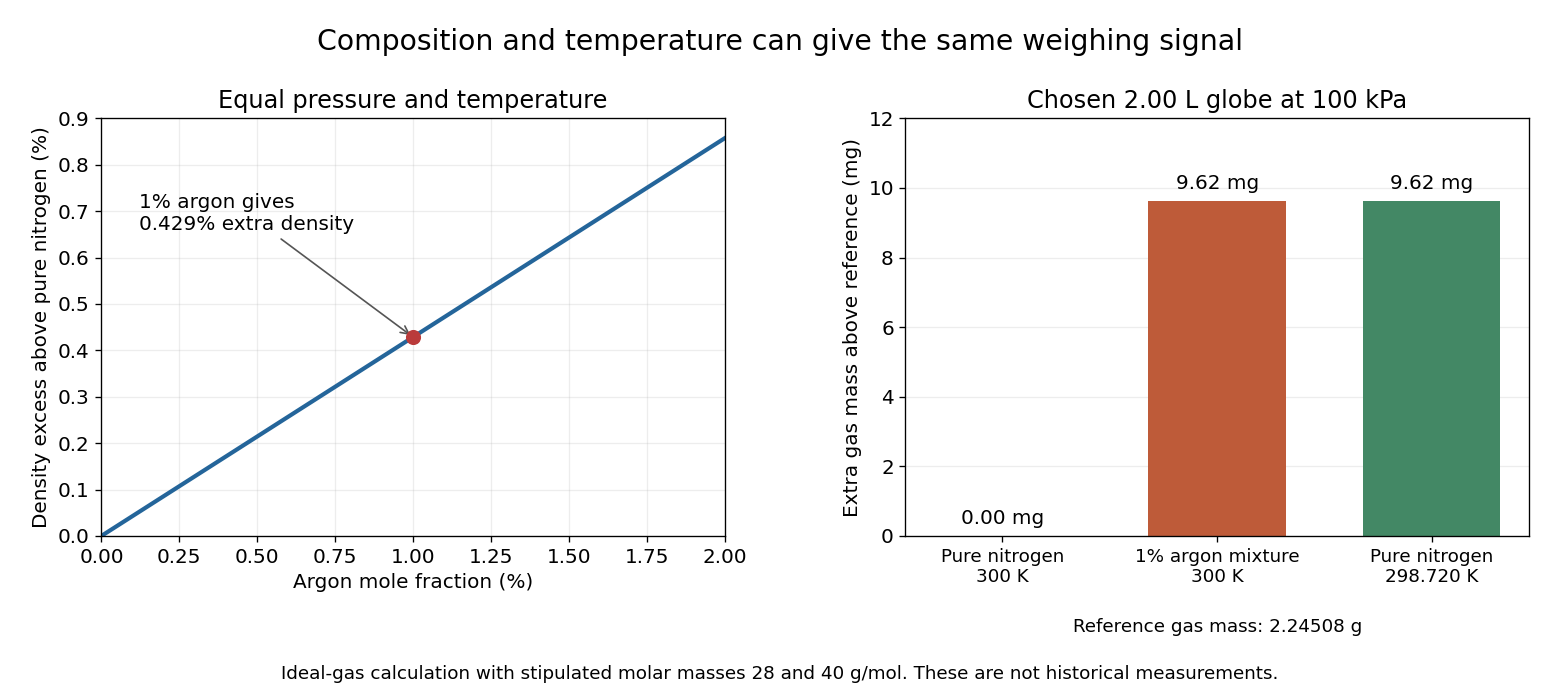

A direct control calculation explains why the filling conditions matter. At fixed pressure, pure nitrogen athas the same gas density as that mixture at . A roughly mismatch can therefore imitate the entire stipulated composition signal. For small changes, the ideal gas law givesAn independently measured pressure and temperature, matched weighing procedure, and checks for residual vapour distinguish composition from these alternative causes. The model explains the need for controls; it does not supply the complete corrections for a real gas-weighing instrument.
New to topics? Read the docs here!