ATP synthase rotary mechanism
ID: atp-synthase-rotary-mechanism

The membrane motor contains a rotating ring of subunits beside stationary subunit . Two offset water-accessible half-channels connect opposite membrane sides to the ring. A proton enters one half-channel and protonates a glutamic acid residue on a subunit; neutralization permits that site to enter the hydrophobic lipid bilayer. Rotation carries it around to the other half-channel, where it releases the proton. A conserved arginine in subunit helps separate the routes and promotes release. Downhill proton transfer biases rotation; this is not a freely open transmembrane pore.[ref]
Structure of a bacterial ATP synthase by Hui Guo and others. Guo, Suzuki and Rubinstein, Structure of a bacterial ATP synthase, 2019, Figure 4B–D and Proton translocation through the FO region
The central shaft transmits torque to ; a peripheral stalk prevents the catalytic head from simply co-rotating. Its three catalytic sites, within an head, cycle through different binding shapes. In the simplified binding-change picture, a loose site captures ADP and inorganic phosphate, a tight site favours bound ATP, and opening releases ATP. Rotation changes binding and release as well as chemistry.[ref]
Structure of ATP synthase under strain during catalysis by Hui Guo and John L. Rubinstein. Guo and Rubinstein, Structure of ATP synthase under strain during catalysis, 2022, Introduction and Figure 1: binding-change cycle
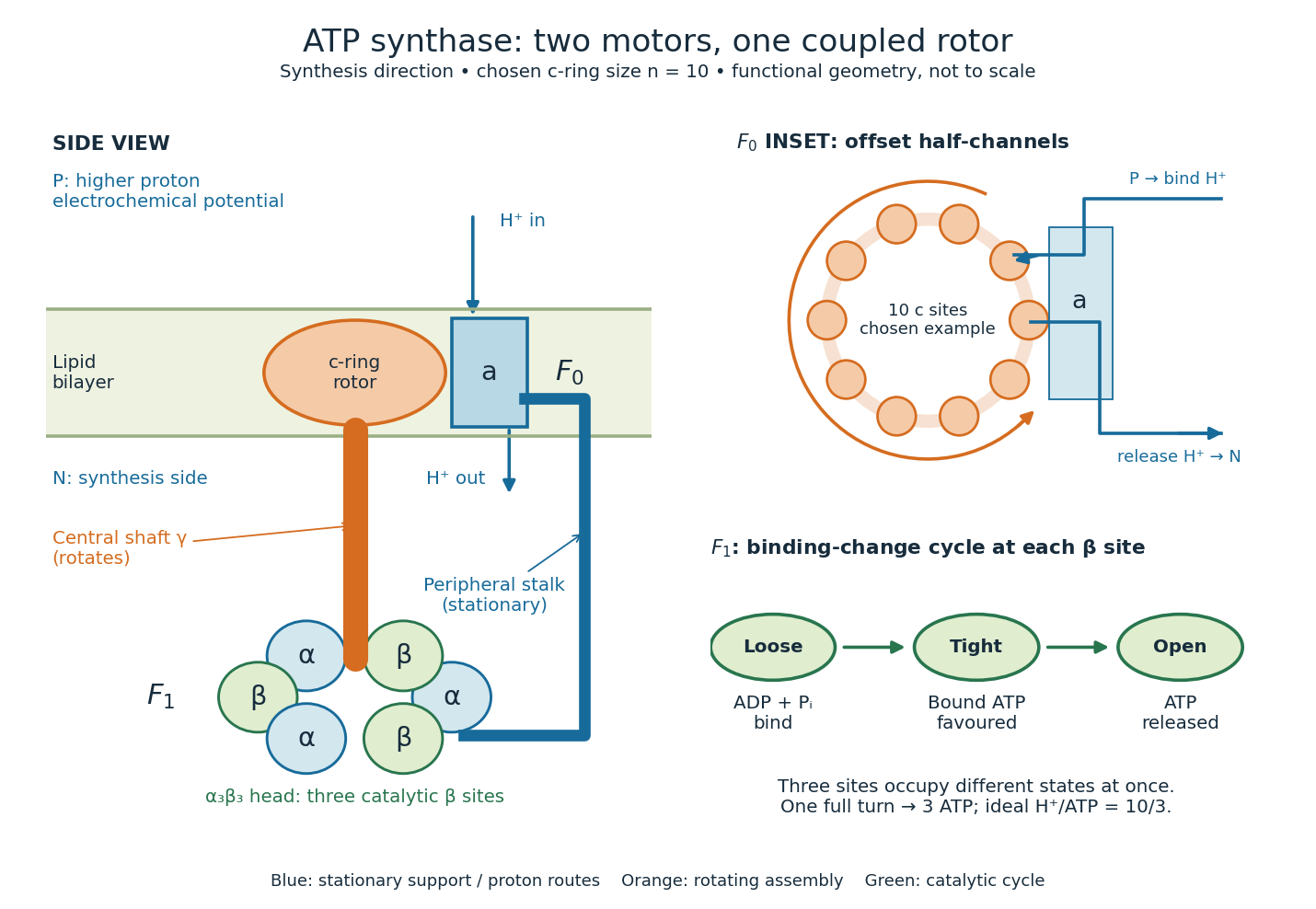

One complete, tightly coupled turn cycles each catalytic site once, producing three ATP molecules. If the ring has proton-binding subunits, the ideal motor budget is transferred protons per turn, or per ATP. Ring size varies between organisms; the worked example chooses , as in the studied bacterial systems, rather than assigning ten to every ATP synthase.[ref]
Rotary catalysis of FoF1-ATP synthase by Rikiya Watanabe. Watanabe, 2013, pp. 51–52: c-ring stoichiometry and H+/ATP ratio
For this example the ring's repeat angle is , whereas the three-site catalytic cycle repeats after . Their ratio is , not an integer. Counting complete turns avoids inventing a fixed integer proton count for every catalytic event. The schematic does not require both parts to advance simultaneously as rigid gears; elasticity allows temporary twisting while their cycles proceed.[ref]
Structure of ATP synthase under strain during catalysis by Hui Guo and John L. Rubinstein. Guo and Rubinstein, 2022, Introduction and Figure 1: symmetry mismatch and elastic coupling
New to topics? Read the docs here!