
Stoichiometry relates the quantities consumed and formed in a chemical reaction. Its coefficients are ratios of entity counts, or equivalently of amount of substance, rather than ratios of masses. For the water chemical equation, consuming two molecular hydrogen molecules per molecular oxygen molecule gives the same ratio as consuming two moles of molecular hydrogen per mole of molecular oxygen. Multiplying every entity count by the same factor preserves the ratio. See Flowers et al., Chemistry 2e, reaction stoichiometry.
Coefficients and subscripts do different jobs. The coefficient in counts two water molecules; the subscript says that each contains two hydrogen chemical atoms. Changing coefficients scales quantities. Changing a subscript changes the specified chemical substance.
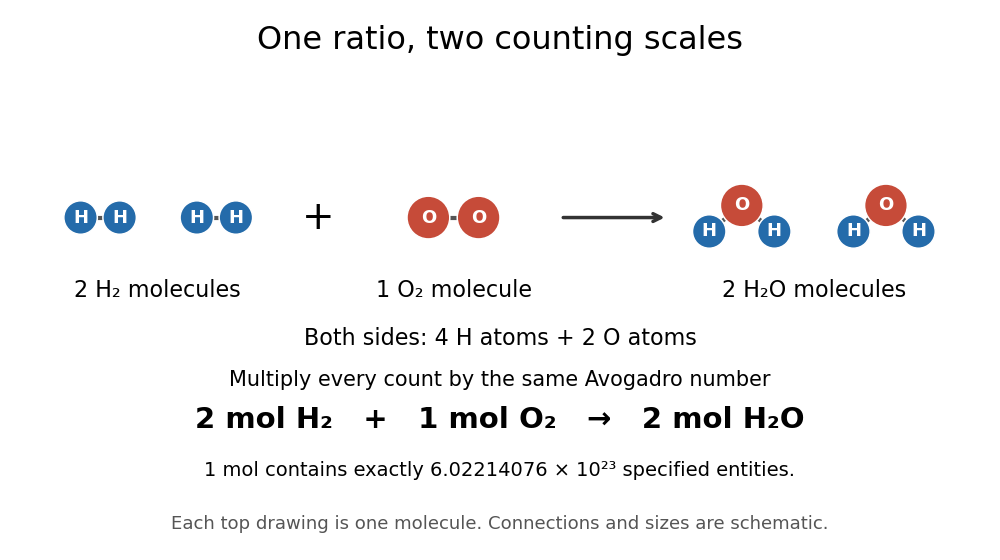
The same stoichiometric ratio at molecular and molar scales
. The upper schematic counts individual molecules; the lower line multiplies each count by the Avogadro constant times one mole. Circle sizes and positions are illustrative. Details.This distinction catches a common counting error: one mole of water molecules contains two moles of hydrogen chemical atoms and one mole of oxygen chemical atoms. Always specify what is counted.
Stoichiometry records reactant and product multiplicities in a chemical reaction or a chemical reaction network. The change caused by one reaction is its stoichiometric vector; multiplying by the reaction rate gives its contribution to the concentration equations. For two identical reactants the rate-constant convention absorbs any combinatorial factor.


Stoichiometry is a branch of chemistry that involves the calculation of reactants and products in chemical reactions. It is based on the conservation of mass, meaning that the total mass of the reactants must equal the total mass of the products in a chemical reaction. Stoichiometry allows chemists to predict the quantities of substances consumed and produced in a given reaction, based on balanced chemical equations.
New to topics? Read the docs here!