
Take the alphabet , fair initial bit , and transition matrixThe stationary distribution is . Every emitted symbol is a fair bit, while the next symbol flips the previous one with probability . For , repeating the previous symbol is the better one-step prediction; for , predicting its opposite is better. The resulting minimum next-symbol error probability is , compared with when no history is used.
Given either state, the next-symbol information entropy is . ThusAt , the best next-symbol prediction succeeds with probability , and the entropy rate is about bits per symbol. The adjacent symbols share mutual information bits. This is useful structure even though the single-symbol counts reveal no bias.
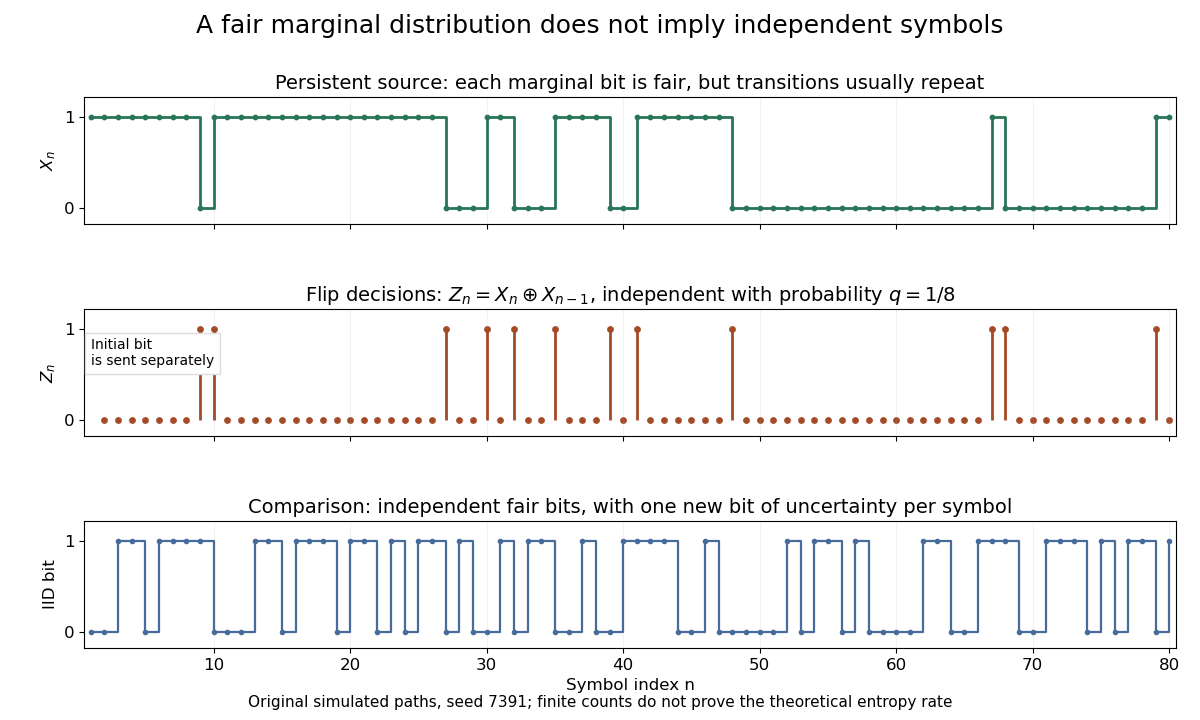

At , the random initial bit is repeated forever; at , it alternates forever. Both have and zero entropy rate. At , the symbols are independent and identically distributed fair bits, giving entropy rate one. Zero rate therefore need not mean that the initial choice was deterministic.
New to topics? Read the docs here!