Take the alphabet , fair initial bit , and transition matrixThe stationary distribution is . Every emitted symbol is a fair bit, while the next symbol flips the previous one with probability . For , repeating the previous symbol is the better one-step prediction; for , predicting its opposite is better. The resulting minimum next-symbol error probability is , compared with when no history is used.
Given either state, the next-symbol information entropy is . ThusAt , the best next-symbol prediction succeeds with probability , and the entropy rate is about bits per symbol. The adjacent symbols share mutual information bits. This is useful structure even though the single-symbol counts reveal no bias.
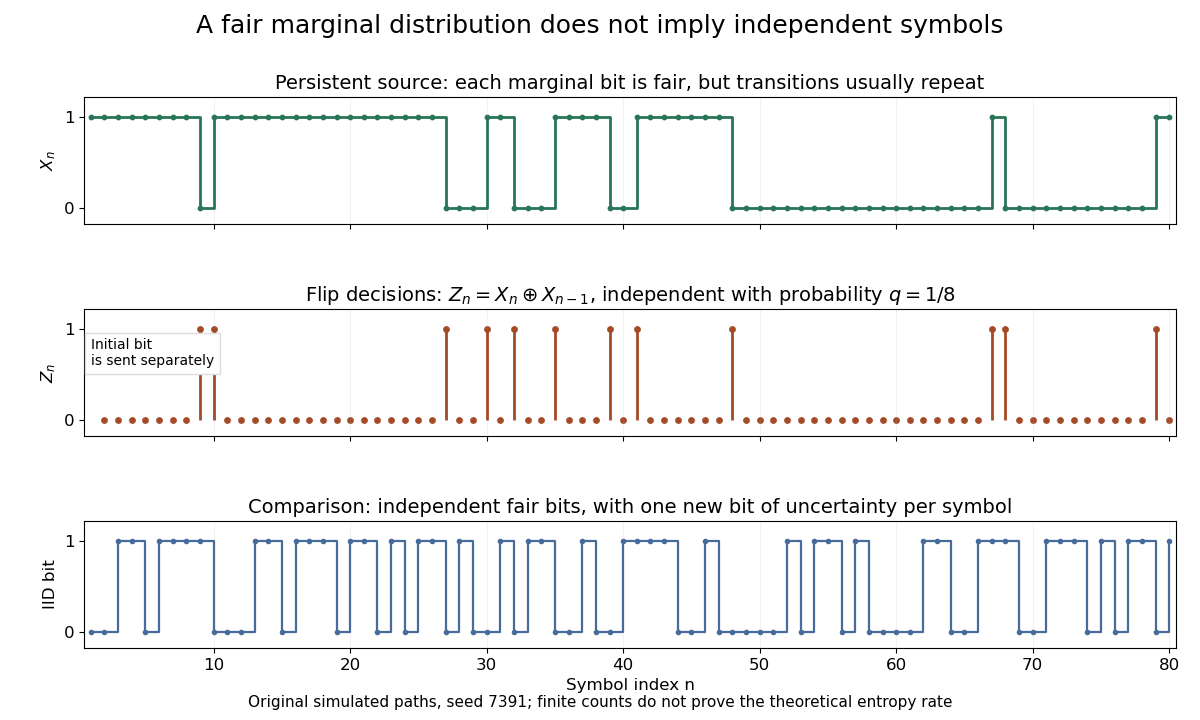

At , the random initial bit is repeated forever; at , it alternates forever. Both have and zero entropy rate. At , the symbols are independent and identically distributed fair bits, giving entropy rate one. Zero rate therefore need not mean that the initial choice was deterministic.
Generate the binary Markov source by taking independent and identically distributed Bernoulli random variables of parameter , independent of a fair initial bit, and setting . Here is exclusive or. Each is the unpredictable flip decision.
The transformation between and is a bijection. It preserves information entropy, soSending the initial bit and encoding the innovation sequence describes every source word exactly. This does not by itself specify a practical compressor, but it identifies the uncertainty which a prefix code or other lossless source coding method must handle.
For a word with flips among its transitions,There are such words: choose the initial bit and the flip positions. At and , each constant word has probability , whereas an independent fair source gives each word probability . Equal marginal probabilities plainly do not imply equal word probabilities.
Articles by others on the same topic
There are currently no matching articles.