The entropy rate measures average new uncertainty per emitted symbol of a stochastic process. Predictability from earlier symbols can make this much smaller than the information entropy of one symbol. For example, a binary Markov source can emit a fair bit at every time while repeating its previous bit with probability : each individual symbol has one bit of uncertainty, but the entropy rate is only about bits per symbol.
For a finite alphabet source , definewhen the limit exists. Base-two logarithms give bits per symbol. Multiplying by a fixed emission frequency gives bits per unit time; the symbol rate and the uncertainty of the sequence are different inputs. A strictly stationary process on a finite alphabet always has an entropy rate, equal to its conditional entropy rate.[ref]
6.441 Information Theory (Spring 2016 lecture notes) by Yury Polyanskiy and others. §5.5, Definition 5.1 and Theorem 5.5, printed p. 57: block entropy and stationary conditional-entropy limit
For an independent and identically distributed source, the chain rule for information entropy gives , hence . With dependence, conditioning reduces entropy and makes the past useful. The examples under Markov information source show this benefit using exact finite-block calculations.
For a strictly stationary process on a finite alphabet, put and for . Each is the average remaining uncertainty in the next symbol after its history is known. More history can improve prediction, so this sequence is nonincreasing:The inequality uses conditioning reduces entropy; the last equality uses strict stationarity. Nonnegative therefore have a limit. By the chain rule for information entropy,The Cesàro mean converges to the same limit, proving the equality with the entropy rate. This is a statement about average information entropy. A constant almost-sure limit of the realized information content requires the further hypotheses in the Shannon-McMillan-Breiman theorem; stationarity without ergodicity in an information source explains the distinction.
Consider a binary Markov source with fair initial bit and flip probability . Its exact -symbol information entropy is . At ,This includes the uncertainty of the initial bit; the entropy rate itself is bits per symbol. The finite-block difference is .
For any finite block distribution, the entropy lower bound for prefix codes gives expected codeword length , while Shannon coding achieves . These bounds apply to each block as one source symbol, without requiring consecutive blocks to be independent. Here Huffman coding on all possible 16-symbol words gives the independently calculated value bits per block, or bits per symbol. The noninteger value is an expected value; each actual codeword has an integer length. As the block length grows, the prefix code bounds squeeze towards the entropy rate when an optimal code is used.
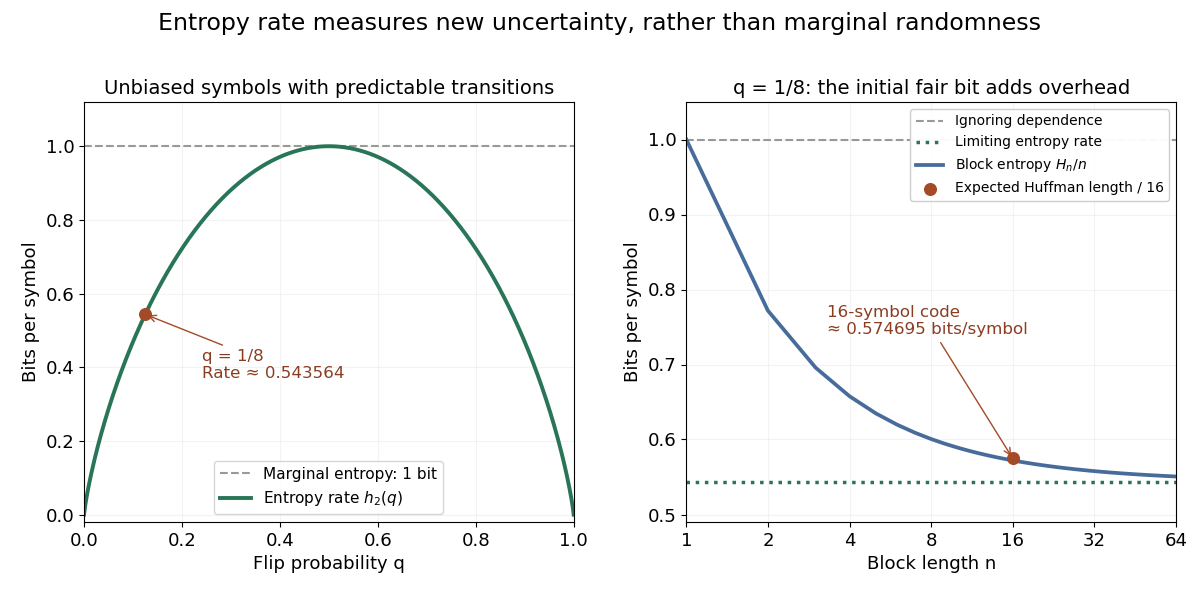
An entropy rate below one does not allow every word to fit into a shorter fixed binary word with zero error. For , all binary words are possible, so an injective fixed-length code needs at least bits. Compression instead exploits variable codeword lengths, or the vanishing-error convention in reliable source encoding at a rate. These are different guarantees.
In A Mathematical Theory of Communication by Claude Shannon, Claude Shannon compares block uncertainty per symbol, denoted , with conditional uncertainty given the preceding symbols, denoted . Theorems 5 and 6 connect both decreasing approximations to the source's limiting uncertainty. He uses symbol statistics at increasing block lengths to expose structure missed by single-letter counts.[ref]
A Mathematical Theory of Communication by Claude Shannon. §7, Theorems 5–6 and discussion, printed p. 14; Appendix 3, printed p. 30: block and conditional entropy approximations
The fair marginal bits of the binary Markov source provide a small exact example of that distinction.A source is reliably encodable at rate if there are block encoders with at most outputs and corresponding decoders whose probability of reconstructing the first source symbols incorrectly tends to zero as .
For a finite-alphabet IID source of entropy , fixed-length block codes of rate have reconstruction success probability tending to zero. At most strings can be correctly reconstructed. Their typical probability is at most , and the atypical probability tends to zero; choose .
// Target: algebra.bigb
For a source and fixed positive integer , form the block source . Whenever the original information rate exists, the blocked source has information rate , because
Articles by others on the same topic


The concept of **entropy rate** is rooted in information theory and is used to measure the average information production rate of a stochastic (random) process or a data source. In detail: 1. **Information Theory Context**: Entropy, introduced by Claude Shannon, quantifies the uncertainty or unpredictability of a random variable or source of information. The entropy \( H(X) \) of a discrete random variable \( X \) with possible outcomes \( x_1, x_2, ...