
A block matrix inverse expresses the matrix inverse in terms of smaller matrices. Partition a square matrix over a field asIf is an invertible matrix, define its Schur complement . Then is an invertible matrix exactly when is an invertible matrix, andThe order of the matrix products matters. In particular, the lower-right block is , rather than generally : the coupling through and changes the response.[ref]
Convex Optimization by Stephen Boyd and Lieven Vandenberghe. Appendix A.5.5, printed p. 650: inverse of a symmetric block matrix; §C.4.1, printed p. 673: elimination for general blocks
For an original example, takeThe Schur complement is . Substitution gives the concise answerMultiplying in either order gives the identity matrix; the lower-right entry is , whereas . The difference records the feedback through the two eliminated variables.
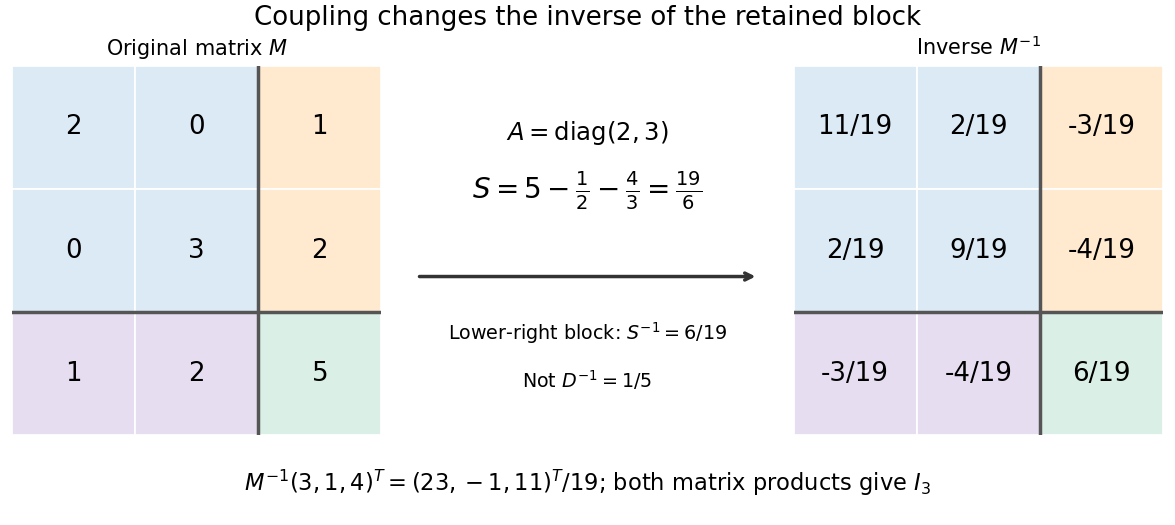

Often the desired output is a solution of a linear system, rather than every entry of a matrix inverse. Block elimination solves with and then with , recovering the eliminated variables by back substitution. Reusing an LU decomposition of avoids explicitly forming . A favourable block diagonal matrix or tridiagonal matrix block can make this useful; merely partitioning an unstructured dense matrix does not guarantee a faster solve.[ref]
Convex Optimization by Stephen Boyd and Lieven Vandenberghe. §C.4.1, printed pp. 672–675: Algorithm C.4, factor-solve interpretation and dense complexity comparison
New to topics? Read the docs here!