For a block matrix with an invertible matrix, the Schur complement of in is . It is the effective coefficient matrix for the remaining variables after block elimination. The definition requires invertibility of , but not of or . Its size is that of , even when and are rectangular matrices.
In the original example under block matrix inverse, becomes because changing the remaining variable also changes the two variables solved through . This is what makes a Schur complement more informative than simply deleting rows and columns. It retains their mediated effect, and its matrix inverse is the corresponding block of when the block matrix inverse exists.
The same elimination appears when minimizing a quadratic form. The Schur complement as a minimized quadratic form gives a geometric example; the Schur complement determinant identity gives an exact test for an invertible matrix.
Let be a real symmetric matrix with a positive-definite matrix. Its quadratic form satisfies the completing the square identityFor each fixed vector , the unique minimizing vector is , so the minimized value is . Also, is a positive-definite matrix exactly when is a positive-definite matrix, under the stated assumption on .[ref]
An original scalar example isHere , , , and the Schur complement is . Holding would give , but letting relax to reduces the quadratic form to . At the respective values are and . Eliminating a variable therefore changes the effective cost of the retained variable.
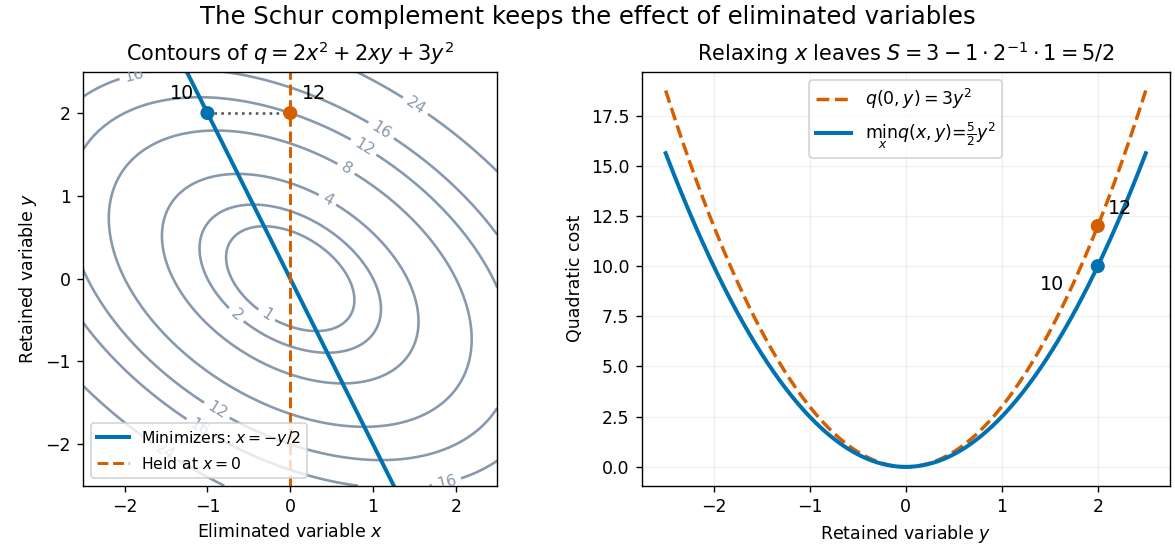
This interpretation supports quadratic optimization and the positive-definite symmetric matrix tests used in Cholesky decomposition. In a multivariate normal distribution, a covariance matrix also gives a conditional covariance through a Schur complement; the required probabilistic hypotheses are supplied by conditional multivariate normal distribution, rather than by the algebra alone.
When is an invertible matrix, the factorization in block elimination has outer triangular factors with determinant one. Hence , without a symmetry assumption. For the original example under block matrix inverse, this gives . An invertible block therefore reduces the question of whether the full matrix is an invertible matrix to the smaller Schur complement; a singular makes a singular matrix.
For a Hermitian matrix, let be its th column without the diagonal entry and let . Solve the two block equations of the inverse against the th coordinate vector to obtain this formula. Both full and minor inverses must exist; nonreal guarantees that. In the real symmetric case may be replaced by .
Articles by others on the same topic


The Schur complement is a concept in linear algebra that arises when dealing with block matrices. Given a partitioned matrix, the Schur complement provides a way to express one part of the matrix in terms of the other parts.