Boltzmann distribution in a four-state system
ID: boltzmann-distribution-in-a-four-state-system

Consider two distinguishable, noninteracting two-level systems, each with energies and . Their four microstates have total energies . Thus the three energy macrostates have state degeneracies . This is a stipulated finite model, not a measured material.
Set . The four individual Boltzmann factors are , so the partition function and aggregate probabilities areEach of the two middle microstates has probability , while their shared energy macrostate has probability .
At the temperature satisfying , the Boltzmann factor is and the partition function is . ThereforeThe middle energy is as likely as the ground state energy because its state degeneracy is twice as large. Yet each individual middle microstate is only half as likely as the ground state microstate. The diagram places the four energies beside their individual probabilities, then shows the sums within each macrostate.
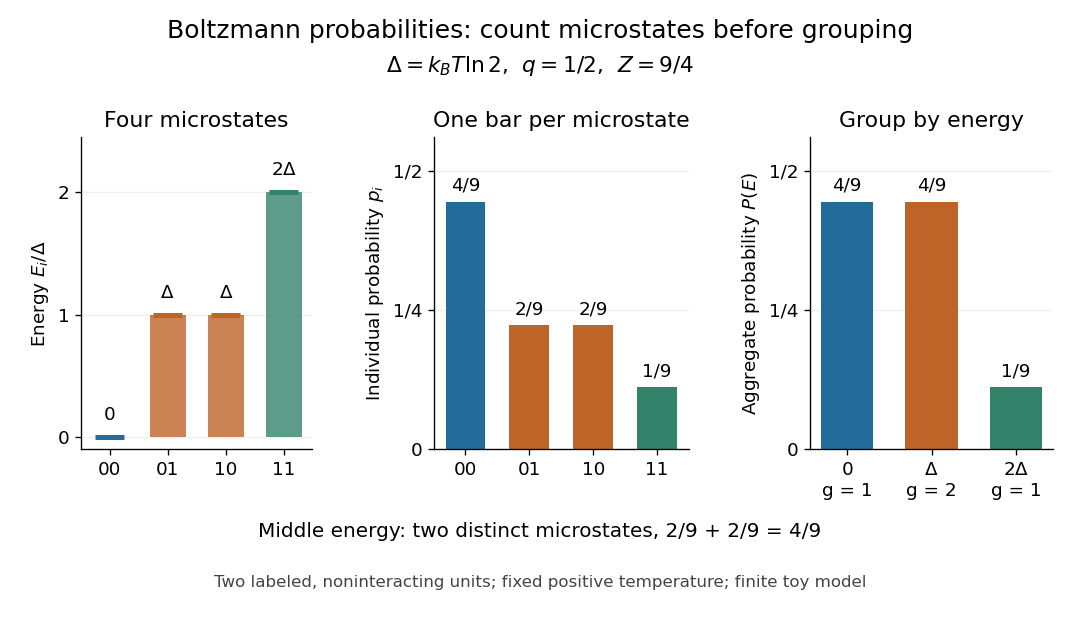

The expected value of energy follows directly by weighting the three possible energies:At this is . An individual energy measurement still returns , or ; the expected value describes the ensemble average, rather than a fourth possible measured energy.
New to topics? Read the docs here!