This counts microstates sharing a macrostate; when the shared quantity is energy, it gives the multiplicity of degenerate energy levels. The degeneracy of a macrostate labelled by is the number of distinct microstates having that value of .
When a single-particle energy is independent of its spin projection and all projections are available, the state degeneracy due to spin is . A spin-half gas has if both projections are available, while a fully polarized gas can have one populated spin species. A magnetic field that resolves Zeeman splitting requires counting the separate energies instead of multiplying one common occupancy by .
A degeneracy factor counts distinct microstates sharing the same specified energy or other grouped quantum labels. If an energy level has multiplicity , its contribution to the canonical partition function is . The probability of occupying that entire level is consequently proportional to both its Boltzmann factor and its state degeneracy.
For a lower nondegenerate level at zero energy and an upper level at with degeneracy factor , the upper-level probability is . Equal level probabilities occur at , rather than necessarily at equal energies. This makes state counting a source of observable entropic shifts. The multiplicity must match what has already been counted explicitly; summing separately over spin states and then multiplying by the same spin multiplicity would double-count microstates.
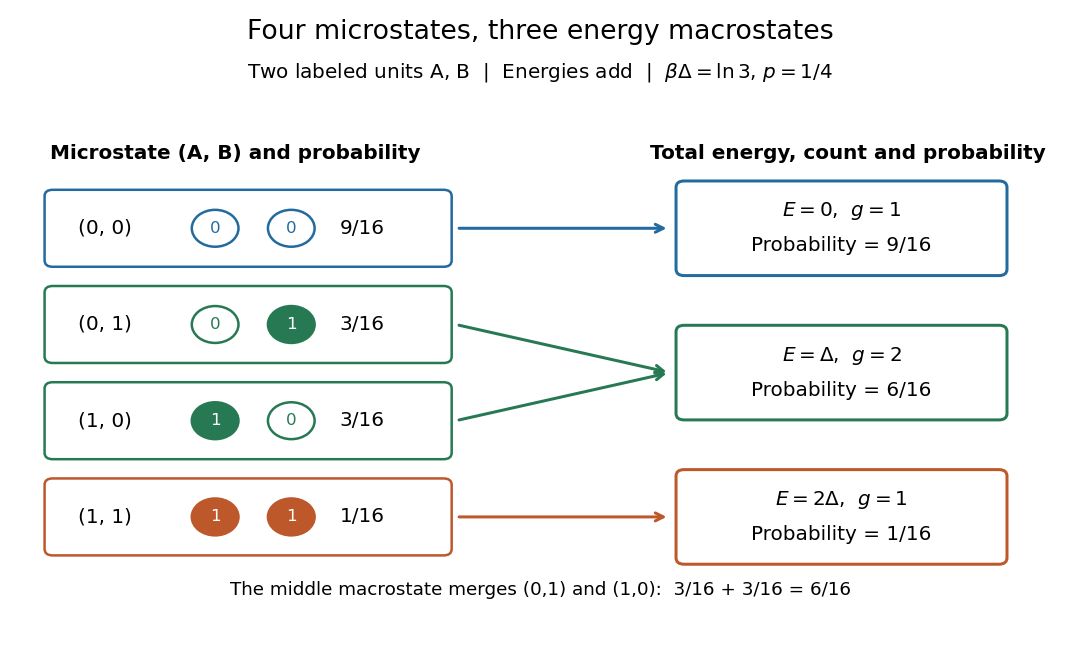
A microstate is a complete microscopic specification within the chosen model. For two distinguishable, noninteracting two-level systems, label the units and their states , with energies and . The four microstates arewith total energies . Distinguishability matters: and describe different assignments to the labeled units. Noninteraction matters too: their energies add without an extra coupling term.
For a classical particle model, a microstate can instead be a point in phase space, specifying every position and momentum. In the quantum canonical ensemble, the sum uses energy eigenstates; a general quantum state may also contain quantum coherence, which an energy label alone does not specify.
A macrostate groups microstates sharing prescribed coarse data. The grouping depends on what is retained: here retain only total energy. For the two distinguishable two-level systems, the macrostates have state degeneracies . Although two units are not macroscopic in size, they make this loss of information visible: knowing does not tell us which unit is excited.
At inverse temperature , each unit's excited-state probability is . Their independence gives microstate probabilities in the order above. Adding within each macrostate givesThe total expected value of energy is therefore , matching two units each with expected value of energy . Equal state degeneracies would give the wrong answer: macrostate probabilities combine counting with the Boltzmann factor. At very high positive temperature, all four microstates become equally likely, but these three macrostate probabilities approach .

Articles by others on the same topic
There are currently no matching articles.