Capacitor gap aspect ratio
ID: capacitor-gap-aspect-ratio

The capacitor gap aspect ratio compares the gap with a lateral plate width . For rectangular plates of widths , require both and for the leading parallel-plate capacitor approximation. Large area alone is insufficient: a long narrow strip can have large area and still have comparable with its smaller width. In addition, the observation point must be many gap widths from an edge. Reducing improves the interior approximation without making the edge itself disappear.
In a two-dimensional straight gap, write the electric potential as the infinite-plate solution plus a perturbation:The perturbation satisfies the Laplace equation and vanishes on the two ideal plates. Separation of variables in a semi-infinite strip, with the distance inward from its entrance, gives transverse modesThus edge disturbances have a natural penetration scale set by . Modes forbidden by a particular symmetry have zero coefficients; this expression is an explanation of localization in an ideal strip, not a universal numerical correction to finite-plate capacitance. The outside boundary conditions determine the coefficients.
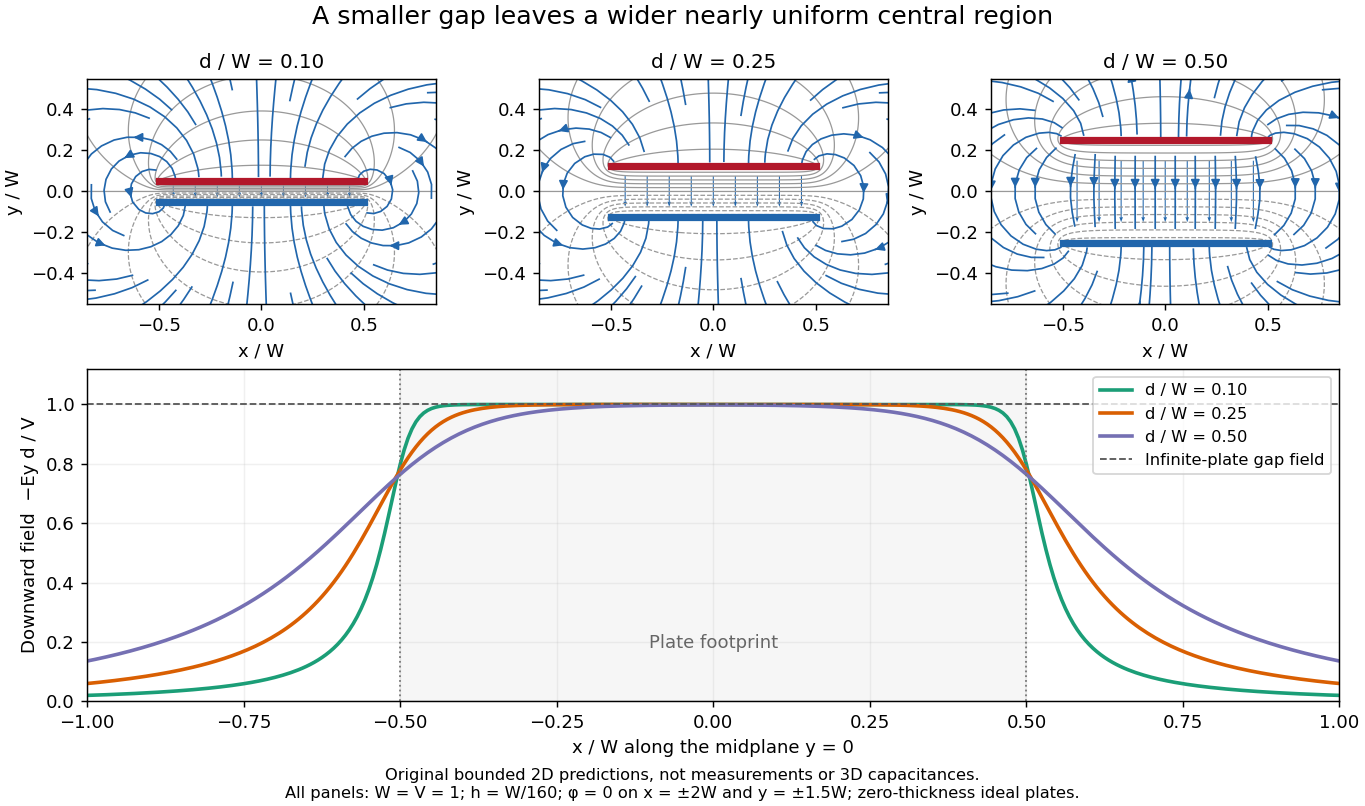
Capacitor gap aspect ratio and the width of the nearly uniform electric field region
. Three original solutions of the same bounded two-dimensional capacitor field model at . The lower curves show on the midplane ; the dashed reference is the infinite-plate value inside the gap. The dashed value is not the infinite-plate prediction outside the plate footprint. All curves are calculated, with the same mesh and outer Dirichlet boundary conditions; they are neither measurements nor an exact open-domain three-dimensional capacitance calculation. Details.
There is no single aspect-ratio cutoff guaranteeing an assigned accuracy: the requested observable, plate shape and thickness, surroundings, dielectric distribution, and guard geometry all matter. The small-gap approximation is local and is not uniform across an edge. It also does not justify extrapolating to arbitrarily large , where finite electrical conductors and their external electric field dominate. At fixed , formally shrinking an ideal gap makes the interior electric field grow like ; real electric currents across an imperfectly insulating gap, surface roughness and contact eventually invalidate that ideal limit.
New to topics? Read the docs here!