A parallel-plate capacitor consists of two parallel electrical conductors with overlapping area and separation . If the gap is small compared with both plate widths and is filled by a uniform material of positive permittivity , its capacitance is approximatelyThis neglects the fringing field of a capacitor near the plate edges. The interior electric field points from the plate of positive electric charge to the plate of negative electric charge, and is approximately uniform. [ref].
For a worked vacuum example, stipulate , , and vacuum permittivity . This rounds the value in Fundamental Physical Constants — Complete Listing by National Institute of Standards and Technology and others. Within the approximation,At terminal electric potential difference , the electric field magnitude is , the plate electric charge magnitude is , and the capacitor energy is . These numbers use the stipulated rounded vacuum permittivity; finite plates also have corrections from the fringing field of a capacitor.
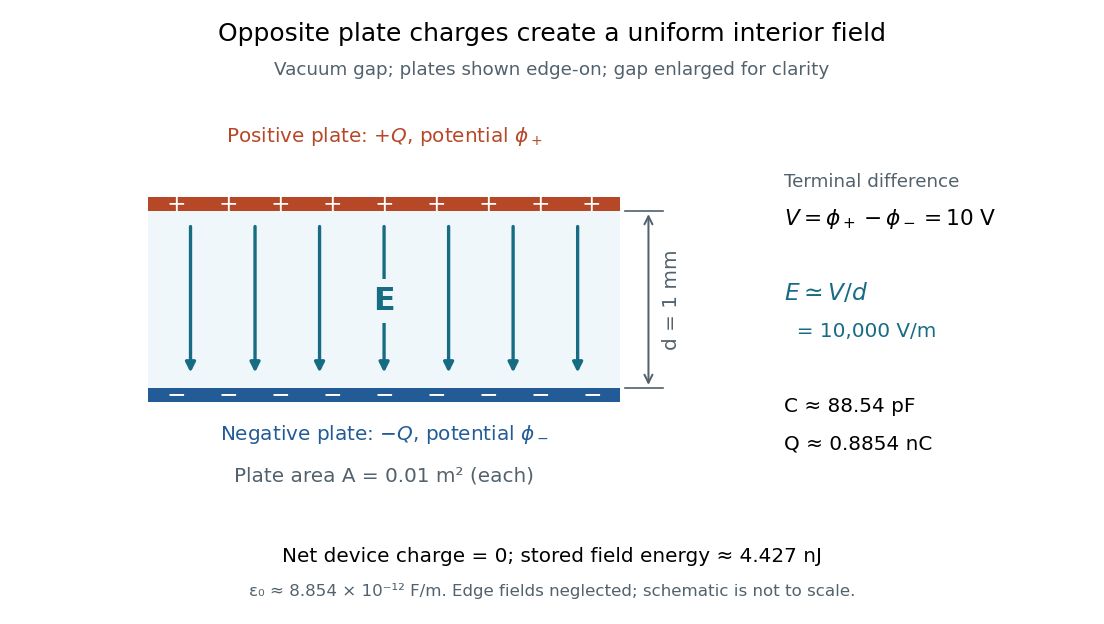

The formula makes design changes easy to predict: doubling the overlapping area doubles the capacitance, and halving the gap doubles the capacitance, with permittivity fixed and the fringing field of a capacitor neglected. Doubling permittivity also doubles capacitance if the material uniformly fills the gap and remains linear. This lets a compact device store more separated electric charge at the same terminal electric potential difference.
The short derivation uses surface charge density . In the interior, Gauss's law gives electric field magnitude . The electric potential difference is , so dividing by gives . A narrow curved capacitor gap has the same leading local approximation when its width is much less than the curvature radius.
Articles by others on the same topic
There are currently no matching articles.