Cold-junction compensation
ID: cold-junction-compensation

Cold-junction compensation converts a reading with reference temperature into the equivalent reading for a chosen standard reference. Define the thermocouple reference function , where means , not absolute zero. Additivity of the definite integral givesThe final inverse function requires a suitable one-to-one calibration interval. A terminal thermometer supplies independently; the raw thermocouple electric potential difference supplies only the difference of the two reference-function values. In general, first converting to a temperature and then adding is wrong, because the thermocouple reference function need not be linear. The SCC-TC manual explicitly adds the reference-equivalent voltage before its final voltage-to-temperature conversion.[ref]
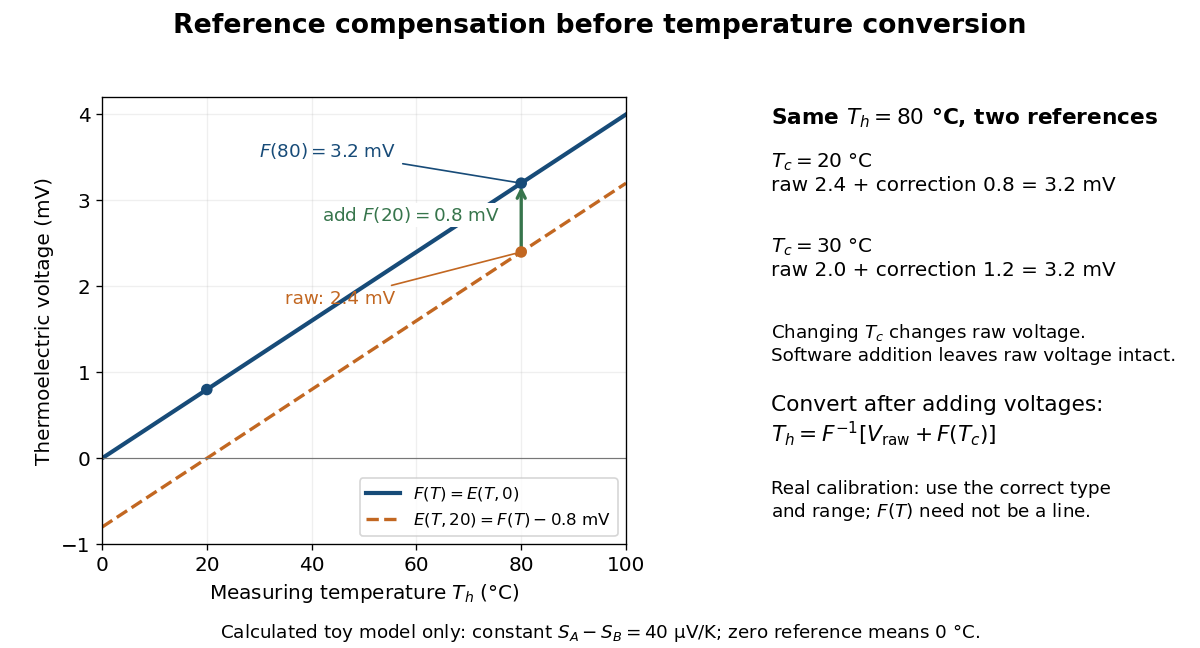
For a stipulated model only, take throughout the interval. No actual material pair is assigned this constant. Because degree Celsius differences have the same numerical size as kelvin differences,In this model and . Adding the correction produces , whose inverse calibration gives . Applying the zero-reference calibration directly to would instead display .
Now physically change only the reference temperature to , leaving the measuring junction at . The raw reading becomes ; the correction becomes , so the corrected total stays . Physically changing the reference changes the measured electric potential difference. Adding a software correction changes its interpretation and leaves the raw reading intact. If the actual reference is but the software still assumes , this model displays .

An actual implementation in FP-TC-120 and cFP-TC-120 Operating Instructions by National Instruments (p. 7, Cold-Junction Compensation) uses terminal-mounted temperature sensors, reports their reading as “CJ Temperature”, and enables compensation in temperature mode but not voltage mode. This makes the distinction between a raw voltage readout and a compensated temperature readout observable. The specified reference-sensor range also produces an out-of-range indication: a calculated number outside a supported range is not a validated measurement.[ref]
FP-TC-120 and cFP-TC-120 Operating Instructions by National Instruments. p. 7, Cold-Junction Compensation: mode selection, CJ Temperature and out-of-range reporting
New to topics? Read the docs here!