
A coronagraph is an optical instrument that suppresses a bright source's light before detection while transmitting some light from nearby directions. Its purpose is to reveal faint structure buried in the bright source's point spread function, as in exoplanet direct imaging. A Lyot coronagraph combines a coronagraphic focal plane mask with a Lyot stop in a reimaged optical pupil; blocking the central image alone does not remove its diffraction rings. [ref].
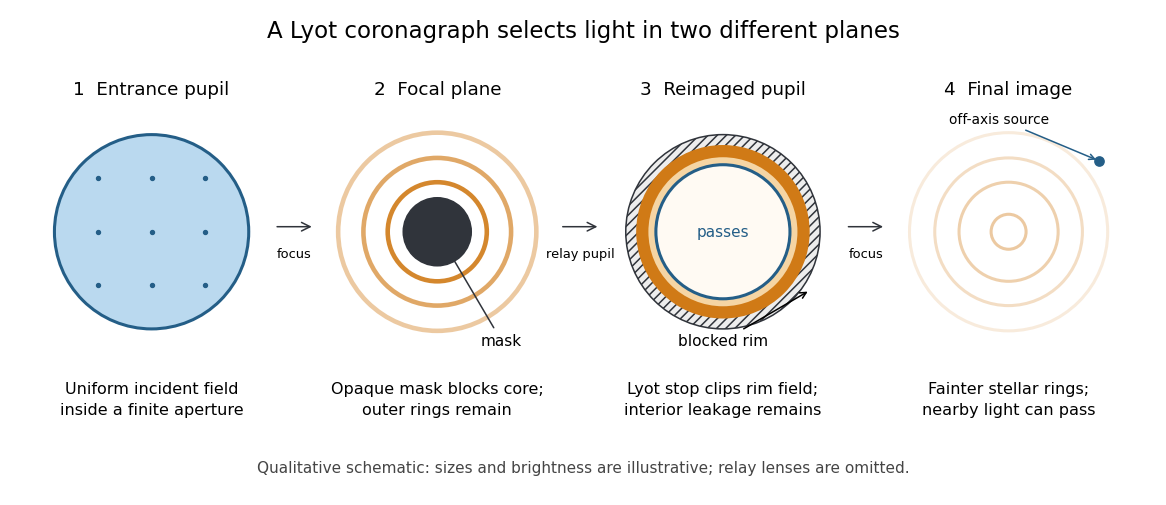
The four principal planes of a Lyot coronagraph: a focal plane mask and a reimaged optical pupil stop select different parts of the wave amplitude distribution. Qualitative schematic, with illustrative sizes and brightness.
Details. 
The original motivation was the solar corona: hiding the bright photosphere would allow longer, repeated observations of faint surrounding light. In his 1930 paper, Lyot explained that short total eclipses restricted observing time and prevented some long exposures for spectral lines. The attraction is an instrument that makes the faint neighborhood accessible on demand. [ref]
https://www.persee.fr/doc/bastr_0245-9760_1930_num_6_1_14031. Bernard Lyot, La couronne solaire étudiée en dehors des éclipses, 1930, p. 305
. The Sun is an extended source; the point-source calculation below illustrates imaging of an unresolved star and is not a quantitative model of the solar corona. New to topics? Read the docs here!