Correlation-length scaling from a thermal direction
ID: correlation-length-scaling-from-a-thermal-direction

Add a thermal scaling coordinate , with its critical value subtracted, satisfyingThis is a relevant direction of a fixed point. A thermal scaling coordinate agrees to leading order with a nonzero multiple of reduced temperature; in a general model it can mix several bare parameters. An ordering conjugate field is held at its critical value. The combined stability matrix at has eigenvalues and . Attraction along therefore does not make the critical point attractive against thermal detuning. The critical surface in this example is .
Let denote the correlation length in microscopic lattice units. A renormalization-group transformation of length factor givesIndeed, a tail with exponential envelope becomes under . Choose the stopping scale so that the transformed thermal coordinate is or . If the stopped correlation length tends to a finite nonzero value as the irrelevant coupling approaches , thenThe limit requires and enough room between , , and the sample size. Singular dependence on a dangerously irrelevant coupling or a marginal operator needs separate analysis. On an ordered branch, use the connected correlation function in a pure thermodynamic phase.
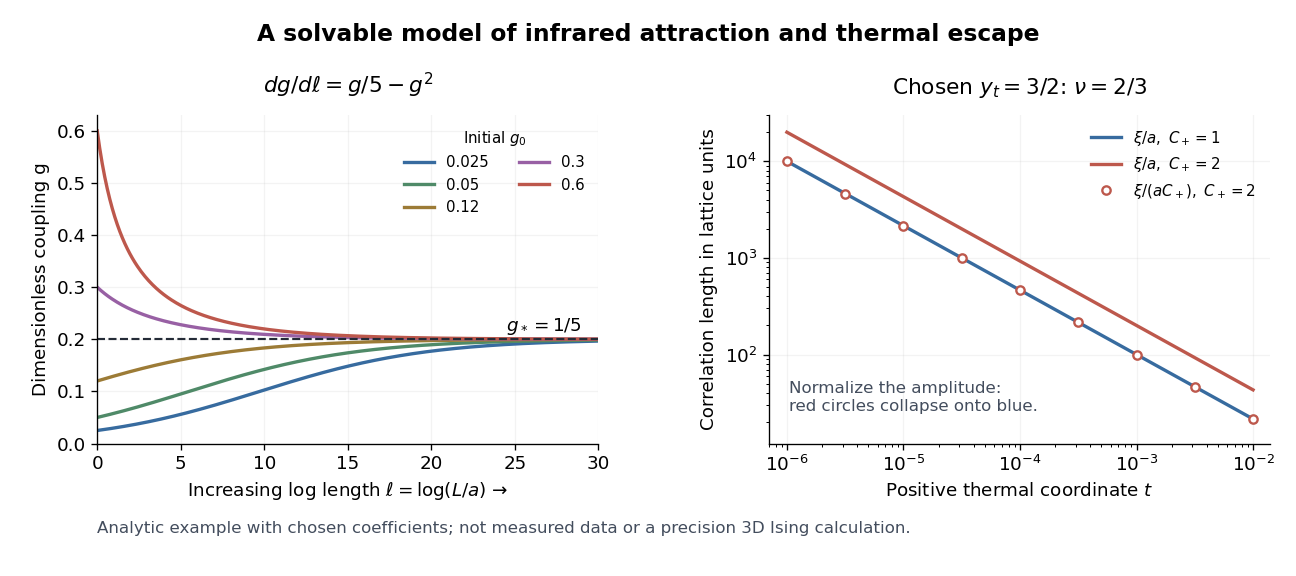
For a completely specified illustrative scaling model choose and for . Then gives , whereas gives . With , and . Models with and have different lengths but identical curves after plotting against . This collapse checks the chosen scaling law; agreement of real data would test that law, rather than follow from this example. Neither nor is being fitted to a three-dimensional Ising model.

New to topics? Read the docs here!