Couette flow with a slipping lower wall
ID: couette-flow-with-a-slipping-lower-wall

Consider steady flow of a Newtonian fluid in incompressible flow with constant dynamic viscosity between parallel plates at and . The bottom plate is stationary and obeys the Navier slip boundary condition with slip length . The top plate moves at velocity and obeys the no-slip boundary condition. There is no streamwise pressure gradient or body force. The Couette flow solution isHere is the constant shear stress magnitude. The lower wall's Navier slip boundary condition holds exactly because . At the top, is exactly the prescribed no-slip boundary condition; no finite upper-wall slip length is imposed in this example.
For a numerical example, stipulate , , and . The bottom velocity is and the shear stress is , compared with when both plates obey the no-slip boundary condition. The extrapolated profile reaches zero at .
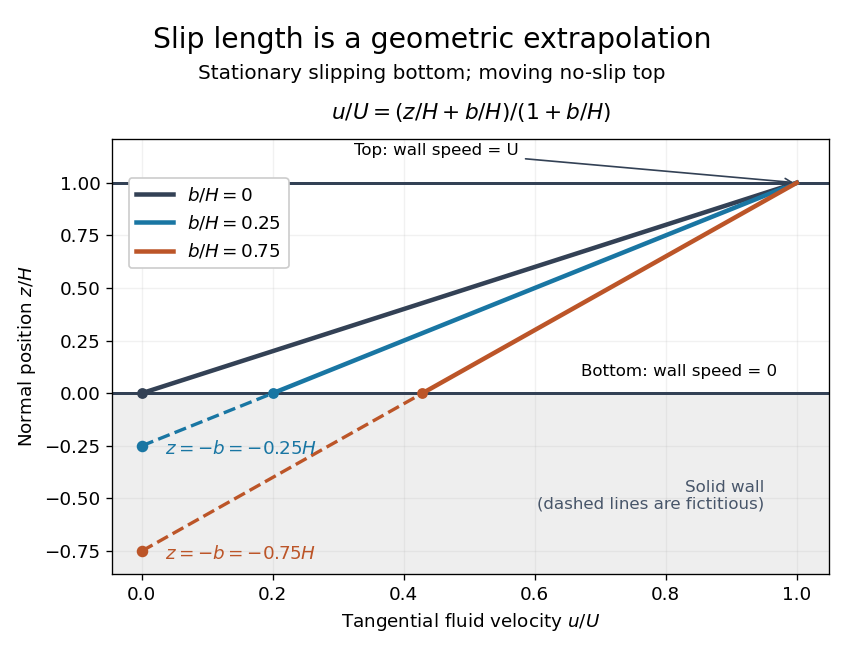

For fixed , and , recovers . As , throughout the gap and : the moving upper wall selects the limiting uniform velocity, while the lower wall approaches a stress-free boundary condition. The dynamic viscosity stays positive; the disappearing shear stress comes from the disappearing velocity gradient.
A short derivation uses unidirectional flow: the convective acceleration vanishes and the Navier-Stokes equation reduces to . Write . The bottom condition gives and the top condition gives .
New to topics? Read the docs here!