
For constant wave speed , the whole-line Cauchy problemhas the unique classical solution, for and ,The first term evolves displacement released from rest; the second evolves initial velocity. The factor converts an integral of velocity over distance into displacement. On a finite string the formula applies before the backward characteristic curves reach an endpoint, or globally after an extension that enforces the boundary conditions. [ref]
For a completely smooth example, choose a bump function with compact support:where sets the half-width and sets the initial peak. ThenAt the two copies coincide, recovering peak . At , . At the pulses are separated, centred at , each of width and peak . Zero initial velocity forces equal left and right contributions; a purely right-moving initial profile instead requires . Thus “released from rest” and “launched to the right” describe different Cauchy data.
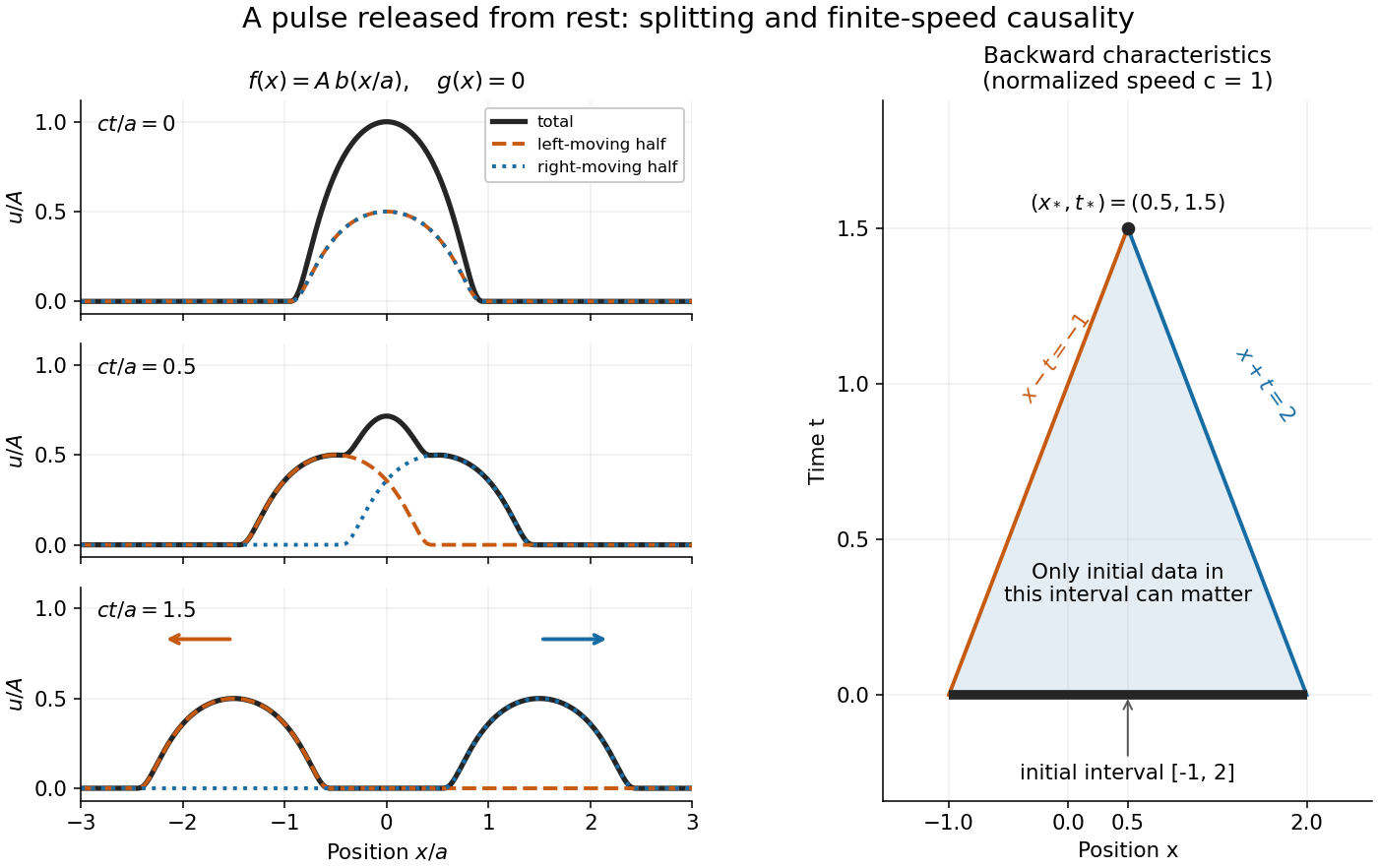
A smooth pulse released from rest splits in two, while backward characteristics select a causal interval
. Details. 
The domain of dependence of , for , is contained in on the initial line. More precisely, displacement contributes only through the two endpoints, while initial velocity contributes throughout the interval. With , and , that interval is . Changing either initial datum outside it cannot change . If both initial data vanish outside , the solution vanishes outside : this is finite propagation speed. The expanding interval bounds possible influence; it need not be filled by nonzero displacement, as the separated bumps demonstrate.
Historically, d'Alembert studied the vibrating-string problem in “Recherches sur la courbe que forme une corde tendue mise en vibration”, in the Berlin Academy's volume for the year 1747, pages 214–219. The memoir introduces the differential equation and integrates it through two arbitrary one-variable functions. The original geometric problem makes the formula's enduring appeal clear: arbitrary initial shapes can be handled without first decomposing them into normal modes. [ref]
https://webusers.imj-prg.fr/~david.aubin/cours/Textes/Dalembert-HAB-1747-cordes-vibrantes.pdf. D'Alembert, vibrating-string memoir, Academy year 1747
For a brief derivation, use characteristic coordinates and . The chain rule gives , so . The initial conditions yield and . Integrating these relations gives the displayed formula; the arbitrary integration constants cancel in their sum.
New to topics? Read the docs here!