Discovery of the first pulsar
ID: discovery-of-the-first-pulsar

Jocelyn Bell Burnell helped build Antony Hewish's radio telescope for finding compact sources through interplanetary scintillation in the solar wind. Operating it and inspecting its chart recorder output in 1967, she recognized an unusual recurring trace, checked earlier charts, and obtained fast recordings resolving pulses in late November. Her observation, recognition and persistent analysis were indispensable.[ref]
Little Green Men, White Dwarfs or Pulsars? by Jocelyn Bell Burnell. Little Green Men, White Dwarfs or Pulsars?, construction through November recordings
The 1968 paper by Antony Hewish, Jocelyn Bell Burnell (bylined S. J. Bell), J. D. H. Pilkington, P. F. Scott and R. A. Collins reported spacing and proposed compact-star oscillations. Its radio telescope had 2,048 full-wave dipole antennas in sixteen rows. Four receivers selected declinations; two array halves formed an east-west interferometer. The receivers passed . Observations used receiver time constant and Rapidigraph chart recorder with time constant; radio second pips calibrated timing.[ref]
Observation of a Rapidly Pulsating Radio Source by Antony Hewish and others. Observation of a Rapidly Pulsating Radio Source, Nature 217, p. 709, opening and Position and Flux Density
Antony Hewish checked sidereal time recurrence. Jocelyn Bell Burnell recalls that P. F. Scott and R. A. Collins reproduced the pulses with another telescope and receivers, while J. D. H. Pilkington measured pulsar dispersion delay: independent checks of instrument independence and intervening plasma.[ref]
Little Green Men, White Dwarfs or Pulsars? by Jocelyn Bell Burnell. Little Green Men, White Dwarfs or Pulsars?, follow-up controls
A useful numerical comparison uses the approximate sidereal time day of . Relative to a schedule, the same sky direction transits about earlier each day, or after ten days. This compares successive passages through the receiving beam; it is a different clock from the roughly pulse spacing within one passage. Sky recurrence alone cannot rule out every transmitter or reflection, and pulsar dispersion delay alone does not uniquely establish an emission mechanism. Their strength lies in independent constraints agreeing.
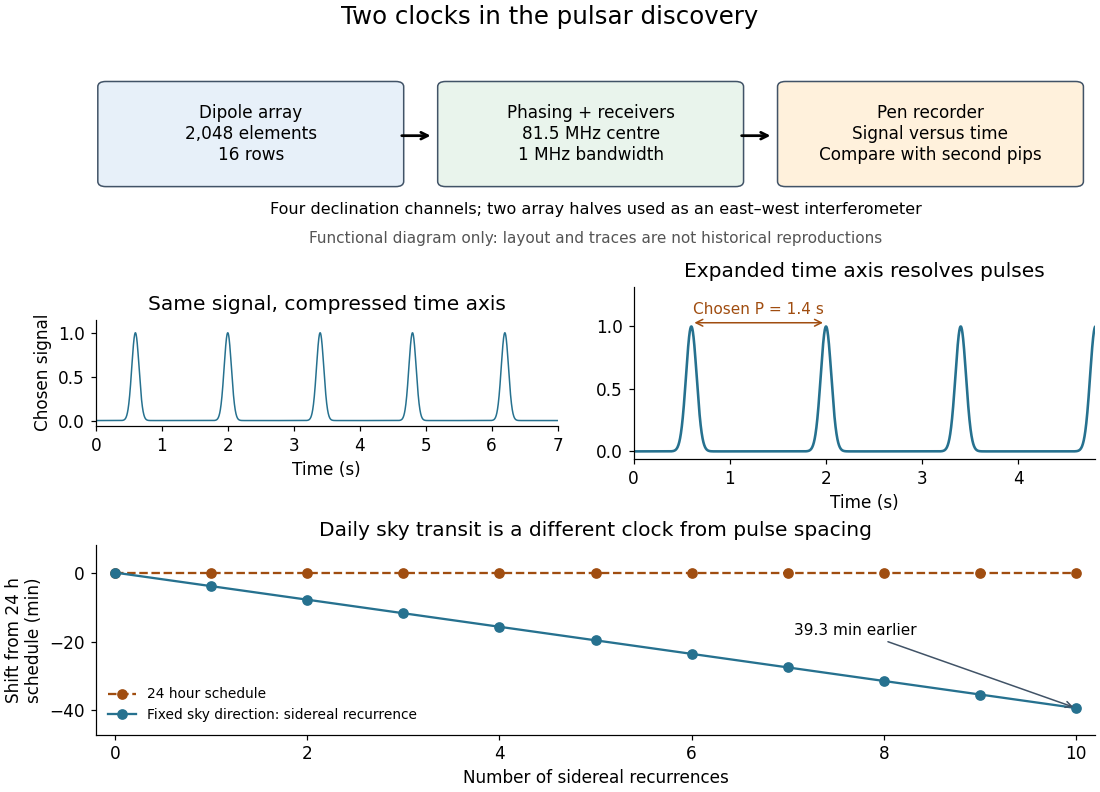

The discovery lesson is that an unexpected signal must survive changes of readout, instrument and observing date. Increasing chart recorder speed exposed structure hidden in a compressed trace; it did not make the source begin pulsing. The pulsar interpretation now separates the rotating clock, beam geometry, pulsar magnetosphere emission and pulsar dispersion delay. The initial observation established periodic arrival, not a direct measurement of the neutron star's surface motion or radius.
New to topics? Read the docs here!