A radio wave traversing a dilute cold plasma has a group velocity that depends on its frequency. In the ideal unmagnetized limit, the dispersion relation is , where is the angular plasma frequency. For , differentiate to obtain , then expand to first order. The excess travel time over a vacuum path isHere is ordinary frequency, is the magnitude of the elementary charge, is the electron mass, is the vacuum permittivity, is Electron number density, and is the speed of light. This approximation neglects magnetic corrections, collisions and multipath scattering; its positive sign means lower frequencies arrive later.
The integrated Electron number density along the line of sight, conventionally quoted in . A dispersion measure is a column, not a unique distance: converting it into distance requires a model of the interstellar medium. A clumpy nearby column and a longer dilute column can give the same pulsar dispersion delay.
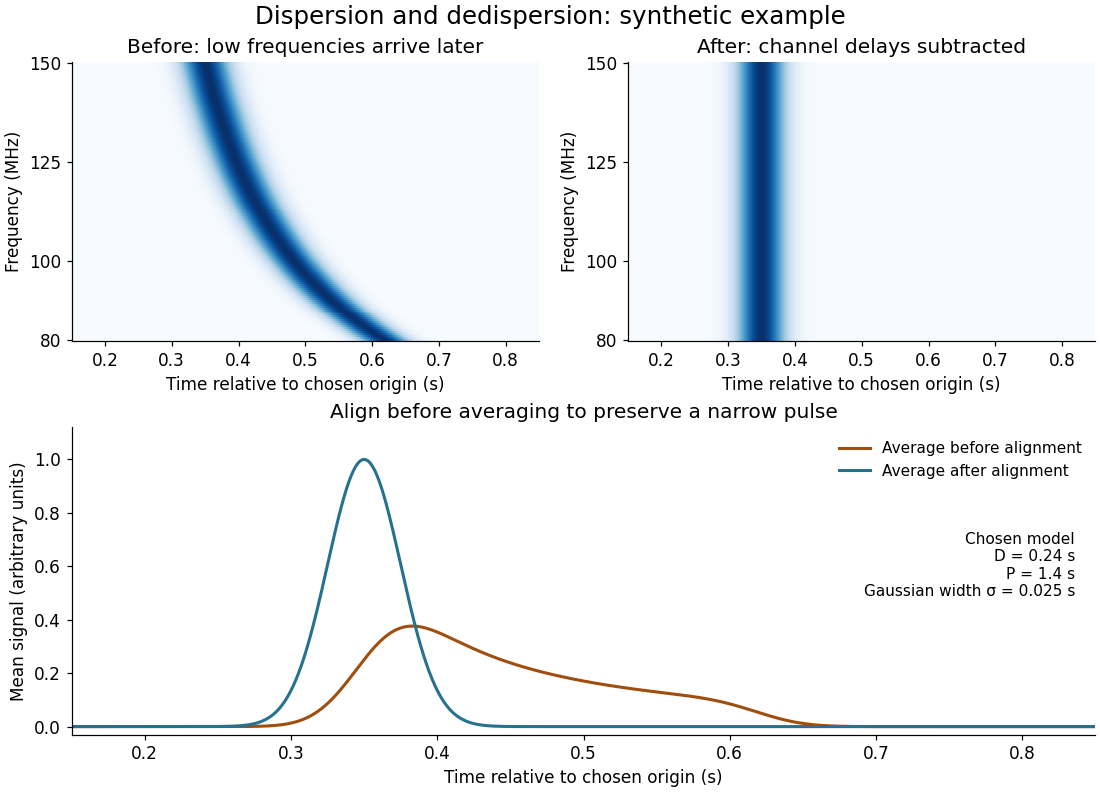
Pulsar dedispersion aligns radio wave arrival times in separate frequency channels before combining them. For an original illustrative model chooseBoth bracketed ratios are dimensionless, so supplies all the time units. The reference is : delays are there, at , and at . These are chosen model values, not measurements of the first pulsar. Subtracting the delay aligns the peaks; summing channels first spreads a short pulse over a longer interval and reduces its peak. Finite channel width and incorrect delay parameters leave residual smearing.

Articles by others on the same topic
There are currently no matching articles.