
The dynamic viscosity is the coefficient relating shear stress to shear rate in a Newtonian fluid. For a simple shear flow ,Here is the component of viscous traction on a plane with normal vector . The shear rate has units . Thus dynamic viscosity measures the stress required to sustain a given rate of deformation. It is the shear coefficient; the separate coefficient for volume change is volume viscosity. [ref]
https://www.homepages.ucl.ac.uk/~uceseug/Fluids2/Slides_1.pdf. UCL, Fluid Mechanics II, Forces in Fluids, slides 4–5
For a worked Couette flow example, place a Newtonian fluid of constant dynamic viscosity between parallel plates separated by . Hold the lower plate fixed and move the upper plate at . Assume steady flow, no streamwise pressure gradient, and the no-slip boundary condition. ThenThe fluid pulls backward on the moving plate with force magnitude , where is its wetted area. For this is . Measuring that force, the gap and the plate velocity determines : a direct way to measure dynamic viscosity. The linear profile and opposing wall tractions are the standard plane Couette flow solution. [ref]
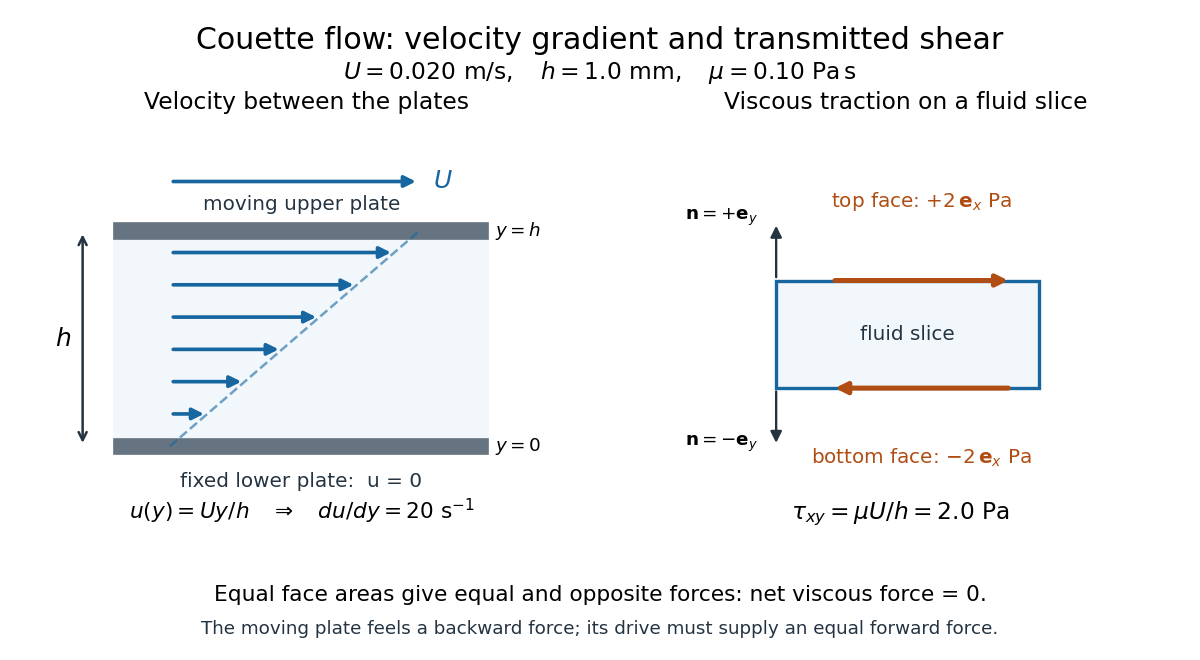

The velocity gradient matters, rather than the velocity itself. Adding the same constant velocity to both plates and the fluid leaves , and hence shear stress, unchanged. In uniform flow, every layer translates together and . More generally, even a nonzero velocity gradient need not generate viscous stress: solid-body rotation has zero strain-rate tensor, as the viscous stress tensor example shows. Thin gaps amplify shear stress for a fixed plate-speed difference, making dynamic viscosity useful for predicting the force needed to move lubricated surfaces.
New to topics? Read the docs here!