
An edge contraction merges the two endpoints of an existing edge. For a finite simple graph and , replace by a new vertex . Retain every edge with neither endpoint in , and join to every member ofHere and denote the original open graph neighbourhoods, and is the new graph neighbourhood. Remove the self-loop arising from and merge duplicate edges, so the result is again a simple graph. This is not deletion of , which keeps both original vertices.[ref]
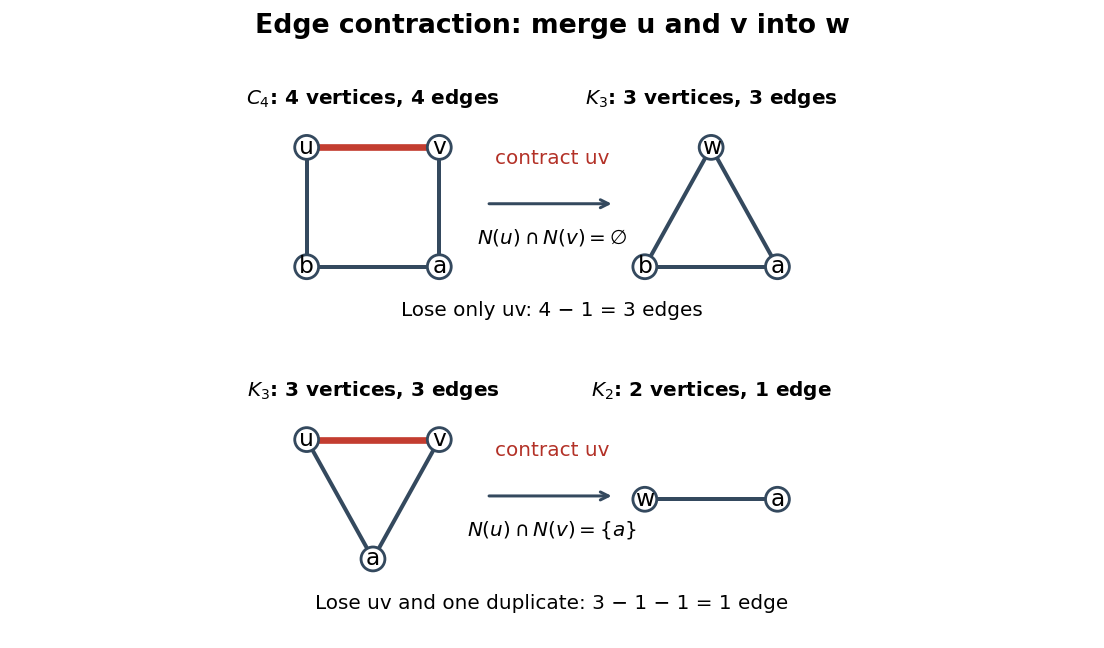
Edge contraction of a four-cycle and a triangle in a graph: common neighbours determine the lost edge count
. Details. The left example contracts in the cycle graph to give . Its endpoints have no common neighbours, so four edges become three. The right example contracts in the triangle in a graph with edges . Its endpoints have the single common neighbour , so the two edges become one edge : three edges become one.
For any such edge contraction, the exact counts areThe contracted edge accounts for one loss. Each common neighbour contributes exactly one further loss, since become a single edge . All other edges correspond one-to-one to surviving edges. In particular the new degree of a vertex isThese formulas depend on simplifying to a simple graph; a multigraph convention that retains duplicate edges has different counts. In the six-vertex branch set of a graph minor diagram, contracting loses one edge, contracting the resulting loses two because of its common neighbour , and contracting loses one. Hence its seven edges become the three edges of : .
An edge contraction can increase a degree of a vertex even while decreasing both total counts. For example, contracting in the tree with edges merges two vertices of degree of a vertex three into one of degree of a vertex four. This is the mechanism behind the distinction between a graph minor and a topological minor.


Edge contraction is a fundamental operation in graph theory that involves modifying a given graph by merging two adjacent vertices into a single vertex. This operation is often used in various algorithms and theoretical contexts, such as simplifying graphs, network flow problems, and studying graph properties. Here's how edge contraction works: 1. **Consider an edge** \(e\) between two vertices \(u\) and \(v\) in a graph \(G\).
New to topics? Read the docs here!