A branch set of a graph minor is the connected region representing one target vertex. For finite simple graphs and , a witness to assigns a nonempty set to each , such that the sets are pairwise disjoint, each induced subgraph is a connected graph, and every has a witnessing edge of between and . Extra edges between branch sets of a graph minor are allowed: they can be deleted. Unused vertices are also allowed.[ref]
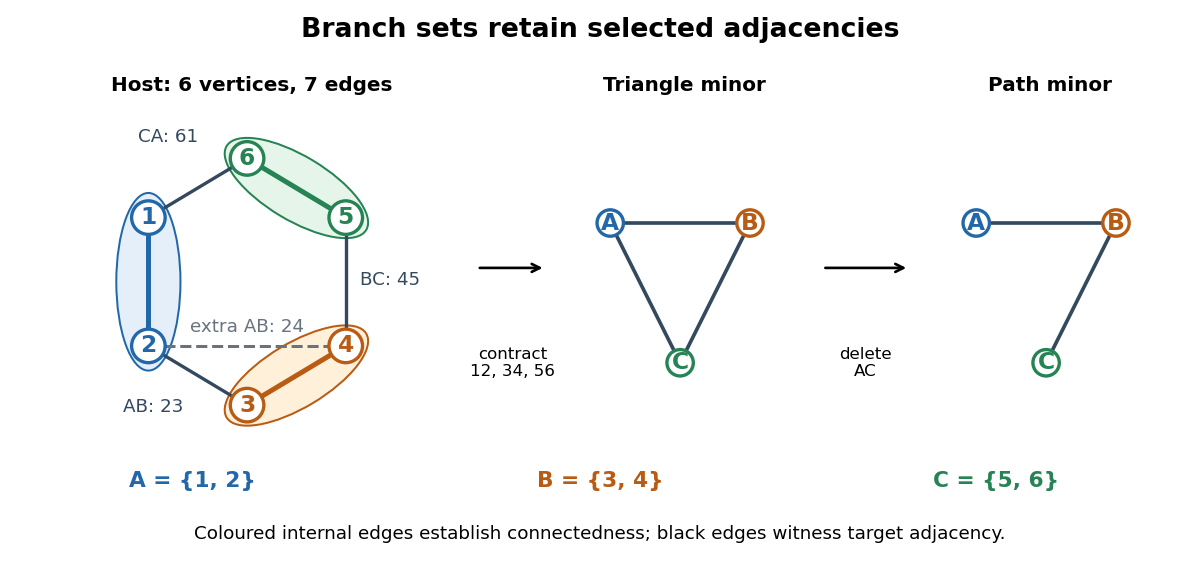

In the diagram, the host graph has vertex set and edgesChoose , , and . Their internal edges establish connectedness. The edges witness , respectively, so they form a model of the complete graph . The additional edge also joins to ; it supplies another witness for the same target edge, not a fourth target edge. Contracting and merging duplicate edges gives exactly .
The same branch sets of a graph minor also witness the path graph : retain the witnesses , and delete to remove the unwanted adjacency. This demonstrates why the definition requires an edge for every target adjacency, without forbidding other adjacencies in the host graph. For a complete graph , there are no unwanted pairs: its model consists of disjoint connected branch sets of a graph minor with an edge between every pair.
To turn a model into an operation sequence, keep a spanning tree inside each , keep one witnessing edge for each edge of , and delete all other edges and unused vertices. Contract each chosen spanning tree to one vertex. Disjointness prevents two target vertices from merging; connectedness provides the edge contractions that merge each individual region. Conversely, track the original vertices merged into every surviving vertex during a deletion-and-edge contraction sequence. They form disjoint connected branch sets of a graph minor, and each surviving edge comes from an original edge between its two regions. A list of these regions, their connecting trees, and their witnessing edges therefore gives a directly checkable certificate.
In a dense graph with many common neighbours for every pair of vertices, choose disjoint random small sets. A set is good if few vertices have no neighbour in it. The Markov inequality controls the number of bad sets, and random sampling makes almost every pair of good sets adjacent. Add unused common neighbours to connect each set and to repair the remaining missing adjacencies. If the number of used vertices stays below every common-neighbour count, this constructs disjoint branch sets of a graph minor representing a large complete graph.
Articles by others on the same topic
There are currently no matching articles.